A Bar at the Folies-Bergère
Édouard Manet · 1882
Oil on canvas
Quick answer
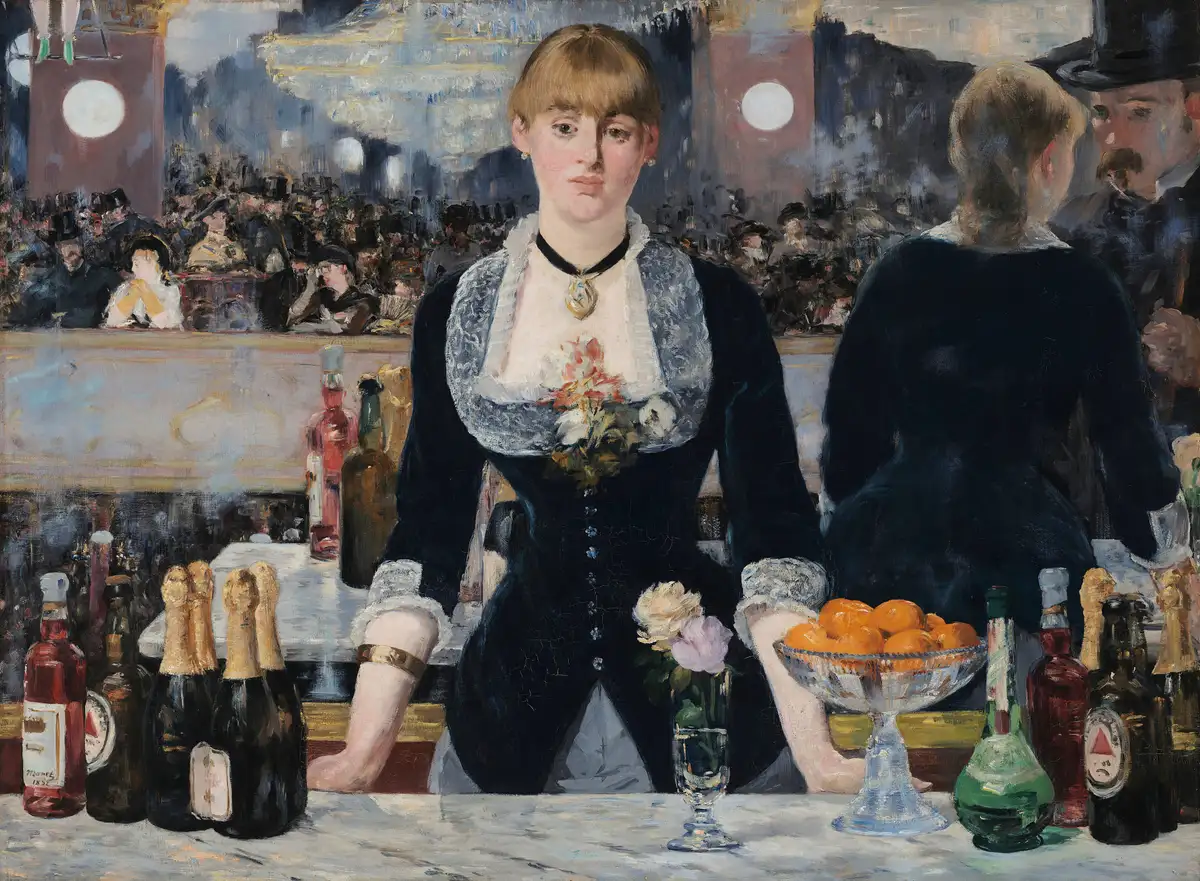
A Bar at the Folies-Bergère (1882) by Édouard Manet is in The Courtauld Gallery, London. A Bar at the Folies-Bergère is an oil painting by French artist Édouard Manet, completed in 1882 — his last major work, exhibited at the Paris Salon the year before he died. It depicts a barmaid at the famous Paris entertainment venue, standing behind a marble counter covered with bottles and fruit. Behind her, a large mirror reflects the audience and, to the right, a reflection of the barmaid in conversation with a customer. The painting is famous for its impossible mirror reflection and is displayed at the Courtauld Gallery in London. World Museum Guide explains what you're looking at and how to see it.
Frequently asked questions
Where is A Bar at the Folies-Bergère?
The painting is in the Courtauld Gallery at Somerset House in London. It is one of the most important works in the Courtauld's Impressionist collection, which also includes major works by Cézanne, Seurat, and Gauguin. The Courtauld is at Strand, London WC2R 0RN.
Why is the mirror reflection in A Bar at the Folies-Bergère wrong?
The reflection is geometrically impossible: if the viewer is standing directly in front of the barmaid, her reflection should appear directly behind her in the mirror. Instead, the reflection appears to the right, showing her in conversation with a man. This inconsistency appears deliberate — Manet may have been commenting on the impossibility of representation (a painting can never show you everything simultaneously), or creating a composite image of different moments in time.
Who was Manet?
Édouard Manet (1832–1883) was a French artist whose work bridges Realism and Impressionism and is considered a founding figure of modern art. His controversial paintings Olympia (1863) and Le Déjeuner sur l'herbe (1863) shocked the Paris art world by depicting nude women in contemporary contexts rather than classical or mythological ones. He was deeply admired by the younger Impressionists — particularly Morisot, Monet, and Renoir — but he himself never exhibited in the Impressionist exhibitions.
What was the Folies-Bergère?
The Folies-Bergère was (and is — it is still operating) a famous music hall and cabaret theatre in Paris, opened in 1869. In the 1880s it was famous for its variety entertainment — acrobats, singers, pantomime — and for its promenoir (standing area) where Parisian men of all social classes could mingle. The barmaids (like Suzon in Manet's painting) served alcohol and were known for their role in the social life of the venue.
What is in the top corner of A Bar at the Folies-Bergère?
In the top left corner of the painting, just barely visible above the reflected crowd in the mirror, are the green-booted legs of a trapeze artist. The acrobat is performing but nearly invisible — an entire human being reduced to a detail at the edge of the frame. It is one of many elements in the painting that suggest Manet was deliberately withholding a full account of the scene.