Napoleon Crossing the Alps
Jacques-Louis David · 1801–1805
Oil on canvas
Quick answer
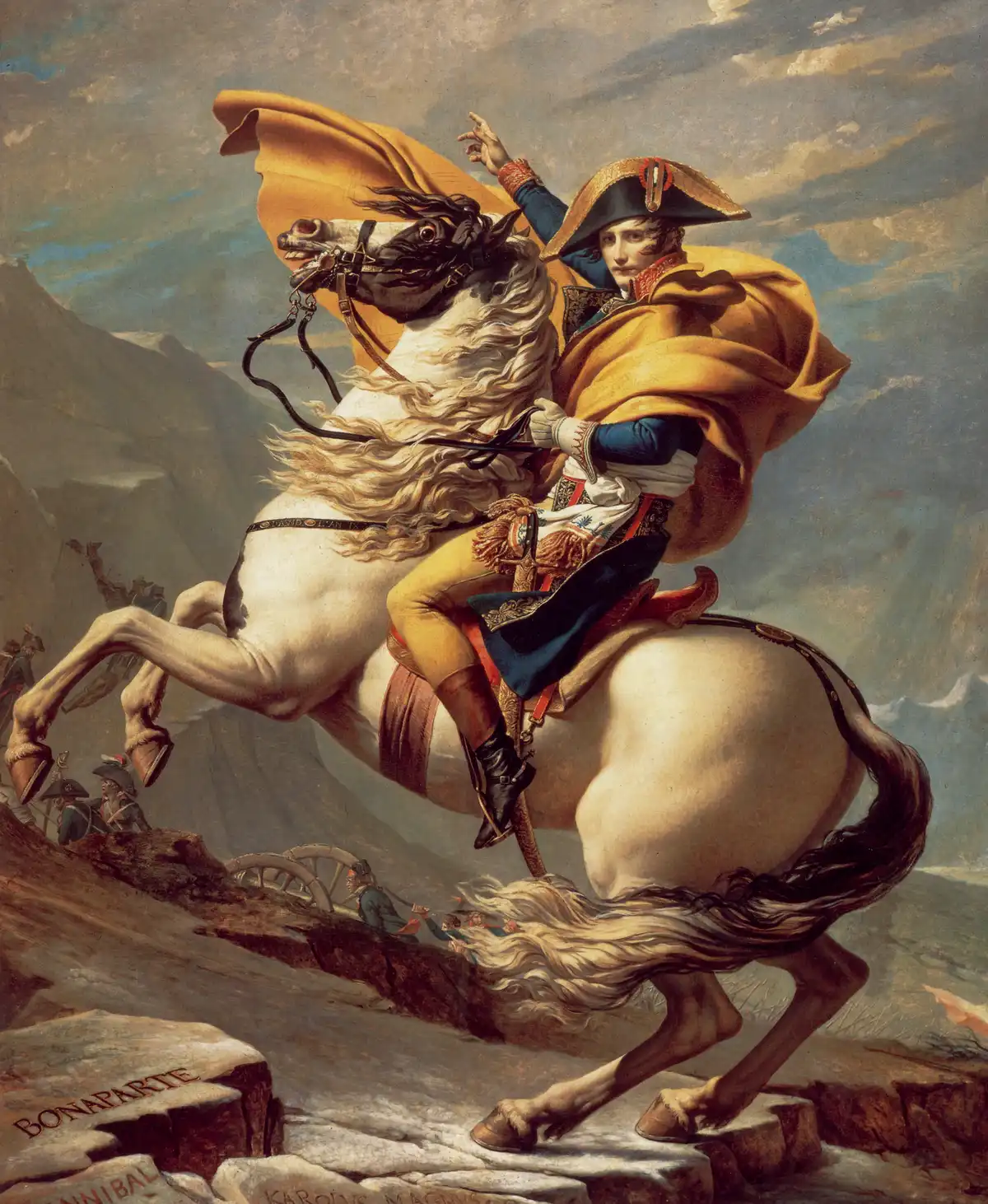
Napoleon Crossing the Alps (1801–1805) by Jacques-Louis David is at Château de Malmaison, Rueil-Malmaison. Napoleon Crossing the Alps (also called Bonaparte Crossing the Grand Saint-Bernard Pass) is a series of five oil paintings by French artist Jacques-Louis David, created between 1801 and 1805. Each painting depicts Napoleon Bonaparte on a rearing white horse, arm outstretched, leading his army across the Alps in May 1800. In reality, Napoleon crossed on a mule, guided by a local. David transformed the event into heroic propaganda. Versions are in collections in France, Germany, and Austria. World Museum Guide explains what you're looking at and how to see it.
Where to see it
Château de Malmaison — Rueil-Malmaison, France
Napoleon and Joséphine's former residence, now a national museum outside our main directory.
This venue is not yet covered by a full World Museum Guide page — we link to the official site for tickets and hours.
Frequently asked questions
How many versions of Napoleon Crossing the Alps are there?
Jacques-Louis David painted five nearly identical versions between 1801 and 1805. The most famous is at the Château de Malmaison near Paris (originally at Malmaison, then in various French collections). A version is at the Palace of Versailles, one at the Kunsthistorisches Museum in Vienna, one at Charlottenburg Palace in Berlin, and one at the Belvedere Palace in Vienna.
Where is Napoleon Crossing the Alps?
The most famous version is at the Château de Malmaison in Rueil-Malmaison, near Paris — the home of Joséphine Bonaparte. Another significant version is at the Palace of Versailles. The version most often used in illustration (with a distinctive warm light) is the one at Malmaison.
Did Napoleon really cross the Alps on a white horse?
No. Napoleon's secretary Louis de Bourrienne confirmed that Napoleon crossed the Saint Bernard Pass on a mule, guided by a local peasant named Pierre Nicolas Dorsaz. David's white rearing horse, heroic pose, and flowing cape are entirely fictional — created at Napoleon's instruction to produce an image of leadership and destiny rather than a factual record.
Who painted Napoleon Crossing the Alps?
Jacques-Louis David (1748–1825), the leading painter of French Neoclassicism and Napoleon's official First Painter. David had previously been deeply involved in Revolutionary politics — he voted for Louis XVI's execution in 1793 and organised Revolutionary festivals. He became Napoleon's devoted propagandist and painted several official portraits and ceremonial scenes for the regime.
What do the names on the rock mean in Napoleon Crossing the Alps?
The foreground boulder has the names 'HANNIBAL' and 'KAROLVS MAGNVS IMP' (Charlemagne) carved into it, with Bonaparte's name prominently visible. David added these to place Napoleon in the company of history's greatest military commanders who had previously crossed the Alps — Hannibal (218 BC, during the Second Punic War) and Charlemagne (800 AD). Napoleon's name at the top suggests his superiority over both predecessors.