The Ambassadors
Hans Holbein the Younger · 1533
Oil on oak
Quick answer
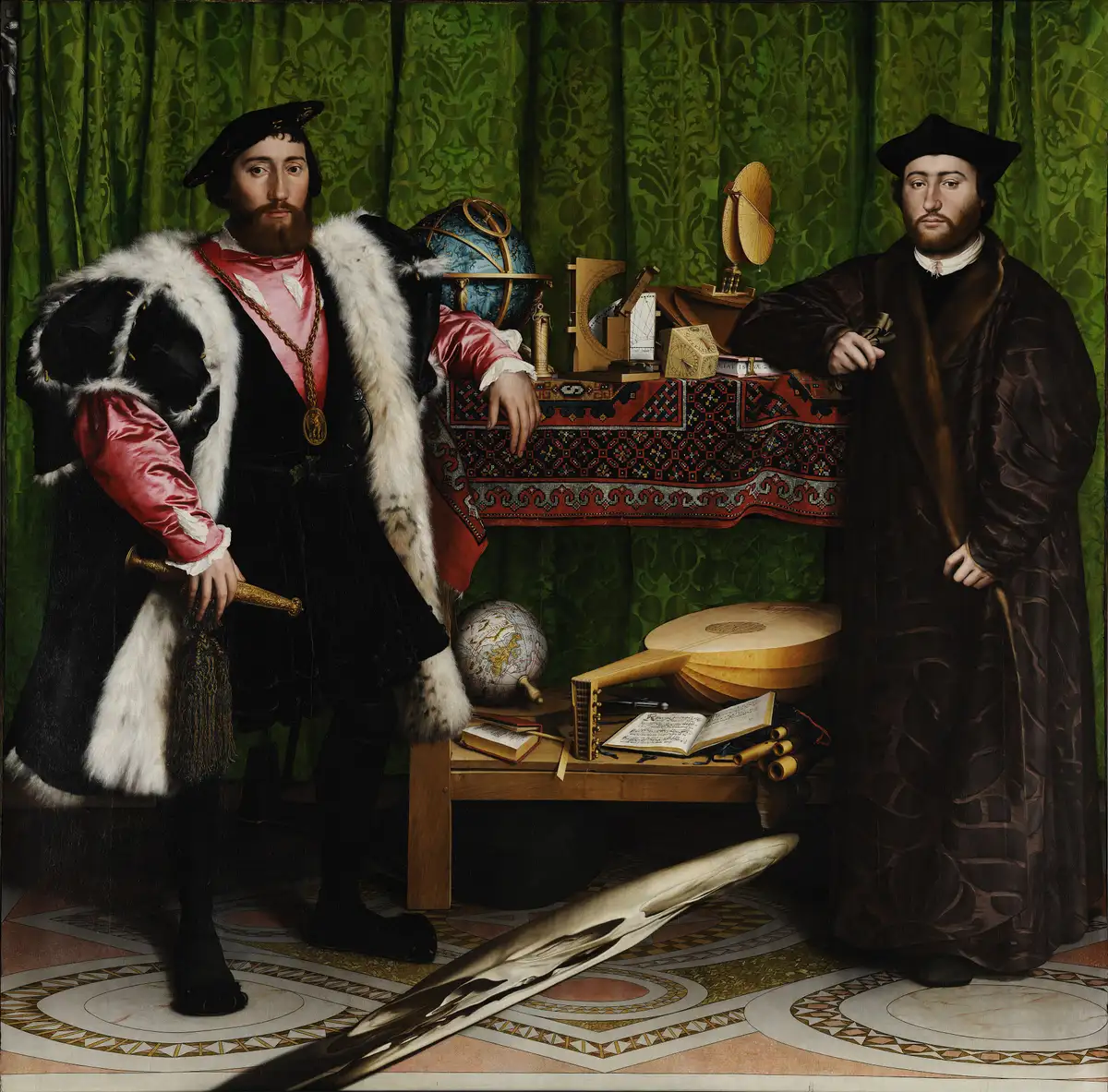
The Ambassadors (1533) by Hans Holbein the Younger is in The National Gallery, London. The Ambassadors is an oil painting on oak by German artist Hans Holbein the Younger, created in 1533. It depicts two young men — the French ambassador to England, Jean de Dinteville, and his friend Georges de Selve, Bishop of Lavaur — flanking a two-tiered table covered with objects related to astronomy, music, mathematics, and trade. In the lower foreground, a severely distorted skull (an anamorphic image) is only recognisable as a skull when viewed from a sharp angle at the lower right. The painting is displayed at the National Gallery in London. World Museum Guide explains what you're looking at and how to see it.
Frequently asked questions
What is the skull in The Ambassadors?
The smear at the bottom of the painting is an anamorphic skull — a skull drawn with deliberate distortion so that it only becomes recognisable when viewed from an extreme angle (from close to the floor, on the lower right side of the painting). It is a memento mori — a reminder of death — embedded within the painting's celebration of human learning and diplomatic achievement.
Where is The Ambassadors?
The Ambassadors is in Room 4 of the National Gallery in London, Trafalgar Square. It has been in the National Gallery's collection since 1890, when it was purchased from the Longford Castle collection for £55,000 — a record at the time.
Who are the two men in The Ambassadors?
The man on the left (wearing the medallion and dagger) is Jean de Dinteville (aged 29), French ambassador to England in 1533. The man on the right (in clerical dress) is Georges de Selve (aged 25), Bishop of Lavaur and a humanist scholar and diplomat who briefly visited his friend in London in April–May 1533. Both men were central figures in French diplomatic life.
What do the objects in The Ambassadors mean?
The shelves between the two men are covered with scientific instruments and cultural objects: a celestial globe, a terrestrial globe, a quadrant, a polyhedral sundial, a lute, and an open Lutheran hymnbook. These represent the full range of Renaissance learning — astronomy, geography, mathematics, music, and theology. Together they demonstrate the humanist ideal of a complete, well-rounded intellectual. The broken lute string suggests that this comprehensive human knowledge is imperfect or incomplete.
When was The Ambassadors painted?
Holbein dated the painting precisely: the celestial globe shown in the painting is set to a star configuration that corresponds to 11 April 1533. The painting was therefore almost certainly completed around this date, during Jean de Dinteville's second term as French ambassador to Henry VIII's court in London.