The Creation of Adam
Michelangelo · 1508–1512
Fresco
Quick answer
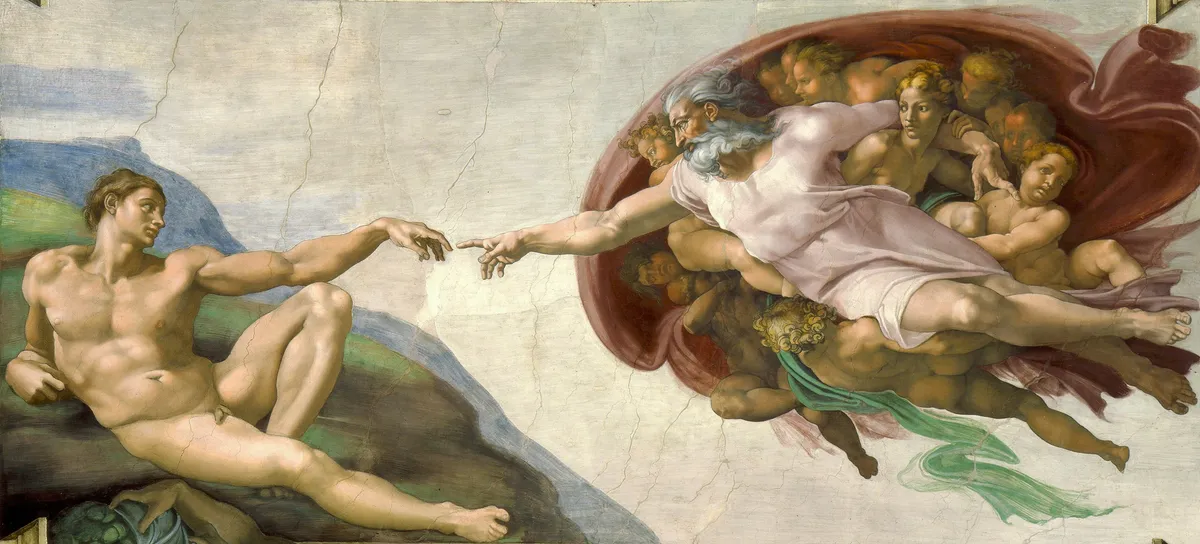
The Creation of Adam (1508–1512) by Michelangelo is in Vatican Museums, Vatican City. The Creation of Adam is a fresco painting by Italian Renaissance artist Michelangelo, part of the Sistine Chapel ceiling completed between 1508 and 1512. It depicts the Biblical scene in which God breathes life into Adam, the first man, with the two figures reaching toward each other, their fingers almost touching. The fresco is in the Sistine Chapel within the Vatican Museums in Vatican City. It is one of the most reproduced and recognised images in Western art. World Museum Guide explains what you're looking at and how to see it.
Frequently asked questions
Where is The Creation of Adam?
The Creation of Adam is a fresco on the ceiling of the Sistine Chapel within the Vatican Museums in Vatican City. It is not a separate painting that can be moved or exhibited elsewhere — it is permanently part of the ceiling. Visitors can view it by booking tickets to the Vatican Museums, which include entry to the Sistine Chapel.
Why are the fingers not touching in The Creation of Adam?
The gap between God's and Adam's fingers is deliberate. Rather than depicting the creation as a physical act of touch, Michelangelo showed the transmission of divine life-force as an almost-electric charge crossing a gap. Adam's limp, barely-raised arm compared to God's urgently outstretched one dramatises the contrast between passive recipient and active creator.
How long did Michelangelo take to paint the Sistine Chapel ceiling?
Michelangelo painted the complete Sistine Chapel ceiling — not just The Creation of Adam — over approximately four years, from 1508 to 1512. He worked largely alone, lying on a specially designed scaffolding system. The project covered approximately 500 square metres of ceiling and included over 300 individual figures.
What does the shape behind God represent?
The billowing cloak surrounding God and the accompanying figures has been interpreted in various ways. In 1990, neurosurgeon Frank Meshberger published a paper in the Journal of the American Medical Association arguing that the shape is an anatomically accurate cross-section of the human brain, suggesting Michelangelo was depicting God's gift of intellect to humanity. Not all art historians accept this interpretation.
Can you take photos in the Sistine Chapel?
Photography is strictly prohibited inside the Sistine Chapel. Visitors who photograph the ceiling risk having their devices confiscated and being removed from the museum. The prohibition is enforced by museum staff and is a condition of the Vatican's agreement with NTV (the Japanese broadcaster that funded the 1980s restoration). Signs and repeated announcements remind visitors of the rule.