The Great Wave off Kanagawa
Katsushika Hokusai · c. 1831
Woodblock print (ukiyo-e)
Quick answer
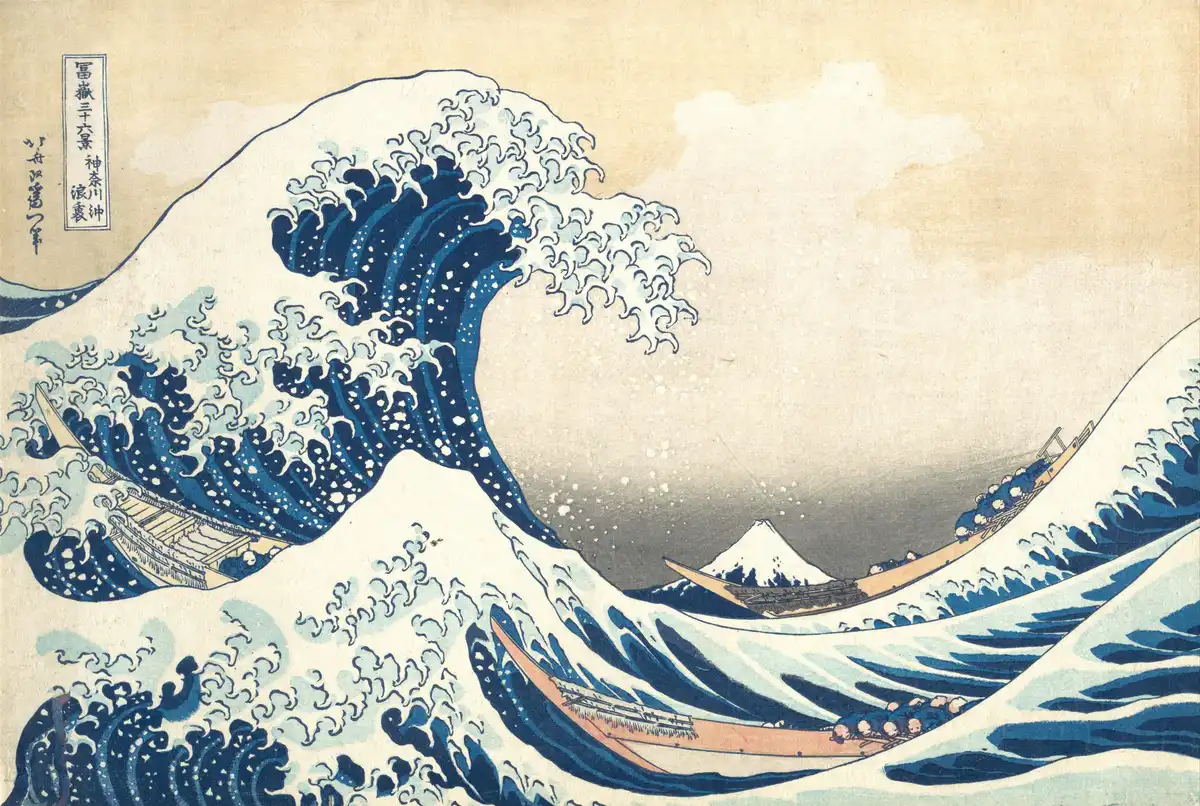
The Great Wave off Kanagawa (c. 1831) by Katsushika Hokusai is in The Metropolitan Museum of Art, New York City. The Great Wave off Kanagawa is a woodblock print by Japanese ukiyo-e artist Katsushika Hokusai, created around 1831 as the first image in his series Thirty-Six Views of Mount Fuji. It depicts an enormous cresting wave about to crash over three oshiokuri-bune fishing boats, with a calm Mount Fuji visible in the background. As a printed work, multiple original impressions exist in major museums worldwide, including the Metropolitan Museum of Art in New York and the British Museum in London. It is the most recognised work of Japanese art globally. World Museum Guide explains what you're looking at and how to see it.
Where to see it
The Metropolitan Museum of Art — New York City, United States
Museum visitor guide →Frequently asked questions
Where is The Great Wave?
The Great Wave off Kanagawa is a woodblock print, meaning multiple original impressions were produced from the same carved blocks. Major institutions holding original impressions include: the Metropolitan Museum of Art in New York, the British Museum in London, the Art Institute of Chicago, the Library of Congress in Washington D.C., and the Musée Guimet in Paris. No single museum can claim the "original."
Is The Great Wave a painting or print?
It is a woodblock print (ukiyo-e), not a painting. Hokusai carved the image into wooden blocks, applied ink, and pressed paper onto the blocks to create prints. This means the image could be reproduced multiple times — approximately 5,000 impressions were created in the original production run, and thousands survive today in museums and private collections around the world.
What does The Great Wave mean?
The wave can be interpreted as a force of nature both awesome and threatening, with the tiny boats and their crews — and even Mount Fuji, reduced to a small form in the background — made small by its power. It expresses the Japanese concept of the sublime in nature and humanity's vulnerability within it. It may also represent the energy and dynamism of a Japan in transition during the late Edo period.
Did The Great Wave influence Western art?
Profoundly. The wave's curved forms, dynamic asymmetry, and bold outlines directly influenced the Art Nouveau movement in Europe. Monet displayed Japanese prints throughout his Giverny home. Van Gogh copied Japanese prints and wrote about their influence. Toulouse-Lautrec, Whistler, Klimt, and many others absorbed Japanese compositional principles. The influence of Hokusai and other ukiyo-e artists on late 19th-century European art is called "Japonisme."
How much is The Great Wave worth?
Fine impressions of The Great Wave sell for significant sums at auction. A particularly fine, early impression sold at Christie's New York in 2023 for $2.76 million — a record for the work. Average museum-quality impressions typically sell in the range of $500,000 to $1 million. Condition and the quality of the impression (early versus later printings, before the blocks wore down) are the key value factors.