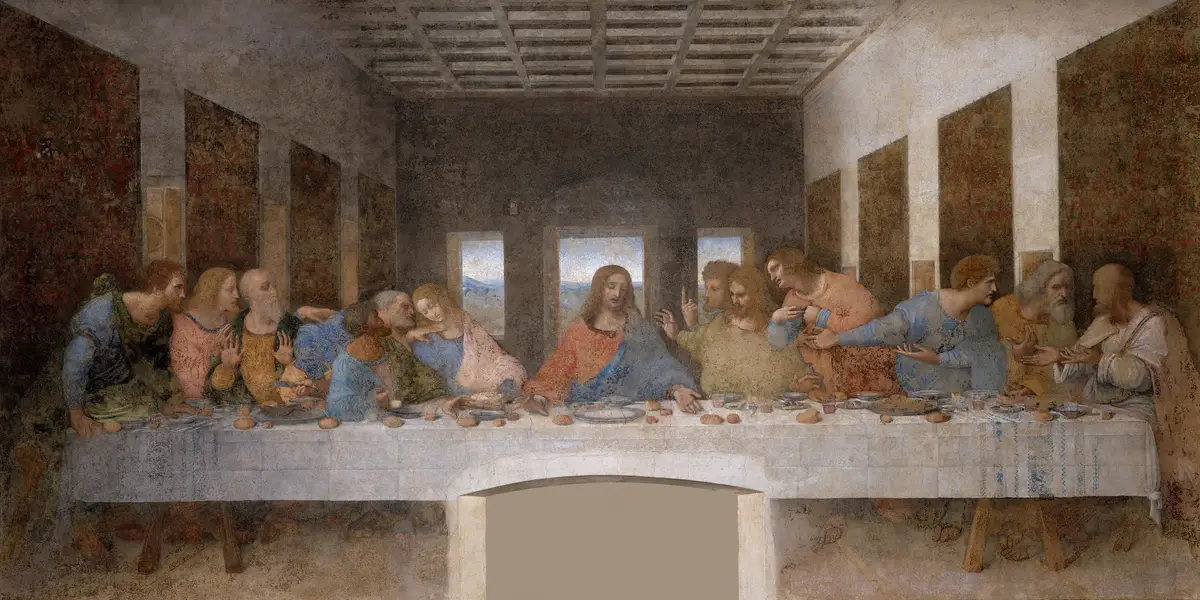
The Last Supper
Leonardo da Vinci · 1495–1498
Tempera and oil on plaster
Quick answer
The Last Supper (1495–1498) by Leonardo da Vinci is at Santa Maria delle Grazie, Milan. The Last Supper is a mural painting by Leonardo da Vinci, created between 1495 and 1498 on the end wall of the refectory (dining hall) of the convent of Santa Maria delle Grazie in Milan, Italy. It depicts the moment described in the Gospel of John when Jesus announces that one of his apostles will betray him. The work is a UNESCO World Heritage Site and is visited by up to 1,000 people per day on timed, 15-minute tickets. World Museum Guide explains what you're looking at and how to see it.
Where to see it
Santa Maria delle Grazie — Milan, Italy
The Last Supper is in the refectory of this Dominican convent — not a conventional museum. Timed-entry tickets are mandatory.
This venue is not yet covered by a full World Museum Guide page — we link to the official site for tickets and hours.
Frequently asked questions
Where is The Last Supper located?
The Last Supper is painted on the wall of the refectory (dining hall) of the convent of Santa Maria delle Grazie in Milan, Italy. It is not a portable painting — it is a mural on the building's wall. The refectory is now a museum, and visits are strictly controlled: maximum 30 visitors at a time, 15 minutes per session, with tickets often sold out months in advance. Book online well ahead of your visit.
Why is The Last Supper so hard to see?
Access is strictly limited to protect the fragile surviving paint — visitors enter through multiple air-lock chambers to control humidity, and maximum 30 people are allowed in at a time for no more than 15 minutes. Tickets must be booked online in advance (often months ahead) and sell out consistently. Photography without flash is permitted.
Is The Last Supper damaged?
Yes — significantly. Leonardo used an experimental technique (tempera and oil on dry plaster) rather than traditional fresco, and the paint began flaking within decades of completion. Subsequent restorations, floods, wars, and a 1943 bombing that destroyed three walls of the refectory have all taken their toll. The 1999 restoration stabilised the work but could only conserve what remained; some sections are almost entirely lost.
Who are the figures in The Last Supper?
The painting depicts Jesus Christ and his twelve apostles at the moment Jesus announces one of them will betray him. Reading left to right: Bartholomew, James the Less, Andrew, Judas, Peter, John, Jesus, Thomas, James the Greater, Philip, Matthew, Thaddaeus, and Simon. Judas is identifiable as the figure recoiling and clutching a small purse.
Is there a Mary Magdalene in The Last Supper?
No — the figure to Jesus's right is the apostle John, who in Renaissance iconography was traditionally depicted as young and androgynous. Dan Brown's The Da Vinci Code (2003) popularised the claim that this figure is Mary Magdalene, but this is contradicted by all historical and art historical evidence. Leonardo's preparatory drawings identify the figure as John, and the composition matches all known descriptions of the work.