The School of Athens
Raphael · 1509–1511
Fresco
Quick answer
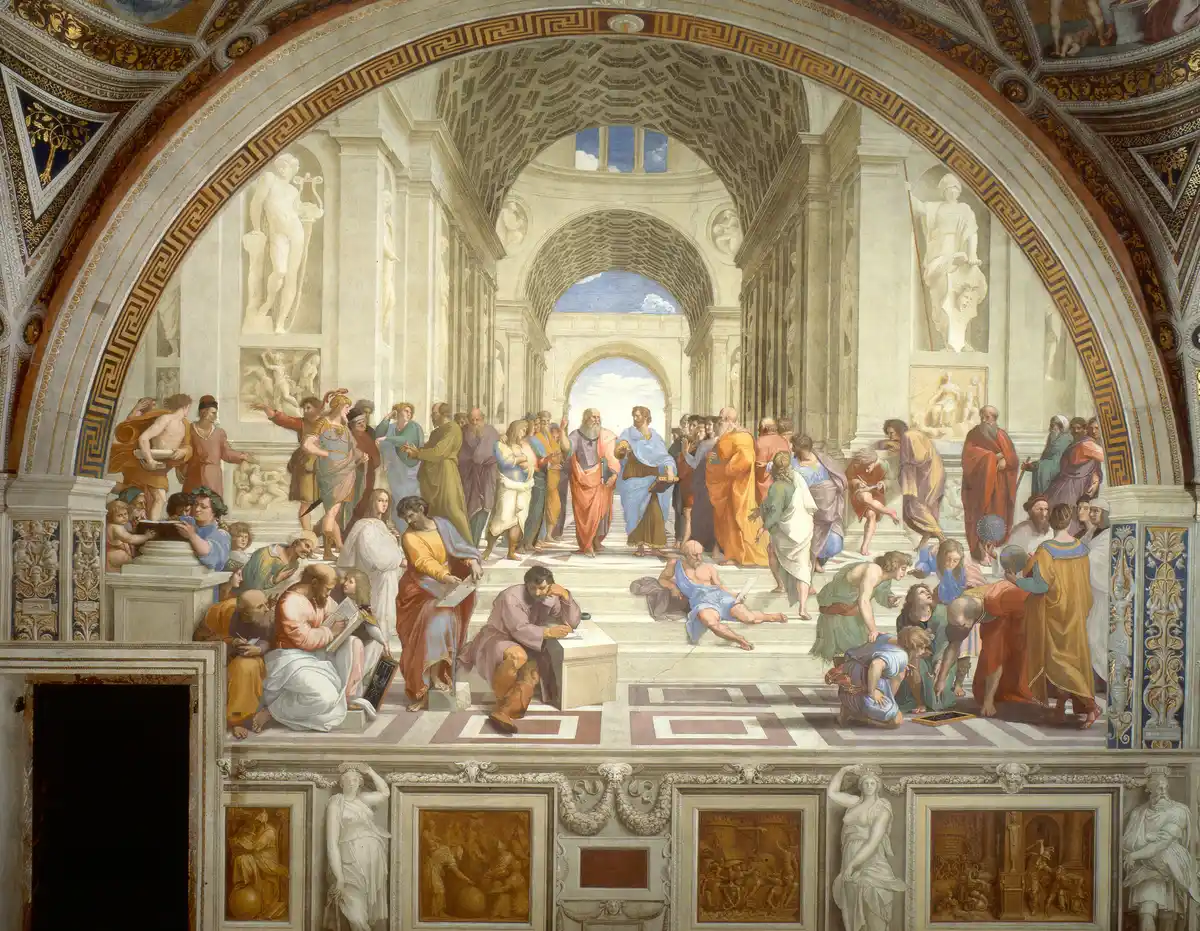
The School of Athens (1509–1511) by Raphael is in Vatican Museums, Vatican City. The School of Athens is a fresco by Italian Renaissance artist Raphael, painted between 1509 and 1511 in the Stanza della Segnatura (Room of the Signature) of the Apostolic Palace in the Vatican. It depicts a gathering of the great philosophers of ancient Greece in an idealised Classical architectural setting, with Plato and Aristotle at the centre. It is widely considered the consummate embodiment of the Renaissance spirit — the reconciliation of classical thought with Christian humanism. World Museum Guide explains what you're looking at and how to see it.
Frequently asked questions
Where is The School of Athens?
The School of Athens is a fresco permanently painted on the wall of the Stanza della Segnatura in the Apostolic Palace, Vatican City. It is part of the Vatican Museums complex and is visited by booking Vatican Museums tickets, which include the Raphael Rooms. It cannot be moved or exhibited elsewhere.
Who are the figures in The School of Athens?
The central figures are Plato (pointing upward, toward ideal forms — modelled on Leonardo da Vinci) and Aristotle (gesturing downward, toward the material world). Other identifiable figures include Socrates (counting on fingers, left of centre), Euclid (stooping with compass, lower right — modelled on Bramante), Pythagoras (writing, lower left), and Ptolemy (holding globe, right). Michelangelo appears as the brooding Heraclitus on the steps. Raphael himself appears in the lower right corner.
What does the hand gesture of Plato mean?
Plato points upward with one finger — indicating the realm of ideal Forms that he believed was the source of true knowledge. Aristotle extends his hand palm-down over the earth — indicating his philosophy's grounding in empirical observation and material reality. The two gestures neatly summarise the fundamental divide in Western philosophy between idealism (Plato) and empiricism (Aristotle).
Why is Leonardo da Vinci depicted as Plato?
Raphael chose to give Plato the face of Leonardo da Vinci as a tribute — recognising Leonardo as the greatest living embodiment of the philosopher-thinker ideal. Leonardo was in Rome at the time, working at the Vatican, and the two artists likely knew each other. The identification of the white-bearded, elderly Plato figure with Leonardo is based on comparison with known portraits of Leonardo.
Can you photograph The School of Athens?
Photography without flash is permitted in the Raphael Rooms, including the Stanza della Segnatura where The School of Athens is located. The rooms can become extremely crowded — the Vatican Museums attract over 6 million visitors annually — so early morning tickets are recommended for a less congested experience.