Venus of Urbino
Titian · 1534
Oil on canvas
Quick answer
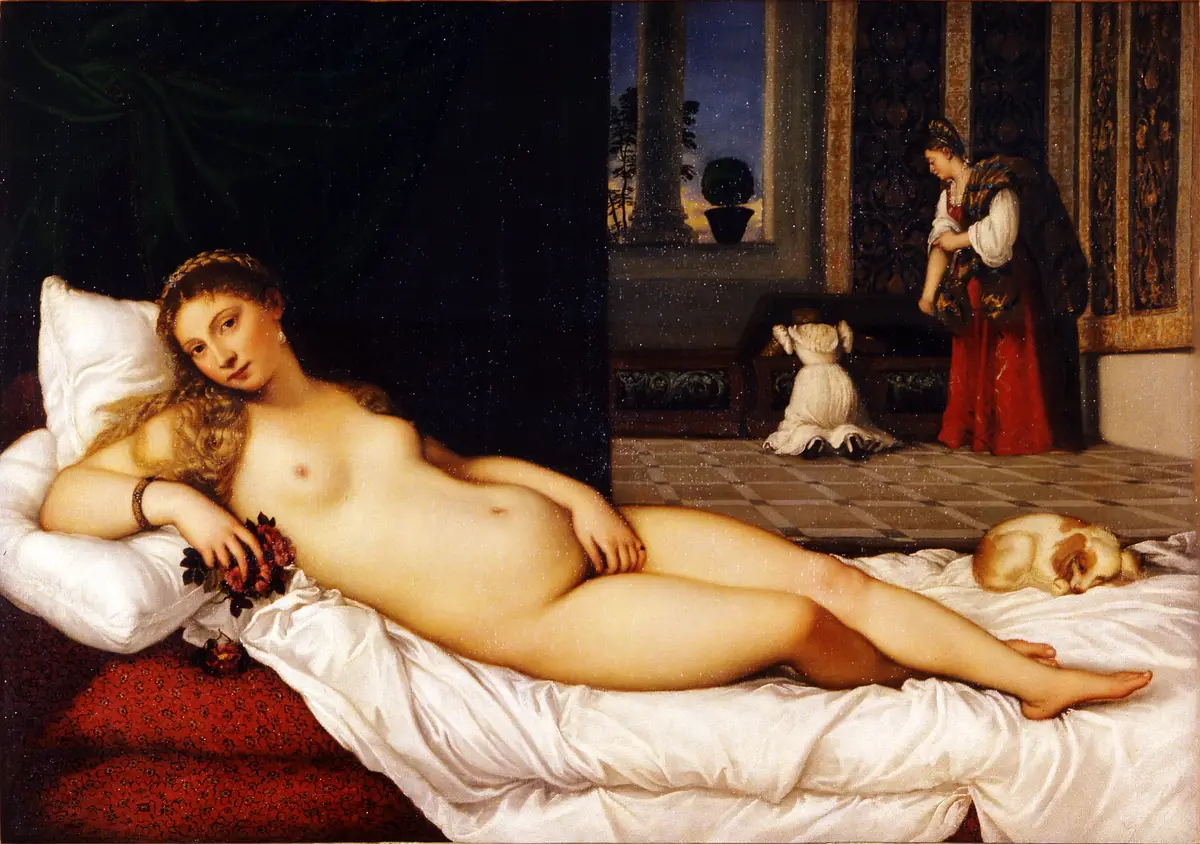
Venus of Urbino (1534) by Titian is in Uffizi Gallery, Florence. Venus of Urbino is an oil painting by Italian Renaissance artist Titian, created in 1534 for Guidobaldo II della Rovere, Duke of Urbino. It depicts a nude woman reclining on a bed, gazing directly at the viewer, with a small spaniel at her feet and two maids searching a chest in the background. Manet directly referenced it in his controversial Olympia (1863). The painting is in the Uffizi Gallery in Florence, Italy. World Museum Guide explains what you're looking at and how to see it.
Frequently asked questions
Where is the Venus of Urbino?
The Venus of Urbino is in Room 28 of the Uffizi Gallery in Florence, Italy, in the Titian Rooms. The Uffizi is one of the world's greatest art museums, holding the largest collection of Italian Renaissance paintings. It is at Piazzale degli Uffizi 6, Florence.
Who is the woman in the Venus of Urbino?
Her identity is uncertain. She may be an idealised courtesan or a representation of the ideal Renaissance bride rather than a specific individual. The domestic setting (a bedroom, with maids, a lapdog symbolising fidelity) suggests she represents marital sexuality rather than divine love — a vision of the erotic within domesticity, appropriate for a private commission by a 17-year-old future Duke.
How did the Venus of Urbino influence Manet's Olympia?
Manet used Titian's composition as the explicit reference point for Olympia (1863): same reclining pose, same direct gaze at the viewer, same arm covering the pubis, same servant in the background. Where Titian's Venus is idealised and timeless, Manet's is a contemporary Parisian woman — making the same confrontational gaze in a recognisably modern context, which is what caused the 1865 Salon scandal.
Is the Venus of Urbino depicting a goddess or a real woman?
Scholars disagree. Titian gave her the title 'Venus' but placed her in a contemporary domestic bedroom — an unusual choice for a divine figure. Many art historians argue she is not literally Venus but a real Venetian or Italian noblewoman depicted in a context associated with Venus (flowers, the gaze of self-possession). The domestic details — the small dog, the maids, the chest — suggest a real domestic interior rather than a mythological setting.
Why did Titian use the name Venus for an indoor reclining nude?
In Renaissance painting and poetry, 'Venus' was used as a poetic designation for erotic beauty in general, not just for the specific goddess. By calling the painting Venus, Titian elevated what might otherwise have been an erotic portrait into a meditation on love and beauty with classical authority. The title gave the work prestige and protected both painter and patron from accusations of mere voyeurism.