Woman with a Parasol
Claude Monet · 1875
Oil on canvas
Quick answer
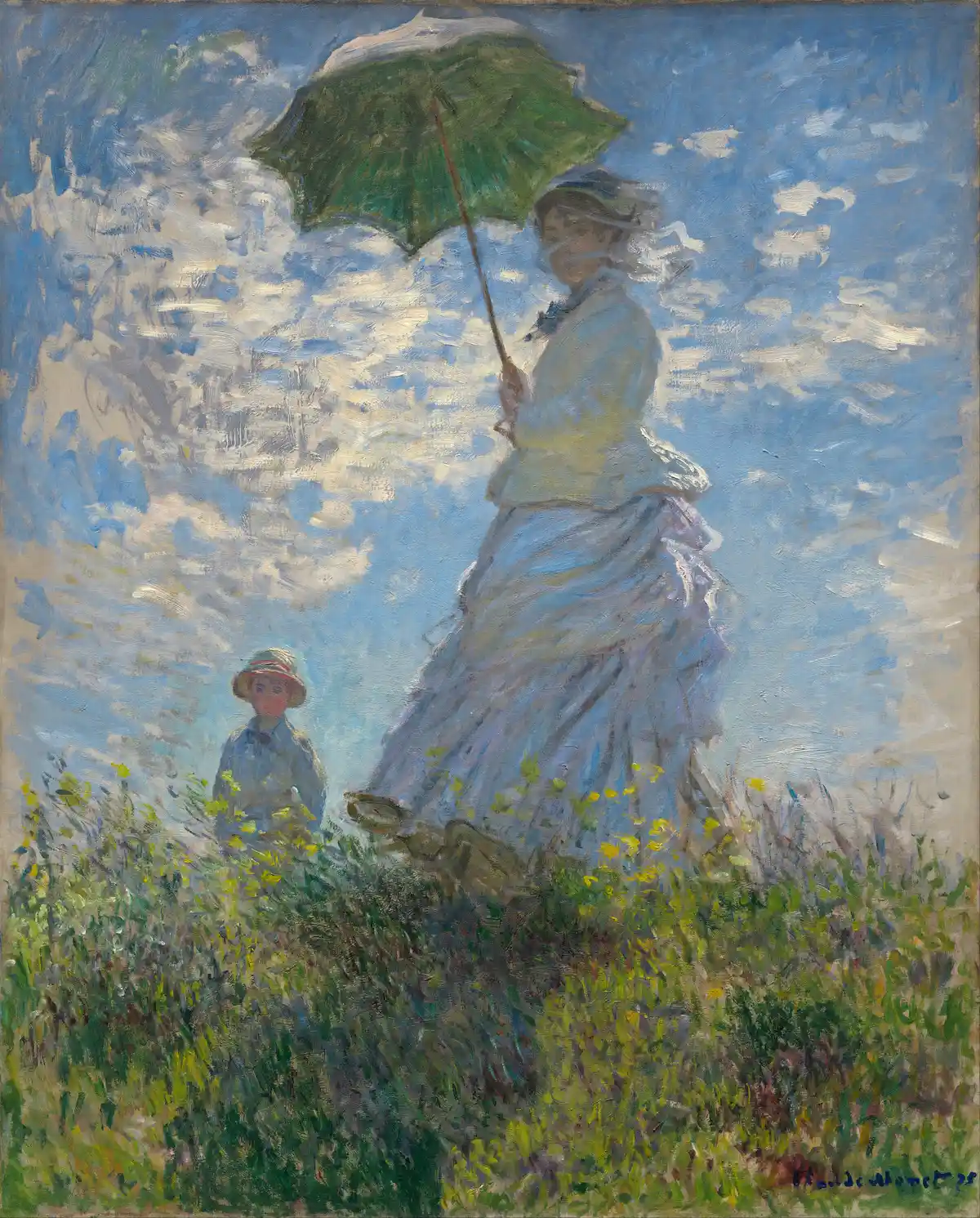
Woman with a Parasol (1875) by Claude Monet is in National Gallery of Art, Washington D.C.. Woman with a Parasol — Madame Monet and Her Son is an oil painting by French Impressionist Claude Monet, created in 1875. It depicts Monet's wife Camille holding a parasol against the wind on a high grassy hill, with their young son Jean visible behind her. The painting captures a spontaneous outdoor scene with extraordinary lightness and freedom of brushwork. It is in the National Gallery of Art in Washington D.C. and is one of the most beloved images of Impressionism. World Museum Guide explains what you're looking at and how to see it.
Frequently asked questions
Where is Woman with a Parasol by Monet?
Woman with a Parasol — Madame Monet and Her Son (1875) is in the collection of the National Gallery of Art in Washington D.C. Admission is free. The museum is on Constitution Avenue NW between 3rd and 9th Streets, accessible from the Gallery Place/Chinatown or Archives metro stations.
Who is the woman in Woman with a Parasol?
The woman is Camille Doncieux Monet (1847–1879), Monet's wife, whom he painted many times. The child behind her on the slope is their son Jean Monet (1867–1914). Camille died of cancer in 1879 at the age of 32. Monet later made two similar paintings of a woman with a parasol in 1886 (now at the Musée d'Orsay), but these use a different model — his stepdaughter Suzanne Hoschedé.
What makes Woman with a Parasol significant?
The painting is significant for its unprecedented capture of wind and movement through pure paint handling. Monet used directional brushstrokes — the veil, the dress, the grass all painted with brushstrokes that follow the movement of the wind — to create the sensation of being on a breezy hill. This dynamic quality, combined with the broken colour technique and the sun-drenched palette, makes it one of the most technically innovative works of early Impressionism.
Are there other versions of Woman with a Parasol?
Yes. In 1886, eleven years after the Madame Monet version, Monet returned to the subject and painted two related works using his stepdaughter Suzanne Hoschedé as the model, both now at the Musée d'Orsay in Paris. These 1886 works show the figure from slightly different angles (facing right and facing left) and are more technically advanced — the figure is more dissolved in light and atmosphere — but they refer back to the 1875 original.
Is the National Gallery of Art free?
Yes — the National Gallery of Art in Washington D.C. is entirely free to enter, with no timed tickets required for the general collection. It is one of the world's great art museums and one of the most accessible, holding masterworks by Monet, Vermeer, Rembrandt, Raphael, da Vinci, and many others. It is funded by the US federal government and private donations.