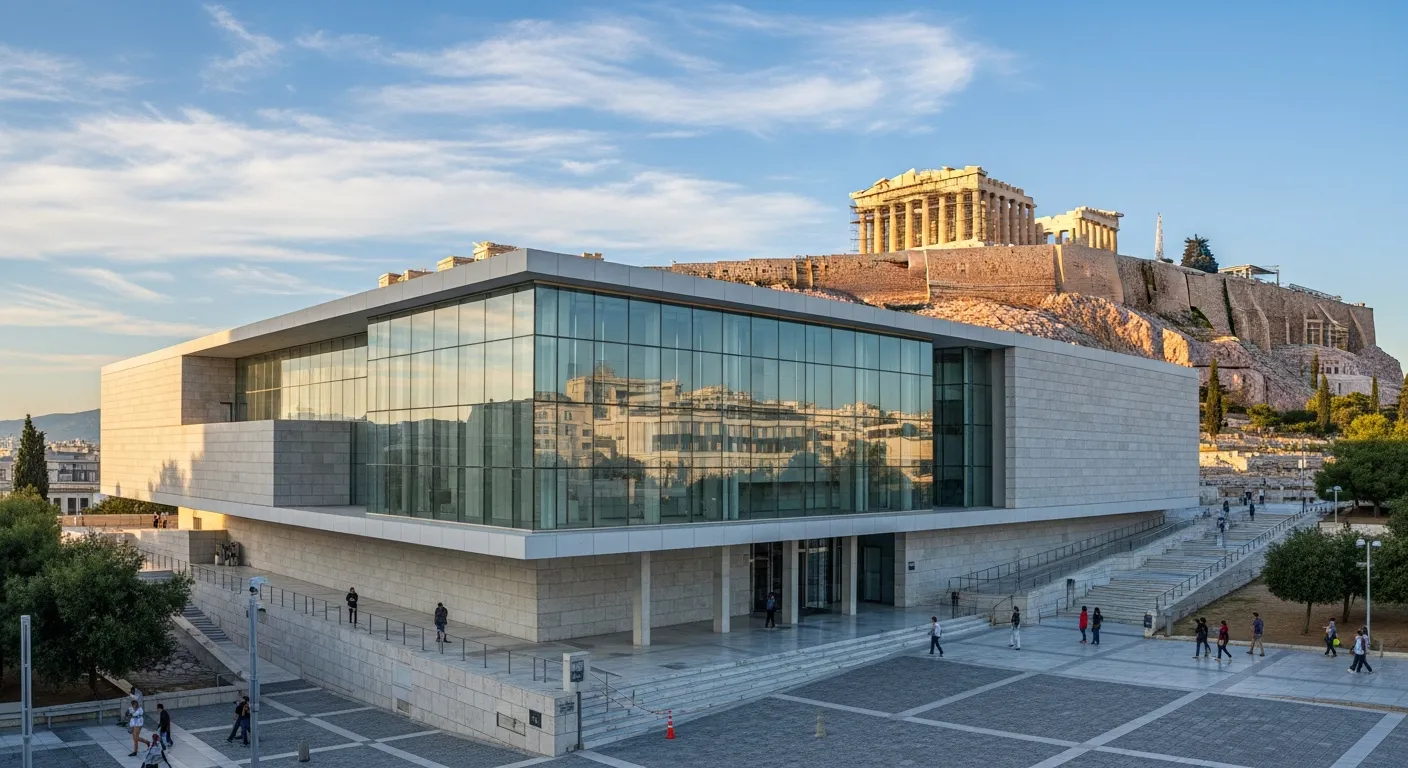
Acropolis Museum
Athens · Greece · Founded 2009
Good for: Art Lovers · First-timers · Rainy-day visits
2009
Founded
1.2 million
Annual Visitors
2 hours
Recommended Visit
Art
Museum type
Quick answer
Acropolis Museum in Athens, Greece — the Acropolis Museum is an archaeological museum focused on the findings of the archaeological site of the Acropolis of Athens. Open Monday to Thursday: 9:00 AM – 5:00 PM; Friday: 9:00 AM – 10:00 PM; Saturday and Sunday: 9:00 AM – 8:00 PM. Admission: €15 standard admission (April–October), €10 (November–March). World Museum Guide covers the highlights, getting there, and how long to allow (2 hours).
Verified 2026-06-30 against official sources.
About Acropolis Museum
The Acropolis Museum is an archaeological museum focused on the findings of the archaeological site of the Acropolis of Athens. The museum was built to house every artifact found on the rock and on its feet, from the Greek Bronze Age to Roman and Byzantine Greece.
It opened to the public on 20 June 2009 and was designed by Swiss-French architect Bernard Tschumi with the collaboration of Greek architect Michael Photiadis. The building's top level mirrors the orientation and dimensions of the Parthenon, which it directly overlooks.
The museum is built over an extensive archaeological site, much of which is visible through transparent floors. Glass throughout the building allows views of the Acropolis, integrating the museum into its historical context.
It plays a central role in the international debate over the return of the Parthenon Sculptures (Elgin Marbles) currently held by the British Museum, with the top-floor Parthenon Gallery designed to display them in their original arrangement.
2 hours highlights route
A focused route through 3 must-see highlights at Acropolis Museum without museum fatigue. · 2 hours
- 1
Caryatid Porch (five of six Caryatids)
📍 Level 3, Parthenon Gallery
Five of the six original carved maidens (Caryatids) who served as architectural columns on the Erechtheion porch.
- 2
Parthenon Frieze (fragments)
📍 Level 3, Parthenon Gallery
The museum's centrepiece: original sections of the Parthenon frieze displayed in their original orientation around the cella of a glass building aligned with the Parthenon above.
- 3
Kritios Boy
📍 Level 2, Archaic Gallery
One of the earliest examples of contrapposto — the slight hip-shift and turn that would revolutionise Greek sculpture and eventually Renaissance art.
Masterworks & must-see highlights
The works that define Acropolis Museum — and why they matter.
Caryatid Porch (five of six Caryatids)
Pheidias workshop · c. 421–406 BCE
📍 Level 3, Parthenon Gallery
Five of the six original carved maidens (Caryatids) who served as architectural columns on the Erechtheion porch. The sixth is in the British Museum — the Acropolis Museum displays a cast in her place as a reminder of the separation.
Parthenon Frieze (fragments)
Pheidias and workshop · c. 447–432 BCE
📍 Level 3, Parthenon Gallery
The museum's centrepiece: original sections of the Parthenon frieze displayed in their original orientation around the cella of a glass building aligned with the Parthenon above. The visible gaps filled with plaster casts mark the pieces in London.
Kritios Boy
Kritios (attr.) · c. 480 BCE
📍 Level 2, Archaic Gallery
One of the earliest examples of contrapposto — the slight hip-shift and turn that would revolutionise Greek sculpture and eventually Renaissance art. A transitional work between the rigid Archaic kouros type and the naturalistic Classical style.
Collections & highlights
- • The Caryatids of the Erechtheion
- • Parthenon Gallery
- • Moschophoros (Calf-Bearer)
- • Peplos Kore
- • Archaeological excavation visible beneath the building
Frequently asked questions
Is the Acropolis Museum the same as the Acropolis ruins?
No — the Acropolis Museum is a modern building at the foot of the Acropolis hill, opened in 2009, which houses the artefacts found on the Acropolis rock and its surrounding slopes. The ancient ruins themselves — the Parthenon, the Erechtheion, the Propylaea, and the Temple of Athena Nike — are on the hilltop and require a separate ticket (€20, or included in a combined Athens antiquities pass). The museum and the ruins are a 5-minute walk apart.
What are the Caryatids at the Acropolis Museum?
The Caryatids are six sculpted female figures that served as architectural columns on the south porch of the Erechtheion (421–407 BCE) on the Acropolis. Five of the originals are in the Acropolis Museum; the sixth was removed by Lord Elgin in 1803 and is in the British Museum in London. In the museum's gallery, a cast marks the place where the sixth Caryatid should stand — a deliberate visual argument for the return of the Elgin Marbles. The figures in the museum are originals; replicas now stand on the Erechtheion itself.
What is the Parthenon Gallery at the Acropolis Museum?
The Parthenon Gallery occupies the entire top floor of the Acropolis Museum — a glass-enclosed hall oriented at the same angle as the Parthenon itself (visible through the windows on the hilltop above). It displays the surviving original sections of the Parthenon frieze alongside plaster casts of the sections held by the British Museum, creating a complete visual narrative of the marble decoration. The empty spaces and different-coloured casts vs. originals make the scale of what is missing in London viscerally clear.
What does the Acropolis Museum cost and what are its opening hours?
Standard admission is €15 (April–October) or €10 (November–March). Opening hours vary by season: in summer (April–October), the museum is open Monday to Thursday 8:00 AM – 8:00 PM, Friday 8:00 AM – 10:00 PM, and Saturday–Sunday 8:00 AM – 8:00 PM. In winter (November–March), hours are shorter — check the official website (theacropolismuseum.gr) before visiting. Friday evenings in summer are particularly atmospheric. The museum's glass floor over the in-situ archaeological site is visible from the main entrance.
Can I see the Elgin Marbles at the Acropolis Museum?
The Acropolis Museum displays the surviving original Parthenon sculptures that remain in Athens, along with plaster casts of those held by the British Museum in London (the 'Elgin Marbles'). The casts are a different colour from the originals to make clear which pieces are absent. Greece has formally requested the return of the sculptures since 1983. The museum was explicitly designed to demonstrate that Athens has the facilities and context to reunite the collection — the top-floor Parthenon Gallery was built with space for the Marbles in mind.
How long should I spend at Acropolis Museum?
Plan 2 hours for the highlights. Add time for temporary exhibitions, the museum shop, and café.
You might also like
World Animal Rescue Network
Protect Africa's lions
African lions have lost half their population in twenty-five years. Donations fund conflict mitigation, snare removal, and cub rehabilitation. Please consider a donation to support this work.
Enjoying our free guides? Support World Museum Guide — optional, and every guide stays free.