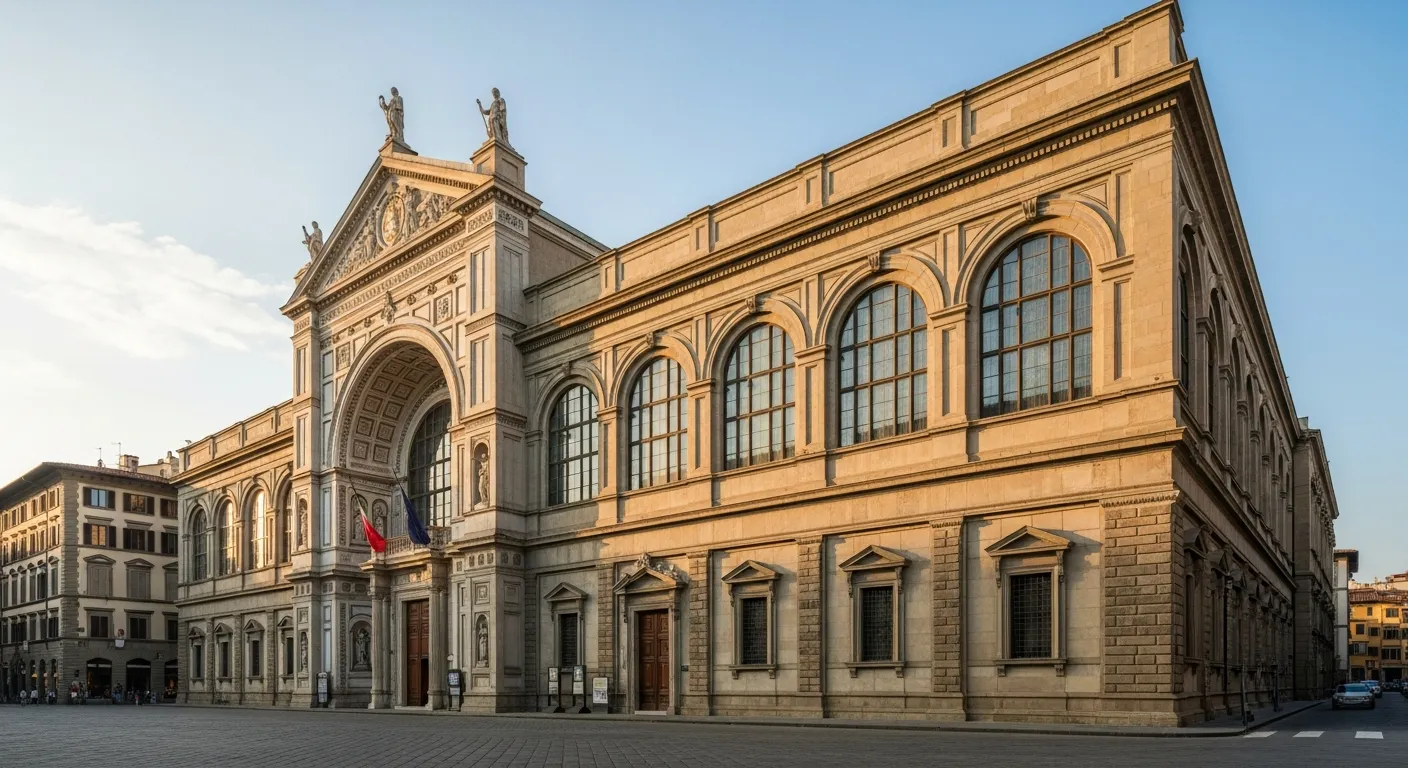
Galleria dell'Accademia
Florence · Italy · Founded 1784
Good for: Art Lovers · First-timers · History Enthusiasts
1784
Founded
5.17 m
Height of David
1–1.5 hours
Recommended Visit
Quick answer
Galleria dell'Accademia in Florence, Italy — founded by Grand Duke Pietro Leopoldo in 1784 as a teaching collection for the Academy of Fine Arts, the gallery received Michelangelo's David in 1873 to protect it from outdoor weathering. Open Tuesday to Sunday: 8:15 AM – 6:50 PM (Closed Mondays). Admission: €16 standard admission. Book timed-entry tickets ahead in peak season. World Museum Guide covers the highlights, getting there, and how long to allow (1–1.5 hours).
Verified 2026-06-30 against official sources.
About Galleria dell'Accademia
Founded by Grand Duke Pietro Leopoldo in 1784 as a teaching collection for Florence's Academy of Fine Arts, the Galleria dell'Accademia was conceived to give art students direct access to masterworks. Its identity was transformed in 1873 when Michelangelo's David was moved indoors from Piazza della Signoria to protect the marble from weathering.
David dominates the Tribune — a purpose-built apse with a skylit dome designed by Emilio de Fabris. At 5.17 metres tall, the sculpture remains the most celebrated single work of the Italian Renaissance, carved from a single block of Carrara marble that other sculptors had rejected as flawed.
Beyond David, the gallery holds Michelangelo's four unfinished Prisoners (Slaves), originally intended for Pope Julius II's tomb, and his unfinished Saint Matthew. The Hall of Colossus displays Giambologna's Rape of the Sabines alongside Florentine Gothic and Renaissance painting, while a dedicated Museum of Musical Instruments holds Stradivarius violins and Medici-era instruments.
Despite its relatively compact size — a focused visit takes 90 minutes — the Accademia is one of Italy's most visited museums. Advance booking is essential during peak season to avoid hours-long queues on Via Ricasoli.
1–1.5 hours highlights route
A focused route through 4 must-see highlights at Galleria dell'Accademia without museum fatigue. · 1–1.5 hours
- 1
David
📍 Tribune (Tribuna)
Michelangelo's colossal marble David — the biblical hero depicted before battle, not after victory.
- 2
Prisoners (Slaves)
📍 Hall of the Prisoners (Galleria dei Prigioni)
Four monumental unfinished figures struggling to emerge from stone — intended for Pope Julius II's tomb.
- 3
Saint Matthew
📍 Hall of the Prisoners
An unfinished marble apostle that demonstrates Michelangelo's working method — the figure appears to be pulling itself free from the block, with drill marks and chisel strokes still visible.
- 4
Rape of the Sabines
📍 Hall of Colossus
Giambologna's spiralling marble group of three intertwined figures — a virtuoso display of Mannerist composition that was designed to be viewed from all angles.
Masterworks & must-see highlights
The works that define Galleria dell'Accademia — and why they matter.
David
Michelangelo · 1501–1504
📍 Tribune (Tribuna)
Michelangelo's colossal marble David — the biblical hero depicted before battle, not after victory. The work established Michelangelo as the greatest sculptor of his age and became the symbol of Florentine republican liberty.
Prisoners (Slaves)
Michelangelo · c. 1519–1534
📍 Hall of the Prisoners (Galleria dei Prigioni)
Four monumental unfinished figures struggling to emerge from stone — intended for Pope Julius II's tomb. The non finito technique influenced Rodin and became a defining feature of Michelangelo's late style.
Saint Matthew
Michelangelo · c. 1505–1506
📍 Hall of the Prisoners
An unfinished marble apostle that demonstrates Michelangelo's working method — the figure appears to be pulling itself free from the block, with drill marks and chisel strokes still visible.
Rape of the Sabines
Giambologna · 1582
📍 Hall of Colossus
Giambologna's spiralling marble group of three intertwined figures — a virtuoso display of Mannerist composition that was designed to be viewed from all angles. One of the finest examples of late Renaissance sculpture in Florence.
Collections & highlights
- • Michelangelo's David and Prisoners
- • Florentine Gothic painting — Pacino di Bonaguida, Giotto followers
- • Museum of Musical Instruments — Stradivarius and Medici instruments
- • Hall of Colossus — Giambologna and Renaissance sculpture
- • Late Gothic and early Renaissance altarpieces
- • Nineteenth-century plaster cast collection
- • Works by Botticini, Perugino, and Filippino Lippi
- • Temporary exhibitions in the adjoining spaces
Famous works in our collection guide
Frequently asked questions
Should I book in advance?
Yes, advance reservations are essential, especially during peak season.
How tall is the David?
Michelangelo's David stands 5.17 metres tall.
How long should I spend at Galleria dell'Accademia?
Plan 2–3 hours for the highlights. Add time for temporary exhibitions, the museum shop, and café.
What is Galleria dell'Accademia best known for?
Founded by Grand Duke Pietro Leopoldo in 1784 as a teaching collection for the Academy of Fine Arts, the gallery received Michelangelo's David in 1873 to protect it from outdoor weathering. Key highlights include Michelangelo's David and Prisoners, Florentine Gothic painting — Pacino di Bonaguida, Giotto followers, Museum of Musical Instruments — Stradivarius and Medici instruments.
How do I get tickets for Galleria dell'Accademia?
€16 standard admission Tickets are usually available on the day, but booking online saves queue time in peak season. Official site: https://www.galleriaaccademiafirenze.it/en/
Is the Accademia worth visiting if I have already seen David replicas?
Absolutely — nothing compares to standing before the original marble. The scale, surface detail, and veining of the Carrara stone are lost in photographs and copies. The Prisoners alone justify the visit even without David.
Can I visit the Accademia and the Uffizi in one day?
Yes — they are a 10-minute walk apart. Book morning Accademia (90 minutes) and afternoon Uffizi (2–3 hours). A combined PassePartout ticket covers both plus Pitti Palace and Boboli Gardens over 72 hours.
Where did the original David stand before 1873?
David stood in Piazza della Signoria from 1504 until 1873, when it was moved to the Accademia for conservation. A bronze copy by Luigi Arrighetti now stands on the original pedestal in the piazza.
World Animal Rescue Network
Protect critical habitats
Critical habitats — forest, wetland, and coastal — are essential for wildlife survival. Your gift funds land protection and restoration with local partners. Please consider a donation to support this work.
Enjoying our free guides? Support World Museum Guide — optional, and every guide stays free.