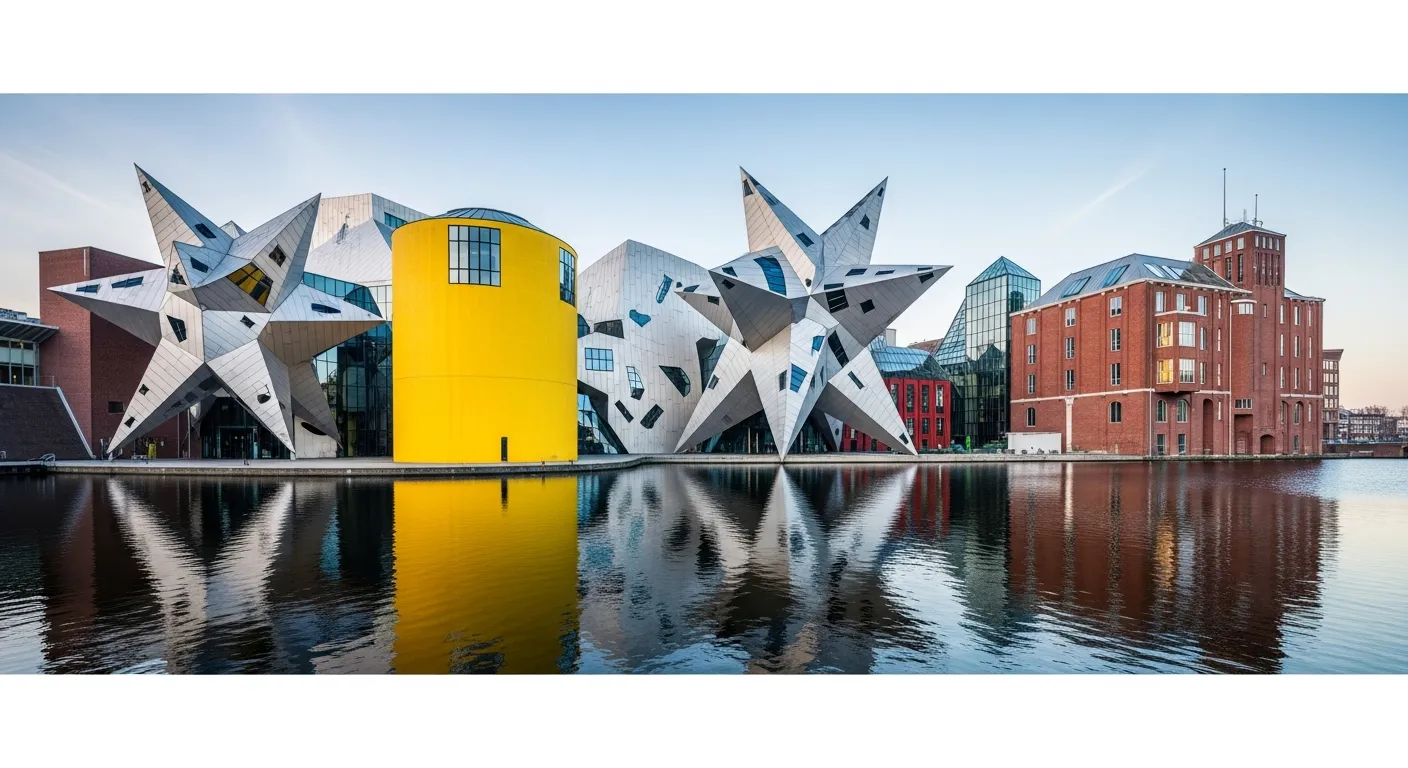
Groninger Museum
Groningen · Netherlands · Founded 1874
Good for: Architecture Enthusiasts · Art Lovers · Design Fans
1874
Founded
1994
Current Building Opened
2–3 hours
Recommended Visit
Quick answer
Groninger Museum in Groningen, Netherlands — the Groninger Museum was founded in 1874 and moved in 1994 into a startling postmodern complex by Alessandro Mendini, with pavilions by Coop Himmelb(l)au, Michele De Lucchi, and Philippe Starck. Open Tuesday to Sunday: 10:00 AM – 5:00 PM (Closed Mondays). Admission: €16 standard admission. World Museum Guide covers the highlights, getting there, and how long to allow (2–3 hours).
Verified 2026-06-30 against official sources.
About Groninger Museum
The Groninger Museum is one of the most architecturally distinctive museums in the Netherlands. Its 1994 building, floating on the Verbindingskanaal beside Groningen's station, was designed as a collaboration between Alessandro Mendini, Coop Himmelb(l)au, Michele De Lucchi, and Philippe Starck — a landmark of postmodern design.
Founded in 1874, the museum's collection spans archaeology, applied arts, and modern and contemporary art. It is especially strong in Groningen's own De Ploeg movement — a group of Expressionist painters active in the 1920s and 1930s — and in Italian design associated with Mendini.
Inside the pavilions, each with its own character and colour scheme, visitors move between archaeological finds from the province, Asian ceramics, fashion, and rotating contemporary exhibitions. The building itself draws as many admirers as the art it contains.
Groningen is a lively university city in the north of the Netherlands, and the museum anchors its cultural quarter alongside the Groninger Forum and city theatre.
2–3 hours highlights route
A focused route through 4 must-see highlights at Groninger Museum without museum fatigue. · 2–3 hours
- 1
The Windows of Peace and War
📍 Mendini Pavilion
Stained-glass windows designed by Chagall for a Jerusalem synagogue, now installed in the museum as a meditation on peace and conflict.
- 2
De Ploeg Paintings
📍 Regional Art Gallery
Expressionist landscapes and portraits by the Groningen artists' collective De Ploeg, documenting the northern Dutch countryside.
- 3
Archaeological Treasures of Groningen
📍 Archaeology Pavilion
Gold and silver hoards, Roman artefacts, and medieval finds excavated from the Groningen province.
- 4
Italian Design Collection
📍 Design Gallery
Furniture, objects, and prototypes from Mendini's circle, reflecting the museum's close ties to Italian postmodern design.
Masterworks & must-see highlights
The works that define Groninger Museum — and why they matter.
The Windows of Peace and War
Marc Chagall · 1946–47
📍 Mendini Pavilion
Stained-glass windows designed by Chagall for a Jerusalem synagogue, now installed in the museum as a meditation on peace and conflict.
De Ploeg Paintings
Jan Altink, Johan Dijkstra, and others · 1920s–30s
📍 Regional Art Gallery
Expressionist landscapes and portraits by the Groningen artists' collective De Ploeg, documenting the northern Dutch countryside.
Archaeological Treasures of Groningen
Various · prehistoric to medieval
📍 Archaeology Pavilion
Gold and silver hoards, Roman artefacts, and medieval finds excavated from the Groningen province.
Italian Design Collection
Alessandro Mendini and Memphis Group · 1980s–90s
📍 Design Gallery
Furniture, objects, and prototypes from Mendini's circle, reflecting the museum's close ties to Italian postmodern design.
Collections & highlights
- • De Ploeg Expressionist painting
- • Marc Chagall stained glass
- • Groningen archaeology and provincial history
- • Asian ceramics and applied arts
- • Italian postmodern design
- • Contemporary art and photography
- • Fashion and textile design
- • Rotating international exhibitions
Frequently asked questions
Is the museum walking distance from the train station?
Yes, it sits directly opposite the main railway station across the canal.
Are guided architecture tours available?
Yes, the museum periodically runs tours focused on its postmodern building.
How long should I spend at Groninger Museum?
Plan 2–3 hours for the highlights. Add time for temporary exhibitions, the museum shop, and café.
What is Groninger Museum best known for?
The Groninger Museum was founded in 1874 and moved in 1994 into a startling postmodern complex by Alessandro Mendini, with pavilions by Coop Himmelb(l)au, Michele De Lucchi, and Philippe Starck. Key highlights include Architecture by Mendini, Coop Himmelb(l)au, Starck, Asian export ceramics, Northern Dutch art collection.
How do I get tickets for Groninger Museum?
€16 standard admission Tickets are usually available on the day, but booking online saves queue time in peak season. Official site: https://www.groningermuseum.nl/en
Is the building worth visiting even if I'm not an art expert?
Absolutely — the Mendini, Coop Himmelb(l)au, De Lucchi, and Starck pavilions are among the most photographed structures in the Netherlands.
Is it walking distance from the train station?
Yes — the museum sits on Museumeiland directly beside Groningen station, making it ideal for a stopover visit.
What is De Ploeg?
De Ploeg (The Plough) was an Expressionist artists' group founded in Groningen in 1918, focused on the landscapes and people of the northern Netherlands.
World Animal Rescue Network
Save the jaguar
Jaguars need connected forest corridors across the Americas. Your gift supports habitat protection and anti-poaching work with local partners. Please consider a donation to support this work.
Enjoying our free guides? Support World Museum Guide — optional, and every guide stays free.