Leonardo da Vinci: The Last Years
Until 14 September 2026A focused presentation of Leonardo's late French period — Saint Anne, the Mona Lisa in context, and workshop drawings rarely shown together.
240 museums across 48 countries
Good for: Art Lovers · History Enthusiasts · First-timers · Families
1793
Founded
9.7 million
Annual Visitors
3–5 hours
Recommended Visit
Art
Museum type
The Louvre in Paris, France — the Louvre is the world's largest art museum and a historic monument in Paris, France. Open Wednesday to Monday: 9:00 AM – 6:00 PM (Closed Tuesdays). Admission: €17 standard admission. Book timed-entry tickets ahead in peak season. World Museum Guide covers the highlights, getting there, and how long to allow (3–5 hours).
Verified 2026-06-30 against official sources.
The Louvre is the world's largest art museum and a historic monument in Paris, France. A central landmark of the city, it is located on the Right Bank of the Seine in the city's 1st arrondissement.
The museum is housed in the Louvre Palace, originally built in the late 12th to 13th century under Philip II. Remnants of the fortress are visible in the basement of the museum. Due to urban expansion, the fortress eventually lost its defensive function, and in 1546 Francis I converted it into the primary residence of the French Kings.
The building was extended many times to form the present Louvre Palace. In 1682, Louis XIV chose the Palace of Versailles for his household, leaving the Louvre primarily as a place to display the royal collection.
During the French Revolution, the National Assembly decreed that the Louvre should be used as a museum to display the nation's masterpieces. The museum opened on 10 August 1793 with an exhibition of 537 paintings, the majority of the works being royal and confiscated church property.
Updated June 2026. Confirm dates and tickets on the official The Louvre website.
A focused presentation of Leonardo's late French period — Saint Anne, the Mona Lisa in context, and workshop drawings rarely shown together.
Sacred objects rescued from the 2019 fire, reunited with medieval liturgical art from the Louvre's own collection.
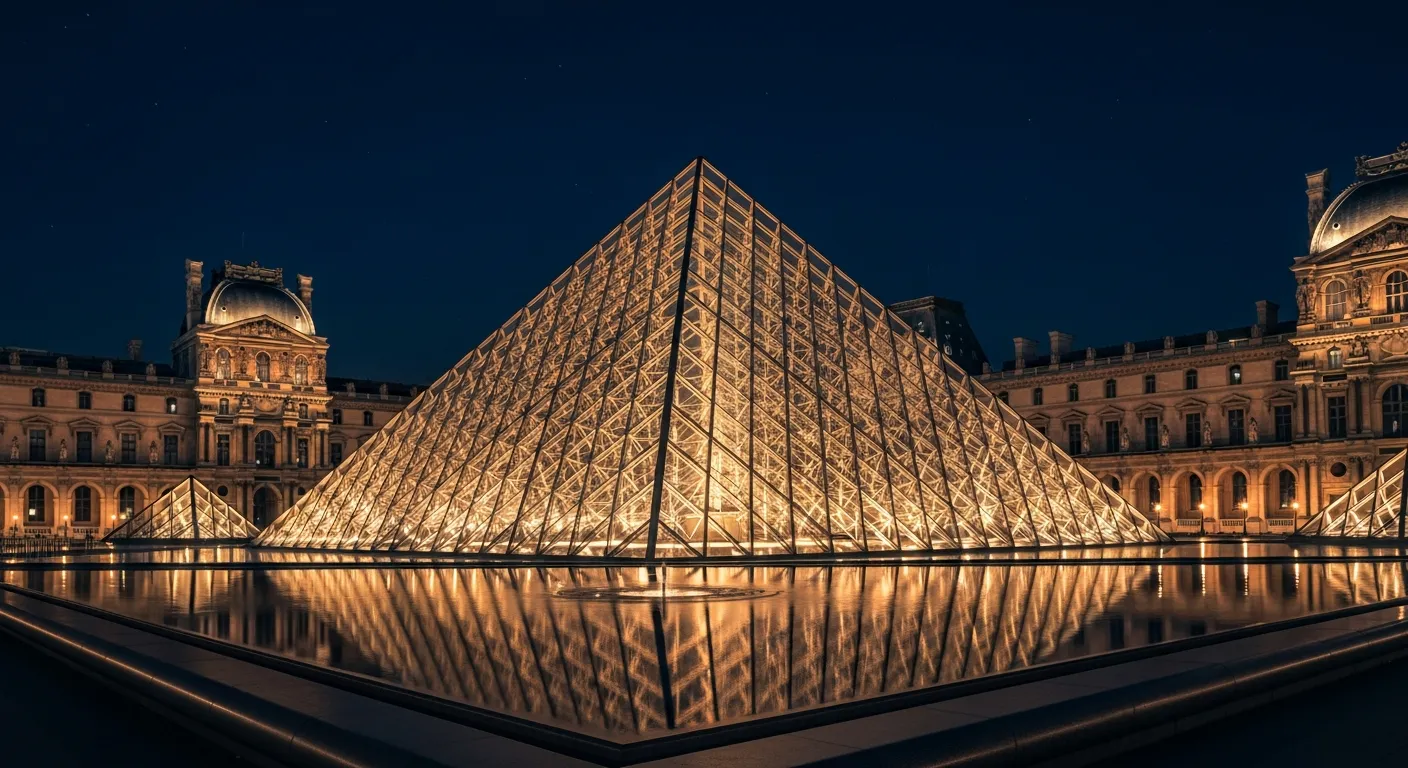
The Louvre occupies a former royal palace stretching along the Seine, and its three main wings — Denon, Sully, and Richelieu — can overwhelm even repeat visitors who underestimate the walking distances between distant galleries. Most first-time itineraries start in the Denon wing, where the Mona Lisa, Winged Victory of Samothrace, and Italian Renaissance galleries cluster near the glass Pyramid entrance that has symbolized the museum since 1989. Timed tickets are essential year-round, and entering through the Carrousel du Louvre shopping arcade often saves queue time compared with the main Pyramid line, especially during rain or peak summer months. Alternative entrances at Porte des Lions and the Galerie du Carrousel help disperse crowds when the central pyramid queue wraps across the courtyard. Download the official app before arrival because mobile signal weakens in basement-level galleries beneath the Sully wing.
Rather than attempting to see everything in one visit, choose one wing as your anchor and treat the rest as optional detours that you add only if energy and time allow. The museum's official app and gallery maps mark major masterpieces, but physical signage can be sparse in remote corridors where lesser-known Roman marbles and decorative arts await discovery. Wednesday and Friday evening openings draw smaller crowds to popular rooms and offer a quieter atmosphere for studying large-format French Romantic canvases without tour-group pressure. Summer afternoons bring the heaviest congestion around the Mona Lisa and Egyptian antiquities, so schedule those rooms immediately at opening or after 5 PM on late-night days. Rest stops at café Richelieu or the Cour Napoléon food court prevent fatigue during multi-hour routes through interconnected floors.
Accessibility is good in the newer Denon galleries, though cobblestone courtyards and occasional stair-only connections between wings require planning for wheelchair users and visitors with strollers. Lockers near the Pyramid accept bags that exceed size limits, which matters because large backpacks are not permitted in the galleries and cannot be carried through crowded masterpiece rooms. Elevators connect major floors but may require staff assistance at certain Richelieu access points marked on accessibility maps available at the information desk. Allow at least four hours for a meaningful first visit, or two hours if you commit to a single-wing highlights route focused on either classical antiquities or European painting. Re-entry on the same day is permitted with a valid ticket, enabling a lunch break in the Tuileries Garden before returning for an afternoon wing.
The Louvre's identity rests on three pillars: ancient Near Eastern and Egyptian civilisations, Greek and Roman antiquities, and European painting from the late medieval period through the nineteenth century. The Egyptian collection in Sully ranks among the finest outside Cairo, with the Seated Scribe and temple reconstructions giving context that smaller museums cannot match for understanding daily life along the Nile. Greek and Roman sculpture in Denon, including the Venus de Milo and Winged Victory, shaped how Western museums display classical art in grand skylit galleries that became the international standard. Mesopotamian holdings such as the Code of Hammurabi in Richelieu anchor legal and urban history long before Athens or Rome dominated Mediterranean culture. Together these civilisations explain why the Louvre functions as an encyclopedic museum rather than a national gallery focused on a single country.
French and Italian painting galleries hold works by Leonardo, Vermeer, Delacroix, and Ingres in rooms that were once royal apartments with parquet floors and chimney pieces still visible beside salon-style hangs. Decorative arts, Islamic art, and Napoleon III's state apartments in Richelieu reward visitors who venture beyond the headline masterpieces into quieter galleries of ceramics, armor, and courtly furniture. The museum's prints and drawings collection is largely in storage due to light sensitivity, but rotating exhibitions in the Hall Napoléon occasionally surface fragile works by Dürer, Michelangelo, and Rembrandt not normally on public view. Dutch Golden Age rooms present Vermeer's Lacemaker and Rembrandt portraits with fewer crowds than Italian Renaissance corridors if timed strategically. Spanish and British painting holdings, though smaller than Madrid or London, include major Goya and Lawrence portraits that complete the European narrative.
Photography without flash is permitted in most permanent galleries, though the Mona Lisa room restricts selfie sticks and large tripods that block sightlines for other visitors. Audio guides and themed trails help families engage children, but many experienced visitors prefer a pre-planned list of ten to fifteen works to avoid decision fatigue in a collection exceeding thirty-five thousand objects on display. The Louvre Lens satellite museum in northern France and Louvre Abu Dhabi extend the brand internationally, yet the Paris original remains unmatched in breadth, depth, and the continuity of royal and revolutionary collecting history. Temporary exhibitions in the Hall Napoléon often require separate tickets but justify the splurge when they reunite dispersed altarpieces or showcase newly cleaned masterpieces. Scholarly catalogs and the Atlas database online help researchers locate specific objects by inventory number before visiting in person.
Focused routes for The Louvre — pick one wing per visit to avoid museum fatigue.
Denon holds the Louvre's most famous works, from the Mona Lisa and Winged Victory to the grand Italian painting galleries and classical sculpture that define the museum in global imagination. Start here if you have limited time, but expect crowds near the Renaissance icons that peak between 11 AM and 3 PM daily. The Daru staircase leading to Winged Victory offers one of the most dramatic architectural approaches to a sculpture anywhere in the world.
Sully covers the medieval Louvre fortress, Egyptian antiquities, and French sculpture in quieter galleries than Denon, making it ideal for visitors seeking depth over selfie landmarks. The lower levels reveal the original castle moat and foundations beneath the palace, explaining how Philippe Auguste's fortress evolved into a royal residence. Egyptian galleries here rank among the most comprehensive outside Egypt and reward unhurried reading of tomb chapel reliefs.
Richelieu houses northern European painting, Mesopotamian treasures, and the lavish Napoleon III state apartments restored to Second Empire splendor with gilded chandeliers and parquet parquetry. It is often less crowded than Denon while offering equally world-class objects including Rubens cycles and the Code of Hammurabi stele. The covered sculpture courtyard provides weatherproof natural light for studying marble portrait busts at close range.
A focused route through 5 must-see highlights at The Louvre without museum fatigue. · 3–5 hours
📍 Salle des États, Room 711, Denon Wing
The world's most visited painting.
📍 Gallery 346, Sully Wing
An ancient Greek marble sculpture representing Aphrodite (Venus), goddess of love.
📍 Top of the Daru Staircase, Denon Wing
A marble sculpture of Nike (Victory) poised on the prow of a ship.
📍 Room 700, Denon Wing
Delacroix's iconic Romantic canvas commemorating the July Revolution.
📍 Salle des États, Room 711, facing the Mona Lisa
The largest painting in the Louvre at 677 × 994 cm.
The works that define The Louvre — and why they matter.
Leonardo da Vinci · c. 1503–1519
📍 Salle des États, Room 711, Denon Wing
The world's most visited painting. A portrait believed to depict Lisa Gherardini, painted in oil on poplar wood. Its sfumato technique, enigmatic expression, and 1911 theft propelled it to global celebrity.
Unknown Greek sculptor · c. 130–100 BCE
📍 Gallery 346, Sully Wing
An ancient Greek marble sculpture representing Aphrodite (Venus), goddess of love. Discovered on the island of Milos in 1820, it is celebrated as one of the greatest achievements of ancient Greek sculpture.
Unknown Greek sculptor · c. 200–190 BCE
📍 Top of the Daru Staircase, Denon Wing
A marble sculpture of Nike (Victory) poised on the prow of a ship. The masterpiece is prized for its dramatic forward momentum and extraordinarily naturalistic drapery.
Eugène Delacroix · 1830
📍 Room 700, Denon Wing
Delacroix's iconic Romantic canvas commemorating the July Revolution. The allegorical figure of Liberty holding a tricolour has become one of the most recognisable images of freedom in Western art.
Paolo Veronese · 1562–1563
📍 Salle des États, Room 711, facing the Mona Lisa
The largest painting in the Louvre at 677 × 994 cm. Veronese's monumental canvas depicts Christ's first miracle at a lavish Venetian banquet, with over 130 figures including portraits of Titian and Tintoretto.
A focused visit covering the main highlights — the Mona Lisa, Venus de Milo, and Winged Victory — takes around 3 hours. To see the full museum would take days; the Louvre has 35,000 works on display across 72,735 square metres of gallery space.
The Mona Lisa (La Joconde) is displayed in the Salle des États (Room 711) on the first floor of the Denon Wing. It hangs opposite Paolo Veronese's enormous Wedding at Cana. Follow the signs marked 'Mona Lisa' from the main entrance.
The Mona Lisa is a poplar wood panel measuring 77 × 53 cm — roughly A2 poster size. Leonardo da Vinci painted it as a private commission, not as a public monument. Its worldwide fame stems from its theft in 1911 (recovered two years later), its technical mastery, and its reproduction in billions of images. Many visitors are surprised by its size.
Book timed-entry tickets in advance on the official Louvre website (louvre.fr). On-the-day queues at the Pyramid entrance can be 1–2 hours. Ticket holders with timed slots skip the general queue. EU residents under 26 enter free. The Louvre is free for all visitors on the first Friday evening of each month (6 PM–9:45 PM) and on Bastille Day (14 July).
Yes — EU citizens under 26 enter free at all times. The Louvre is also free for all visitors on the first Friday evening of each month (after 6 PM) and on Bastille Day (14 July). Teachers and artists from EU countries enter free with proof of qualification.
The Venus de Milo (Greek sculpture, c. 130–100 BCE) in the Sully Wing, the Winged Victory of Samothrace (c. 200–190 BCE) at the top of the Daru staircase, the Wedding at Cana by Veronese (the largest painting in the museum), Vermeer's The Lacemaker, and the monumental French Romantic canvases by Delacroix and Géricault in the Denon Wing.
World Animal Rescue Network
Tigers need allies worldwide. A symbolic adoption is a meaningful one-off or monthly gift — with a certificate — that funds real conservation in the field. Please consider a donation to support this work.
Enjoying our free guides? Support World Museum Guide — optional, and every guide stays free.