Louvre Abu Dhabi
Abu Dhabi · United Arab Emirates · Founded 2017
Good for: Art Lovers · First-timers · Rainy-day visits
2017
Founded
800,000
Annual Visitors
2–3 hours
Recommended Visit
Art
Museum type
Quick answer
Louvre Abu Dhabi in Abu Dhabi, United Arab Emirates — the Louvre Abu Dhabi is an art and civilization museum, located in Abu Dhabi, United Arab Emirates. Open Tuesday to Sunday: 10:00 AM – 6:30 PM (Closed Mondays). Admission: 63 AED standard admission. World Museum Guide covers the highlights, getting there, and how long to allow (2–3 hours).
Verified 2026-06-30 against official sources.
About Louvre Abu Dhabi
The Louvre Abu Dhabi is an art and civilization museum, located in Abu Dhabi, United Arab Emirates. The museum was established on November 8, 2017 by French President Emmanuel Macron and United Arab Emirates Vice President Mohammed bin Rashid Al Maktoum.
It is part of a thirty-year agreement between the city of Abu Dhabi and the French government. The museum is located on the Saadiyat Island Cultural District. It is approximately 24,000 square metres in size, with 8,000 square metres of galleries, making it the largest art museum in the Arabian peninsula.
Artworks from around the world are showcased at the museum, with stated intent to bridge the gap between Eastern and Western art.
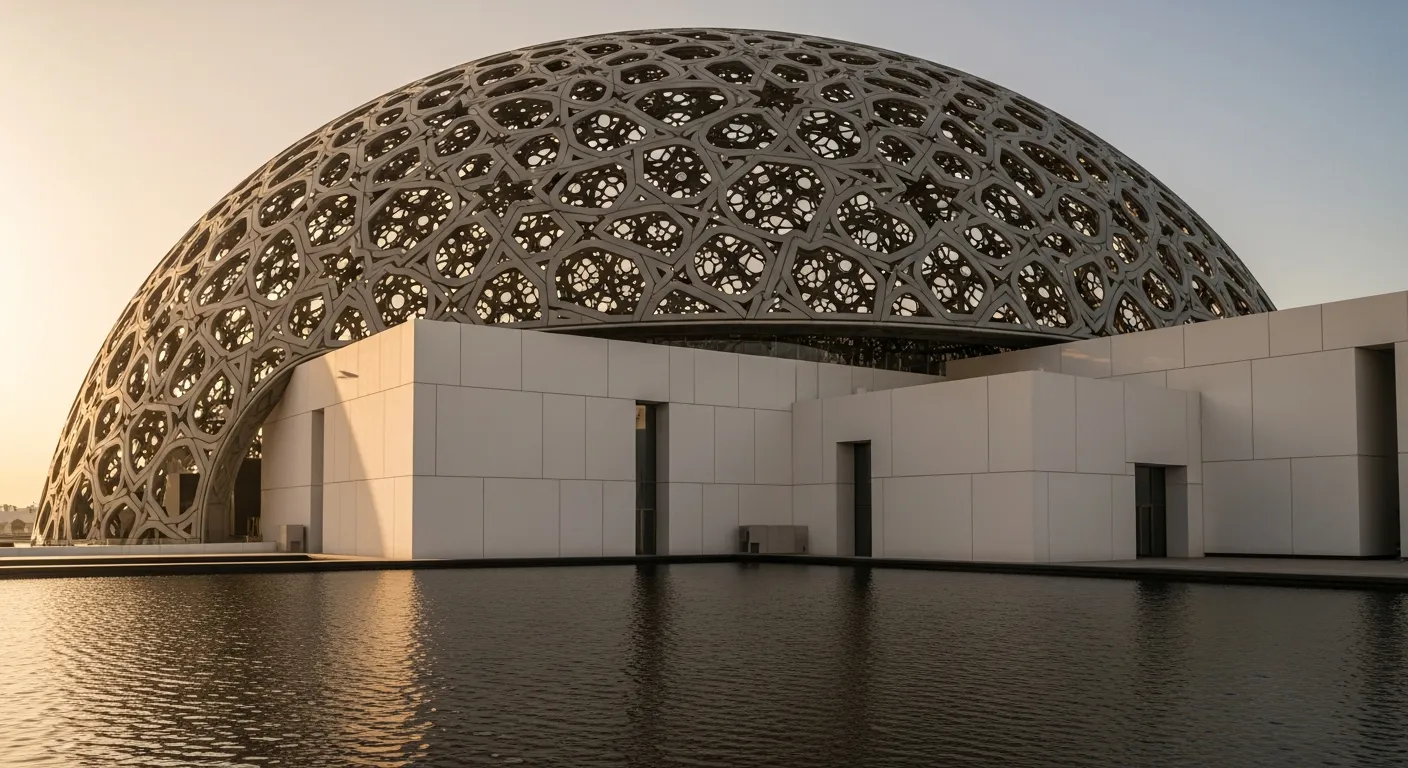
The museum's stunning architectural design, created by Jean Nouvel, features a massive webbed dome that creates a 'rain of light' effect, filtering sunlight through intricate geometric patterns.
2–3 hours highlights route
A focused route through 3 must-see highlights at Louvre Abu Dhabi without museum fatigue. · 2–3 hours
- 1
Portrait of a Young Woman
📍 Chapter 12, Modernity
One of the most intimate portraits by the leading painter of the French Revolution.
- 2
La Belle Ferronnière
📍 Chapter 3, Universal Religions
A portrait attributed to Leonardo depicting a young woman of the Milanese court.
- 3
The Last Supper (after da Vinci)
📍 Long Gallery
A rare full-scale oil-on-canvas copy of da Vinci's wall painting made within decades of the original, preserving details since lost to deterioration.
Masterworks & must-see highlights
The works that define Louvre Abu Dhabi — and why they matter.
Portrait of a Young Woman
Jacques-Louis David · 1800
📍 Chapter 12, Modernity
One of the most intimate portraits by the leading painter of the French Revolution. The young woman's direct gaze and loosened hair give this commission an unusual psychological intensity.
La Belle Ferronnière
Leonardo da Vinci · c. 1495–1499
📍 Chapter 3, Universal Religions
A portrait attributed to Leonardo depicting a young woman of the Milanese court. The model's three-quarter pose and her direct gaze — unusual for the time — suggest she was a person of significance rather than a passive subject.
The Last Supper (after da Vinci)
Workshop of Leonardo · 16th century
📍 Long Gallery
A rare full-scale oil-on-canvas copy of da Vinci's wall painting made within decades of the original, preserving details since lost to deterioration. One of only a handful of near-contemporary copies in existence.
Collections & highlights
- • Fountain of Light installation
- • Bactrian Princess
- • Virgin and Child by Giovanni Bellini
- • Portrait of a Lady by Pablo Picasso
- • The Rain of Light dome
Frequently asked questions
How is the Louvre Abu Dhabi different from the Louvre in Paris?
The Louvre Abu Dhabi is a completely independent museum that shares only the name and a temporary loan arrangement with the Louvre in Paris. Under a 30-year intergovernmental agreement signed in 2007, France loans artworks from the Louvre and other major French museums to Abu Dhabi. The Abu Dhabi museum focuses on 'universal history of humanity' — presenting art from all civilisations chronologically rather than by culture or region, to show the parallels between Eastern and Western art across time.
What is the 'Rain of Light' at the Louvre Abu Dhabi?
The Rain of Light is the effect created by the museum's extraordinary white dome, designed by French architect Jean Nouvel. The dome — 180 metres in diameter and weighing 7,500 tonnes — is made of eight interlocking geometric layers of perforated steel and aluminium, creating a complex arabesque pattern inspired by traditional Islamic lattice screens. As sunlight moves across the dome throughout the day, thousands of tiny light shafts filter through, creating the illusion of dappled light falling on the galleries, water, and buildings below.
What are the must-see works at the Louvre Abu Dhabi?
Highlights include the Bactrian Princess (2500–1500 BCE) — a rare composite statuette found in Central Asia combining stone, gold, and bitumen; Virgin and Child (c. 1480) by Giovanni Bellini; Portrait of a Lady by Picasso; Fountain of Light (2016) by Ai Weiwei — a 7-metre chandelier of crystal and steel; and a rotating selection of major loans from French institutions, which can include works from the Louvre, Versailles, the Musée d'Orsay, and the Centre Pompidou.
Is the Louvre Abu Dhabi worth visiting?
Yes — the Louvre Abu Dhabi is considered one of the finest museums in the Middle East and one of the most architecturally significant museum buildings in the world. The Jean Nouvel dome alone justifies a visit. The collection, while smaller than the Paris Louvre, is curated to tell a genuinely cross-cultural narrative of human history. The waterfront setting on Saadiyat Island, with views over the Arabian Gulf, adds to the experience. Allow 2–3 hours for the main collection and exhibition.
How do I get to the Louvre Abu Dhabi?
The Louvre Abu Dhabi is located on Saadiyat Island, approximately 10 minutes by taxi from central Abu Dhabi. The museum is open Tuesday to Sunday, 10:00 AM to 6:30 PM (closed Mondays). Standard admission is 63 AED. Free parking is available on site. The museum is a 1.5-hour drive or 1-hour express bus journey from Dubai.
How long should I spend at Louvre Abu Dhabi?
Plan 2–3 hours for the highlights. Add time for temporary exhibitions, the museum shop, and café.
World Animal Rescue Network
Adopt a pangolin symbolically
Pangolins are the world's most trafficked mammals. A symbolic adoption gift funds confiscation response and specialist rehabilitation. Please consider a donation to support this work.
Enjoying our free guides? Support World Museum Guide — optional, and every guide stays free.