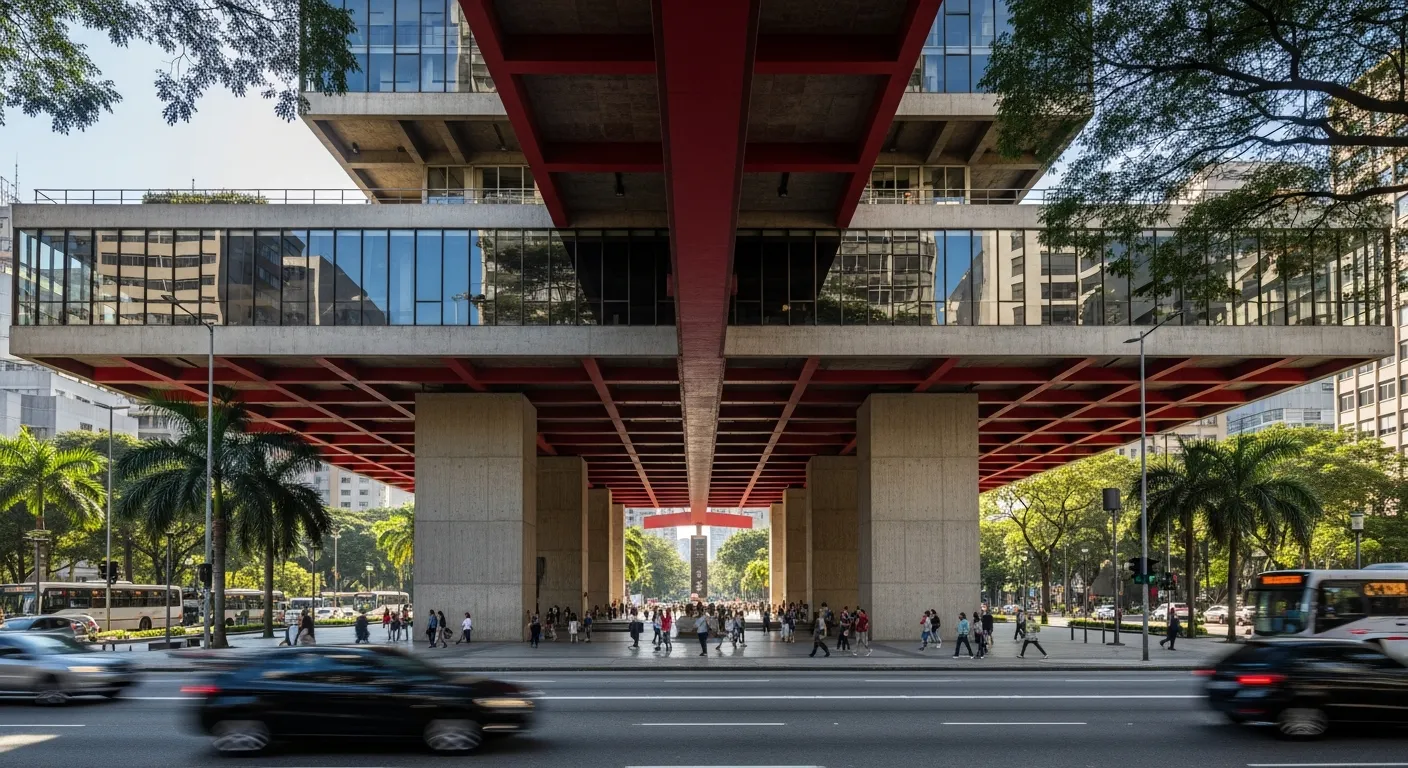
Museu de Arte de São Paulo
São Paulo · Brazil · Founded 1947
Good for: Art Lovers · First-timers · Rainy-day visits
1947
Founded
2.5 million
Annual Visitors
2–3 hours
Recommended Visit
Art
Museum type
Quick answer
Museu de Arte de São Paulo in São Paulo, Brazil — the São Paulo Museum of Art (Portuguese: Museu de Arte de São Paulo Assis Chateaubriand, MASP) is a non-profit art museum located on Paulista Avenue in the city of São Paulo, Brazil. Open Tuesday: 10:00 AM – 8:00 PM; Wednesday to Sunday: 10:00 AM – 6:00 PM (Closed Mondays). Admission: ✓ R$75 standard admission; free on Tuesdays. World Museum Guide covers the highlights, getting there, and how long to allow (2–3 hours).
Verified 2026-06-30 against official sources.
About Museu de Arte de São Paulo
The São Paulo Museum of Art (Portuguese: Museu de Arte de São Paulo Assis Chateaubriand, MASP) is a non-profit art museum located on Paulista Avenue in the city of São Paulo, Brazil. It is well known for its headquarters, a 1968 concrete and glass structure designed by Lina Bo Bardi.
The museum was founded in 1947 by Assis Chateaubriand and Pietro Maria Bardi. MASP is recognized as one of Latin America's most important cultural institutions, and is a non-profit private institution.
The museum is also known for its glass easels — a 2015 reinstallation by curator Adriano Pedrosa that returned the works to Lina Bo Bardi's original concept of presenting paintings on transparent glass supports without traditional walls.
Its collection of European art, with major works by Raphael, Titian, Rembrandt, Velázquez, Goya, Manet, Renoir, Cézanne, and Van Gogh, is regarded as the finest in the Southern Hemisphere.
2–3 hours highlights route
A focused route through 3 must-see highlights at Museu de Arte de São Paulo without museum fatigue. · 2–3 hours
- 1
The Student (Portrait of Iracema)
📍 Brazilian Art Collection
The most iconic Brazilian painting in the collection — a young woman reading, depicted with extraordinary naturalistic light.
- 2
Portrait of the Art Dealer Ambroise Vollard
📍 European Paintings
A masterwork of Analytic Cubism in which the figure of Vollard is fractured into overlapping geometric planes.
- 3
Young Woman Sewing
📍 European Paintings
A tender domestic scene typical of Renoir's Impressionist period — dappled light falls on a seamstress absorbed in her work.
Masterworks & must-see highlights
The works that define Museu de Arte de São Paulo — and why they matter.
The Student (Portrait of Iracema)
José Ferraz de Almeida Júnior · 1891
📍 Brazilian Art Collection
The most iconic Brazilian painting in the collection — a young woman reading, depicted with extraordinary naturalistic light. Almeida Júnior broke from European academicism to portray Brazilian everyday life.
Portrait of the Art Dealer Ambroise Vollard
Pablo Picasso · 1910
📍 European Paintings
A masterwork of Analytic Cubism in which the figure of Vollard is fractured into overlapping geometric planes. One of MASP's greatest treasures and a defining document of Cubism.
Young Woman Sewing
Pierre-Auguste Renoir · 1879
📍 European Paintings
A tender domestic scene typical of Renoir's Impressionist period — dappled light falls on a seamstress absorbed in her work. One of several major Impressionist works in MASP's acclaimed European collection.
Collections & highlights
- • Self-Portrait with Bandaged Ear by Vincent van Gogh
- • Resurrection of Christ by Raphael
- • The Schoolboy by Amedeo Modigliani
- • Lina Bo Bardi's glass easel display system
- • The free public square beneath the suspended building
Frequently asked questions
Why is the MASP building suspended on red beams?
Architect Lina Bo Bardi designed MASP's main building (1968) elevated on two massive red concrete beams to preserve an unobstructed view through the site from the upper Paulista Avenue level down to Trianon Park below — a view the city of São Paulo requested be maintained as a public right. The 74-metre span between the two beams creates a free-standing civic square underneath the museum, used for public events, markets, and performances. The structure is one of the most daring architectural feats of 20th-century Brazilian modernism.
Are the paintings really displayed on transparent glass easels at MASP?
Yes — MASP's most distinctive display feature is its glass easel system, designed by Lina Bo Bardi in 1968. Each painting is mounted on a crystal-clear glass support standing on a concrete base, with the explanatory label on the reverse. This allows visitors to walk around each work, see paintings from any angle, and read the label without the work impeding their view. The system was restored in 2015 by then-curator Adriano Pedrosa after decades in which traditional walls had replaced it. It is unique in world museum practice.
Is MASP free to visit?
MASP is free on Tuesdays for all visitors. On other days, standard admission is R$75 (subject to change). The covered civic square beneath the building is always free and publicly accessible at any time. MASP is closed on Mondays. The museum is located on Avenida Paulista, São Paulo's main cultural and financial boulevard, and is easily reached by metro (Trianon-MASP station on Line 2).
What are the most important works in the MASP collection?
Self-Portrait with Bandaged Ear and Pipe (1889) by Vincent van Gogh — one of his most recognisable self-portraits; Resurrection of Christ (c. 1502) by Raphael; The Schoolboy (c. 1918) by Amedeo Modigliani; A Young Man (c. 1665) by Rembrandt; and works by Renoir, Manet, Cézanne, Toulouse-Lautrec, Degas, and Velázquez. MASP also holds one of the most important collections of Brazilian art in the world, particularly strong in 19th- and 20th-century works, and has an outstanding photography collection.
Why is MASP significant for Latin America?
MASP (Museu de Arte de São Paulo Assis Chateaubriand) is widely considered the most important art museum in Latin America and the Southern Hemisphere. Founded in 1947 by media magnate Assis Chateaubriand and art critic Pietro Maria Bardi, it brought European masterpieces to Brazil at a time when South American museums had little access to world-class Western art. Its collection of European Old Masters and Impressionists — Raphael, Bellini, Tintoretto, El Greco, Rubens, Goya, Constable, Manet, Renoir, Cézanne, and van Gogh — is considered the finest in the Southern Hemisphere.
How long should I spend at Museu de Arte de São Paulo?
Plan 2–3 hours for the highlights. Add time for temporary exhibitions, the museum shop, and café.
World Animal Rescue Network
Stop parrot trafficking
Trafficked parrots are among the world's most illegally traded birds. Your gift supports seizure response, rehabilitation, and release programmes. Please consider a donation to support this work.
Enjoying our free guides? Support World Museum Guide — optional, and every guide stays free.