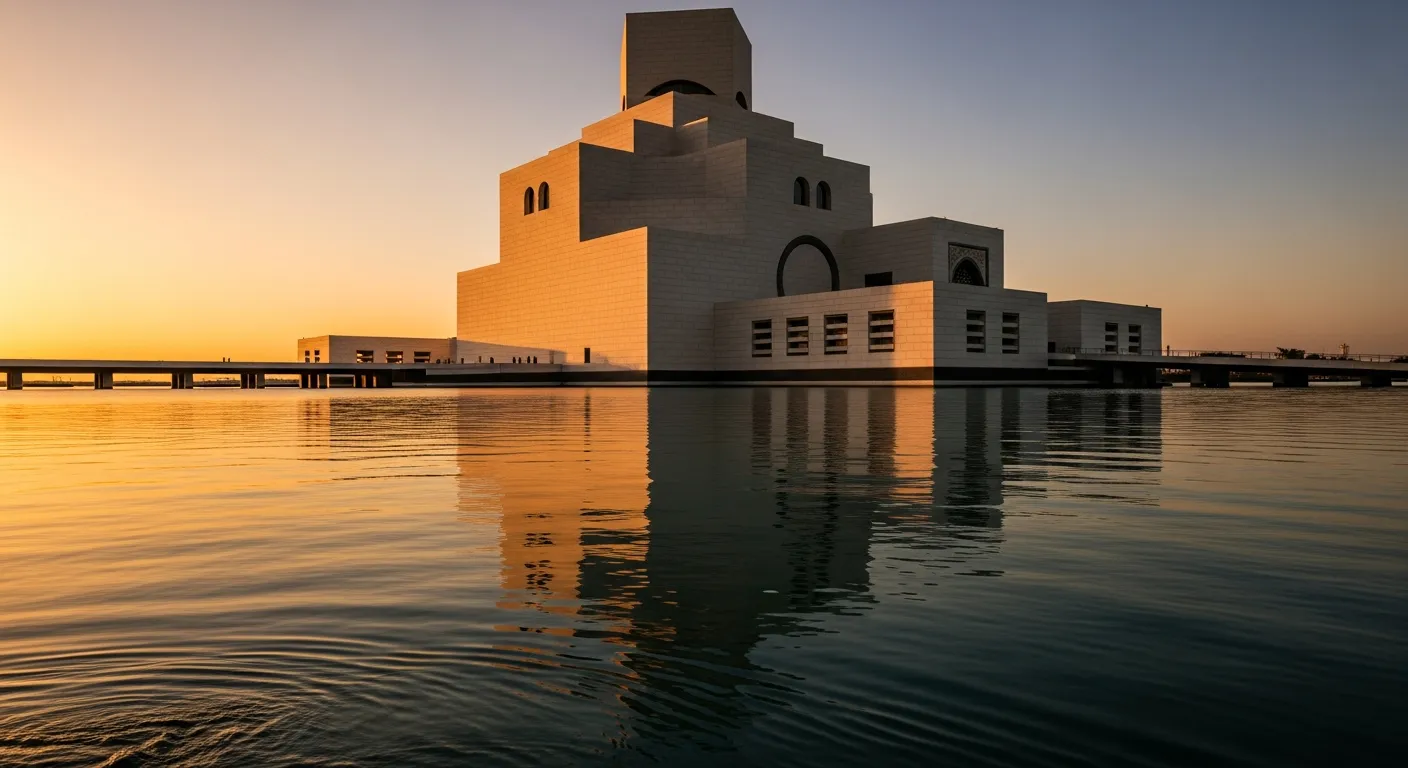
Museum of Islamic Art
Good for: Art Lovers · First-timers · Rainy-day visits
2008
Founded
900,000
Annual Visitors
2–3 hours
Recommended Visit
Art
Museum type
Quick answer
Museum of Islamic Art in Doha, Qatar — the Museum of Islamic Art (MIA) is a museum on one end of the seven-kilometer-long Corniche in Doha, Qatar. Open Saturday to Thursday: 9:00 AM – 7:00 PM; Fridays: 1:30 PM – 7:00 PM. Admission: ✓ 50 QAR for non-residents, free for residents. World Museum Guide covers the highlights, getting there, and how long to allow (2–3 hours).
Verified 2026-06-30 against official sources.
About Museum of Islamic Art
The Museum of Islamic Art (MIA) is a museum on one end of the seven-kilometer-long Corniche in Doha, Qatar. As per the architect I. M. Pei's specifications, the museum is built on an island off an artificial projecting peninsula near the traditional dhow harbor.
A purpose-built park surrounds the edifice on the eastern and southern facades while two bridges connect the southern front facade of the property with the main peninsula that holds the park.
The museum draws much influence from ancient Islamic architecture, notably the Ibn Tulun Mosque in Cairo, yet has a unique design. It was the first of its kind in Arab States of the Persian Gulf and has a very large collection of Islamic art.
The museum houses a collection of works gathered since the late 1980s, including manuscripts, textiles, and ceramics. It represents Islamic art from three continents over 1,400 years.
2–3 hours highlights route
A focused route through 3 must-see highlights at Museum of Islamic Art without museum fatigue. · 2–3 hours
- 1
Baptistère de Saint Louis
📍 Level 1, Room 1.2
A bronze basin inlaid with silver and gold — one of the most technically accomplished works of medieval Islamic art.
- 2
Pyxis of al-Mughira
📍 Level 1
An ivory cosmetic container carved with court scenes for the Caliph's son.
- 3
Ardabil Carpet
📍 Level 1, Carpet Gallery
One of the oldest dated carpets in the world — woven for the Ardabil Shrine in Iran with 36 million knots per square metre.
Masterworks & must-see highlights
The works that define Museum of Islamic Art — and why they matter.
Baptistère de Saint Louis
Muhammad ibn al-Zayn · c. 1320–1340
📍 Level 1, Room 1.2
A bronze basin inlaid with silver and gold — one of the most technically accomplished works of medieval Islamic art. It was used for French royal christenings for centuries and is named after the saint though predating him.
Pyxis of al-Mughira
Unknown Andalusian craftsman · 968 CE
📍 Level 1
An ivory cosmetic container carved with court scenes for the Caliph's son. Its complex imagery documenting Umayyad court life makes it one of the most significant objects of medieval Islamic art.
Ardabil Carpet
Unknown Persian weavers · 1539–1540
📍 Level 1, Carpet Gallery
One of the oldest dated carpets in the world — woven for the Ardabil Shrine in Iran with 36 million knots per square metre. The MIA holds one of the finest Persian carpet collections outside Iran.
Collections & highlights
- • The Shahnameh Manuscript
- • Astrolabe from 10th century
- • Iznik Pottery
- • Mamluk glass mosque lamps
- • The MIA Park
Frequently asked questions
Who designed the Museum of Islamic Art in Doha?
The Museum of Islamic Art was designed by Chinese-American architect I. M. Pei, who came out of retirement at the age of 91 to take on the commission. Pei spent time studying Islamic architecture across North Africa, the Middle East, and Spain before settling on a design inspired by the 9th-century Ibn Tulun Mosque in Cairo. The building's stark geometric forms — a series of interlocking squares and pentagons in limestone — rise from an artificial peninsula and are considered one of his finest works.
Is the Museum of Islamic Art in Doha free to enter?
Entry to the Museum of Islamic Art costs 50 QAR for non-residents of Qatar. Residents of Qatar enter free. The MIA Park surrounding the building is open 24 hours and free for everyone. The park offers spectacular views of the Doha skyline and the traditional dhow harbour, and is a popular destination independently of the museum.
What is the most famous object in the Museum of Islamic Art collection?
The museum's collection spans 1,400 years of Islamic art across three continents, but among the most celebrated objects are a rare Fatimid rock crystal ewer (10th–11th century), a gold and enamel Mamluk glass mosque lamp, illustrated pages from the Shahnameh (Book of Kings), and a 10th-century brass astrolabe — a navigational and astronomical instrument that represents the scientific achievements of the Islamic Golden Age. The ceramics collection, particularly the Iznik pottery, is also exceptional.
How long does a visit to the Museum of Islamic Art take?
The museum has five floors of galleries. A focused visit to the main collection highlights takes 1.5–2 hours. A thorough visit through all floors, including the special exhibitions, takes 2.5–3 hours. The MIA Park and waterfront promenade add another 30–60 minutes if you walk the full length of the Corniche. The on-site IDAM restaurant, designed by Alain Ducasse with Pei, is worth a visit for coffee or a meal.
What type of art is in the Museum of Islamic Art?
The museum houses art representing the full breadth of the Islamic world — manuscripts and calligraphy, textiles and carpets, metalwork, ceramics, jewellery, woodwork, and glass — created from Spain to Central Asia between the 7th and 19th centuries. The focus is specifically on moveable objects and decorative arts rather than architectural elements. The collection was gathered since the late 1980s by the Qatar Museums Authority and is now one of the finest Islamic art collections in the world.
How long should I spend at Museum of Islamic Art?
Plan 2–3 hours for the highlights. Add time for temporary exhibitions, the museum shop, and café.
You might also like
World Animal Rescue Network
Adopt an elephant symbolically
Elephants face poaching and habitat loss daily. Symbolic adoption supports rescue and protection programmes through frontline partners. Please consider a donation to support this work.
Enjoying our free guides? Support World Museum Guide — optional, and every guide stays free.