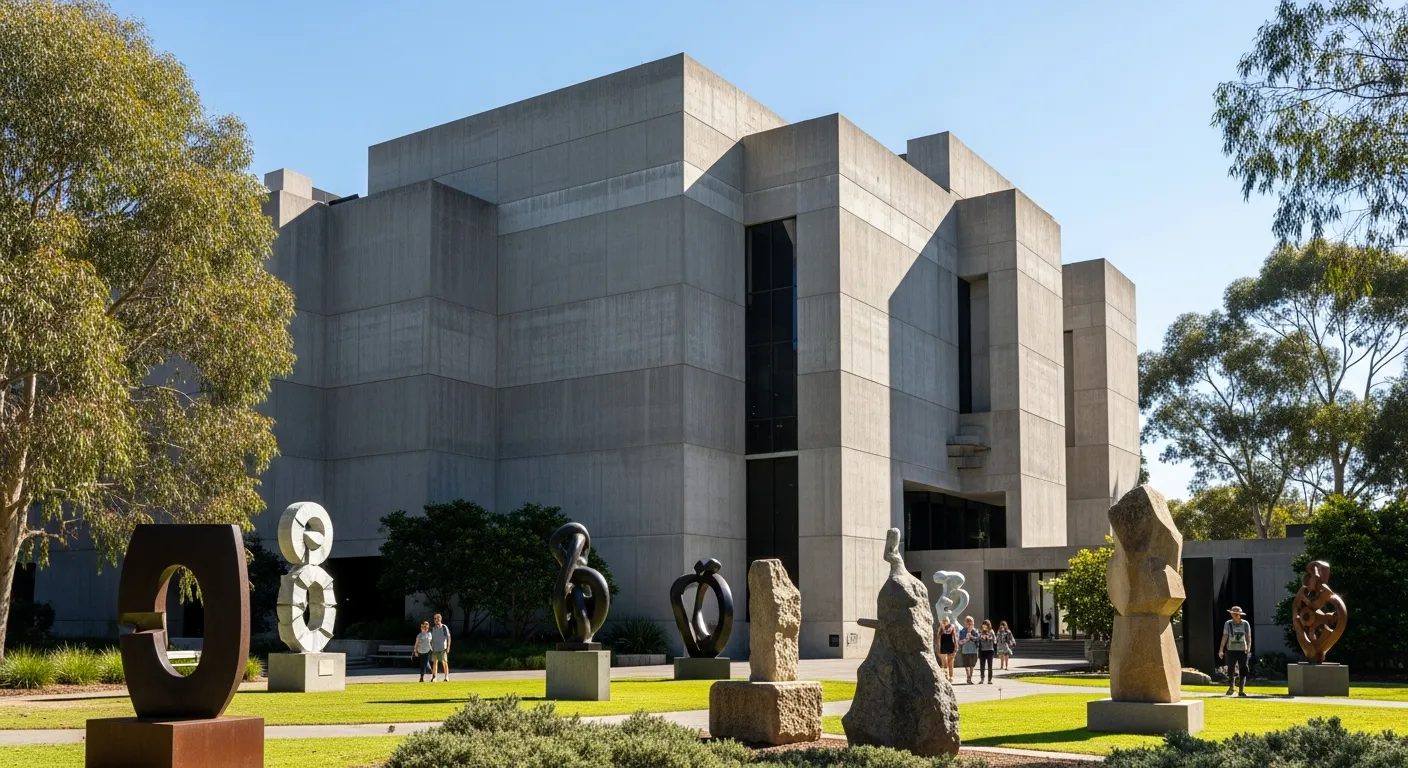
National Gallery of Australia
Canberra · Australia · Founded 1982
Good for: Art Lovers · First-timers · Rainy-day visits
1982
Founded
500,000
Annual Visitors
2–3 hours
Recommended Visit
Art
Museum type
Quick answer
National Gallery of Australia in Canberra, Australia — the National Gallery of Australia, formerly the Australian National Gallery, is the national art museum of Australia. Open Daily: 10:00 AM – 5:00 PM. Admission: ✓ Free admission to the permanent collection. World Museum Guide covers the highlights, getting there, and how long to allow (2–3 hours).
Verified 2026-06-30 against official sources.
About National Gallery of Australia
The National Gallery of Australia, formerly the Australian National Gallery, is the national art museum of Australia. Located in Canberra, the gallery was established in 1967 by the Australian government, opened in 1982, and holds more than 166,000 works of art.
Designed in the late Brutalist style by the architect Colin Madigan, the building was officially opened by Queen Elizabeth II on 12 October 1982. The building is recognized by the Royal Australian Institute of Architects as a building of national significance.
It holds the world's largest collection of Aboriginal and Torres Strait Islander art, with major holdings including the Aboriginal Memorial — 200 hollow log coffins from Central Arnhem Land — and an extensive collection of Western Desert paintings.
International highlights include Jackson Pollock's Blue Poles, one of the most discussed art purchases in Australian history, alongside major works by Monet, Picasso, and Warhol.
2–3 hours highlights route
A focused route through 2 must-see highlights at National Gallery of Australia without museum fatigue. · 2–3 hours
- 1
Blue Poles
📍 International Art, Level 1
Australia's most famous and controversial art purchase — bought for $1.3 million in 1973 (a world record at the time) amid accusations of government extravagance.
- 2
Abstract (Leaf)
📍 Australian Indigenous Art
Kngwarreye began painting at 79 and produced an astonishing body of work in just 8 years.
Masterworks & must-see highlights
The works that define National Gallery of Australia — and why they matter.
Blue Poles
Jackson Pollock · 1952
📍 International Art, Level 1
Australia's most famous and controversial art purchase — bought for $1.3 million in 1973 (a world record at the time) amid accusations of government extravagance. Now valued at over $350 million. Pollock's drip-painting is one of the most important works of Abstract Expressionism outside the United States.
Abstract (Leaf)
Emily Kame Kngwarreye · 1994
📍 Australian Indigenous Art
Kngwarreye began painting at 79 and produced an astonishing body of work in just 8 years. Her large canvases of interlocking dots and lines depicting the ecology of her Utopia homeland in central Australia have been exhibited internationally.
Collections & highlights
- • Blue Poles by Jackson Pollock
- • The Aboriginal Memorial by 43 artists from Ramingining
- • In a Corner on the MacIntyre by Tom Roberts
- • The Skull of a Skeleton with Burning Cigarette by Vincent van Gogh
- • Sidney Nolan's Ned Kelly series
Frequently asked questions
Is the National Gallery of Australia free to visit?
Yes — admission to the National Gallery of Australia's permanent collection is free. Some major touring and special exhibitions carry a separate ticket price (typically A$20–$35). The gallery is open daily 10:00 AM to 5:00 PM and is closed on Christmas Day. Located in Parkes, Canberra, it is easily reached from the city centre; free parking is available on site.
What is Blue Poles by Jackson Pollock and why is it controversial?
Blue Poles (1952) is a large-scale abstract expressionist painting by Jackson Pollock, 212.1 × 488.9 cm, created using his signature drip technique. It was purchased by the Australian government in 1973 for A$1.3 million — then the highest price ever paid for an American painting. The purchase was politically controversial in Australia at the time, with opposition politicians and media attacking it as wasteful public spending. The painting is now valued at over A$350 million and is considered one of the great acquisitions in Australian cultural history.
What is the Aboriginal Memorial at the National Gallery of Australia?
The Aboriginal Memorial (1988) is a monumental collaborative work by 43 artists from the Ramingining community in Central Arnhem Land, created to mark the Australian Bicentenary. It consists of 200 hollow log coffins (dupun), each representing a year of non-indigenous settlement in Australia and honouring the Aboriginal people who died defending their lands during that period. The installation occupies an entire gallery and is considered one of the most significant and moving works in Australian art — the emotional and spiritual heart of the NGA's collection.
What are the highlights of the National Gallery of Australia collection?
Blue Poles (1952) by Jackson Pollock; the Aboriginal Memorial (1988) — 200 hollow log coffins by 43 Arnhem Land artists; Sidney Nolan's Ned Kelly series (1946–47) — 27 paintings depicting the bush outlaw's legend; In a Corner on the MacIntyre (1895) by Tom Roberts; The Skull of a Skeleton with Burning Cigarette (1885) by Van Gogh; and a superb Asian art collection, particularly strong in Japanese, Indian, and Southeast Asian works. The international collection includes works by Monet, Picasso, Warhol, and Bacon.
How long does a visit to the National Gallery of Australia take?
The NGA has 11 galleries across a brutalist concrete building designed by Colin Madigan (1982), expanded by a new wing. The permanent collection alone covers Australian art (colonial to contemporary), Aboriginal and Torres Strait Islander art, Asian art, and international art. A focused visit to the highlights — Aboriginal Memorial, Nolan's Kelly series, Blue Poles, and the international galleries — takes 2–3 hours. A thorough visit takes a full day. The Sculpture Garden on the lake shore is free and worth exploring.
How long should I spend at National Gallery of Australia?
Plan 2–3 hours for the highlights. Add time for temporary exhibitions, the museum shop, and café.
World Animal Rescue Network
Adopt a pangolin symbolically
Pangolins are the world's most trafficked mammals. A symbolic adoption gift funds confiscation response and specialist rehabilitation. Please consider a donation to support this work.
Enjoying our free guides? Support World Museum Guide — optional, and every guide stays free.