Wildlife Photographer of the Year 2026
This exhibition has endedThe annual competition's 100 winning images — always the museum's most popular ticketed show.
240 museums across 48 countries
London · United Kingdom · Founded 1881
Good for: Families · First-timers · Science enthusiasts
1881
Building Opened
80 million+
Specimens
2–3 hours
Recommended Visit
Natural History Museum in London, United Kingdom — alfred Waterhouse's Romanesque-revival building opened in 1881 to display the natural-history collections that had outgrown the British Museum. Open Daily: 10:00 AM – 5:50 PM. Admission: ✓ Free standard admission. World Museum Guide covers the highlights, getting there, and how long to allow (2–3 hours).
Verified 2026-06-30 against official sources.
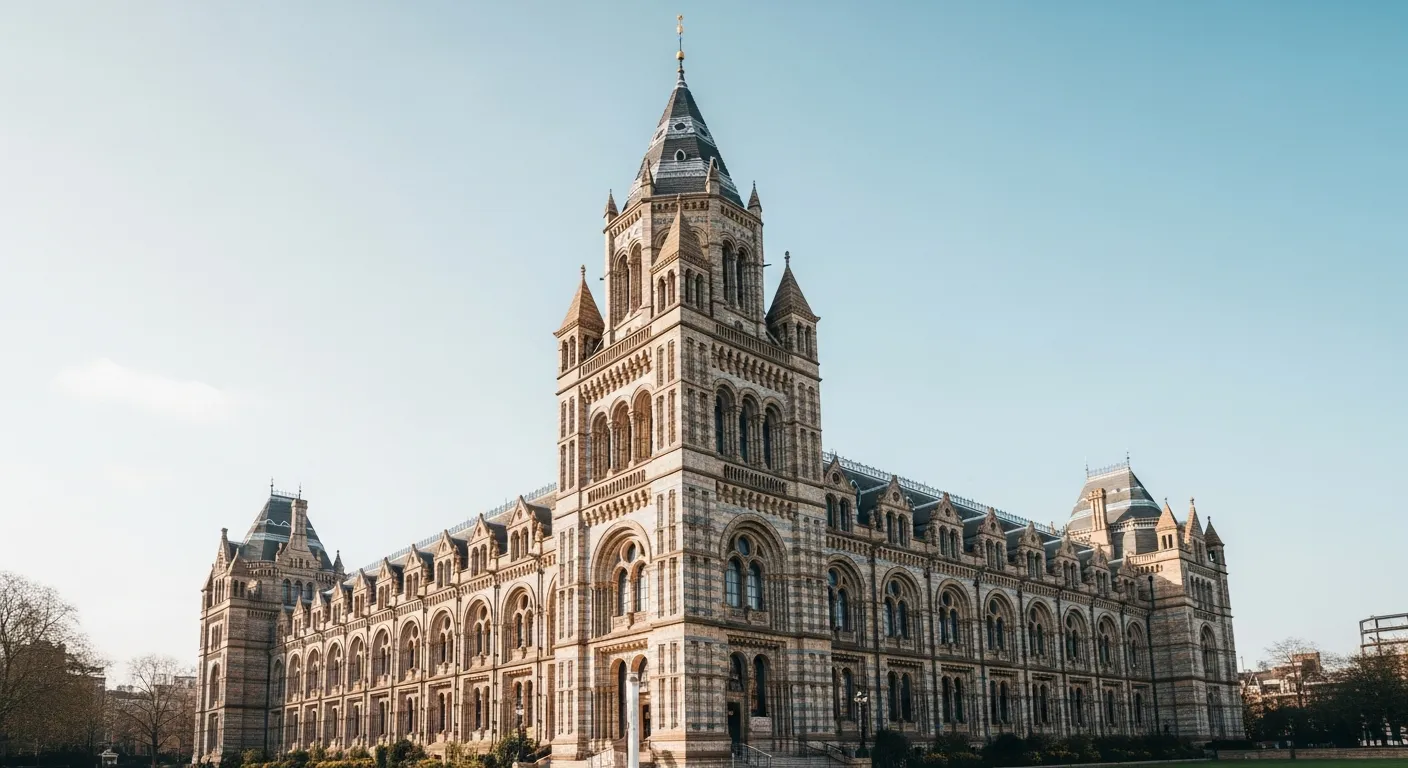
The Natural History Museum in South Kensington is one of the world's great natural history museums — housed in Alfred Waterhouse's 1881 Romanesque cathedral to nature on Cromwell Road. Over 80 million specimens span botany, entomology, mineralogy, palaeontology, and zoology.
Hope the blue whale skeleton dives through the Hintze Hall ceiling — replacing Dippy the diplodocus in 2017 as the museum's centrepiece. The dinosaur gallery with its animatronic T. rex remains the most popular destination for families.
The Darwin Centre's Cocoon building holds millions of specimens behind glass walls. Admission is free to the permanent galleries — the museum is among London's most visited attractions.
The museum sits beside the Victoria and Albert Museum and Science Museum — South Kensington's museum triangle.
Updated June 2026. Confirm dates and tickets on the official Natural History Museum website.
No listed exhibitions are currently running — check the official website for the latest programme.
The annual competition's 100 winning images — always the museum's most popular ticketed show.
The Natural History Museum in South Kensington occupies a cathedral-like Romanesque building completed in 1881, with terracotta fauna sculptures cladding Alfred Waterhouse's design. Free entry makes it one of London's most visited family destinations alongside the Science Museum next door. Hintze Hall's suspended blue whale skeleton, renamed Hope, greets visitors replacing the iconic Diplodocus cast. Exhibition Road shared space with Science Museum and V&A creates a pedestrian-friendly museum quarter in South Kensington. Winter ice rink outside the museum operates seasonally on the east lawn facing Cromwell Road. Darwin Centre spirit collection tours book separately and show millions of specimens in jars behind scenes. Alfred Waterhouse Romanesque terracotta facade on Cromwell Road displays carved fauna and flora that preview collections before entering Hintze Hall. Cromwell Road main entrance queues less than Exhibition Road side entrance during school holiday peak periods.
School holidays transform galleries into crowded but joyful spaces; term-time weekday mornings suit quieter dinosaur viewing. Timed entry reservations during peak periods may apply, so check the website before traveling. The Darwin Centre's Cocoon building offers behind-glass views of scientists at work for interested adults. Red Zone escalator through Earth Hall delivers dramatic geology narrative before dinosaur galleries. Wildlife Garden behind the museum opens spring through autumn with native British habitat trails. Sensory-friendly early openings occur monthly for neurodiverse visitors and families needing quieter environments. Exhibition Road shared pedestrian space links the Natural History Museum to the Science Museum and V&A within five minutes on foot. Seasonal ice rink on the east lawn operates winter months and draws families independent of gallery admission.
South Kensington Tube places the museum within minutes of Hyde Park and the V&A. Cloakrooms handle strollers and coats during wet weather. Plan two to three hours for dinosaurs and Hintze Hall, longer if adding minerals, mammals, and earthquake simulator experiences. Exhibition Road shared space with Science Museum and V&A creates a pedestrian-friendly museum quarter in South Kensington. Winter ice rink outside the museum operates seasonally on the east lawn facing Cromwell Road. Darwin Centre spirit collection tours book separately and show millions of specimens in jars behind scenes. Red Zone escalator through Earth Hall delivers dramatic geology narrative before dinosaur galleries. Hope the blue whale skeleton replaced Dippy the diplodocus cast in Hintze Hall in 2017, reorienting the central nave toward ocean conservation. Sensory-friendly early openings monthly accommodate neurodiverse visitors needing quieter dinosaur gallery experiences.
The museum houses eighty million specimens supporting global research on extinction, climate, and evolution. Dinosaur galleries combine original fossils with animatronic models engaging younger visitors without sacrificing scientific accuracy. The mineral gallery's gemstones and meteorites dazzle visually while explaining crystallography. Wildlife Garden behind the museum opens spring through autumn with native British habitat trails. Sensory-friendly early openings occur monthly for neurodiverse visitors and families needing quieter environments. Darwin Centre Cocoon building offers behind-glass views of scientists working among millions of spirit specimens stored for research. Darwin Centre spirit collection tours book separately and show millions of specimens preserved for research.
Human evolution and mammal halls document biodiversity with taxidermy specimens collected during Victorian expeditions, now interpreted with colonial context. The Wildlife Photographer of the Year exhibition, annual and ticketed, draws photography enthusiasts each autumn. Citizen science programs invite public participation in biodiversity recording. Red Zone Earth Hall escalator delivers dramatic geology narrative before visitors reach dinosaur galleries in the Blue Zone beyond. Wildlife Garden behind the museum opens spring through autumn with native British habitat interpretation trails.
Earthquake House simulator in the Red Zone delivers brief seismic experience popular with children. Blue Zone ocean and marine life galleries complement Hintze Hall's terrestrial focus. The museum's data portal publishes specimen records supporting worldwide ecological research. Wildlife Photographer of the Year exhibition each autumn draws photography enthusiasts with ticketed displays in the Jerwood Gallery space. Red Zone volcano and earthquake simulator delivers brief immersive experience popular with school groups.
Hintze Hall blue whale replaced Dippy the diplodocus as the greeting spectacle — arrive at 10 AM opening when school groups have not yet filled the hall. The Darwin Centre cocoon behind the main building offers behind-the-scenes collection tours booked separately online.
Combine with Victoria and Albert Museum next door via shared underground passage — V&A is free and offers contrasting decorative arts after natural history. Science Museum third in the trio completes a full South Kensington day for families.
Wildlife Photographer of the Year runs annually October through June and requires a separate ticket — book when purchasing general admission if visiting during exhibition season. Dinosaur gallery animatronic T. rex remains the most popular room with children under ten.
Earth Hall geology displays and the escalator through a planet Earth model provide vertical circulation between floors while teaching plate tectonics — a memorable transition between dinosaur galleries and mammal halls upstairs.
Human Biology gallery on the upper floor presents interactive body systems popular with GCSE school groups — visit after 2 PM when morning field trips depart for quieter access to touch-screen exhibits.
Cromwell Road main entrance queues exceed Exhibition Road side door wait times on weekends — enter via Queen's Gate or Exhibition Road when Hintze Hall blue whale is your first destination.
Member mornings on first Sunday of each month offer quieter Hintze Hall photography before general admission opens — membership pays for itself in one crowded school-holiday visit avoided.
Focused routes for Natural History Museum — pick one wing per visit to avoid museum fatigue.
The central hall soars seventy meters to a vaulted ceiling, with Hope the blue whale diving overhead since 2017. Historic marble statues of Darwin and Owen line balconies above the main floor. Hintze Hall vaulted ceiling rises seventy meters with Hope the blue whale diving posture as the unmissable first impression upon entry.
Moving T. rex animatronic and extensive fossil mounts trace dinosaur evolution through the Mesozoic. The gallery's one-way flow can bottleneck at the tyrannosaur encounter. T. rex animatronic in Blue Zone dinosaur gallery moves and vocalizes, making Mesozoic ecology tangible for children and adults alike.
The Human Biology and Mammals halls present primate evolution, hominin fossils, and comparative anatomy. Taxidermy dioramas show African savanna ecosystems with historical collection labels updated. Human Biology gallery traces primate evolution with hominin fossil casts alongside interactive displays explaining genetic evidence for migration.
A focused route through 4 must-see highlights at Natural History Museum without museum fatigue. · 2–3 hours
📍 Hintze Hall, central atrium
An 82-foot blue whale skeleton diving through the Hintze Hall ceiling — suspended since 2017 as the museum's iconic centrepiece, replacing Dippy the diplodocus.
📍 Dinosaurs gallery, Blue Zone
An animatronic Tyrannosaurus rex that moves and roars — the climax of the dinosaur gallery and the museum's most thrilling experience for children.
📍 Fossils gallery
A cast of the Berlin Archaeopteryx — the transitional fossil linking dinosaurs and birds — among the museum's most scientifically important displays.
📍 Entire museum
Romanesque Revival architecture with terracotta animals and plants moulded into every surface — a cathedral to nature that is itself a masterpiece.
The works that define Natural History Museum — and why they matter.
Natural history · 1891 specimen
📍 Hintze Hall, central atrium
An 82-foot blue whale skeleton diving through the Hintze Hall ceiling — suspended since 2017 as the museum's iconic centrepiece, replacing Dippy the diplodocus.
Palaeontology display · permanent
📍 Dinosaurs gallery, Blue Zone
An animatronic Tyrannosaurus rex that moves and roars — the climax of the dinosaur gallery and the museum's most thrilling experience for children.
Natural history · Jurassic
📍 Fossils gallery
A cast of the Berlin Archaeopteryx — the transitional fossil linking dinosaurs and birds — among the museum's most scientifically important displays.
Alfred Waterhouse · 1881
📍 Entire museum
Romanesque Revival architecture with terracotta animals and plants moulded into every surface — a cathedral to nature that is itself a masterpiece.
Free timed tickets are recommended during peak periods.
Yes, the dinosaur gallery is one of the most popular sections of the museum.
Plan 2–3 hours for the highlights. Emotionally intense history museums reward unhurried visits — allow longer if reading extensively.
Alfred Waterhouse's Romanesque-revival building opened in 1881 to display the natural-history collections that had outgrown the British Museum. The terracotta facade is decorated with sculptures of living and extinct species. Key highlights include Hope the blue whale skeleton, Dinosaur gallery, Mineral and meteorite collection.
✓ Free standard admission Tickets are usually available on the day, but booking online saves queue time in peak season. Official site: https://www.nhm.ac.uk/
Dippy left Hintze Hall in 2017 and toured the UK. Hope the blue whale replaced Dippy as the central specimen. Dippy may return for temporary displays — check the museum website.
Yes — though the animatronic T. rex can frighten very young children. The gallery is the museum's most popular space; visit at opening to avoid longest queues.
Yes — permanent galleries are free with no ticket required. Special exhibitions (Wildlife Photographer of the Year, etc.) require paid tickets.
World Animal Rescue Network
Pangolins are the world's most trafficked mammals. A symbolic adoption gift funds confiscation response and specialist rehabilitation. Please consider a donation to support this work.
Enjoying our free guides? Support World Museum Guide — optional, and every guide stays free.