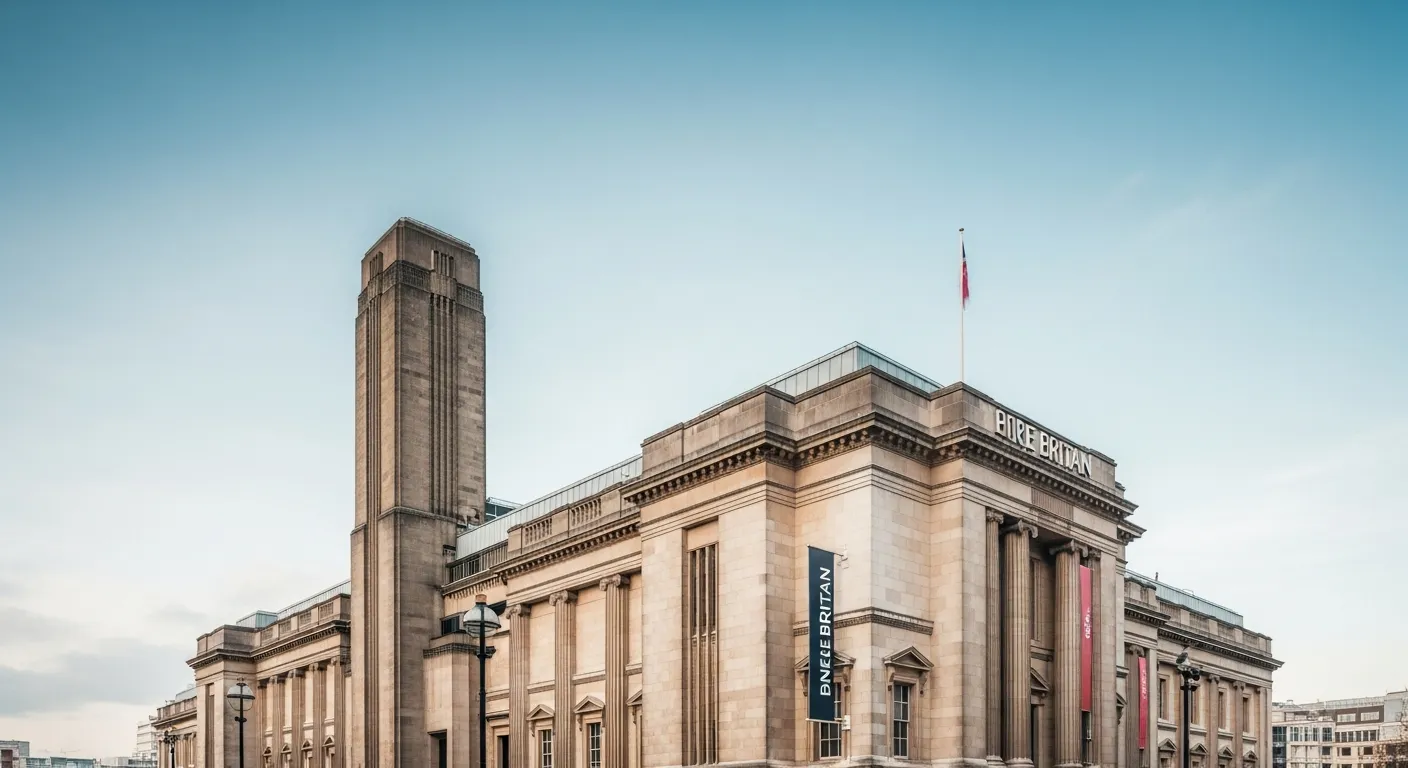
Tate Britain
London · United Kingdom · Founded 1897
Good for: Art Lovers · First-timers · History Enthusiasts
1897
Founded
Free
Permanent Collection
2–3 hours
Recommended Visit
Quick answer
Tate Britain in London, United Kingdom — founded by sugar magnate Henry Tate in 1897 as the National Gallery of British Art, the building was rechristened Tate Britain in 2000 when the modern collection moved across the river. Open Daily: 10:00 AM – 6:00 PM. Admission: ✓ Free standard admission. World Museum Guide covers the highlights, getting there, and how long to allow (2–3 hours).
Verified 2026-06-30 against official sources.
About Tate Britain
Tate Britain on Millbank is the national gallery of British art from 1500 to the present day. Founded in 1897 by the sugar magnate Henry Tate, it was originally the National Gallery of British Art before being rechristened Tate Britain in 2000 when the modern international collection moved to Tate Modern across the Thames.
The Clore Gallery — designed by James Stirling and opened in 1987 — houses the Turner Bequest: over 300 paintings and 30,000 watercolours by J.M.W. Turner, the most extensive collection of any single artist in any British museum. Turner's luminous seascapes and atmospheric landscapes fill dedicated rooms.
The permanent collection is entirely free and includes masterpieces from every era of British art: Hogarth's satirical narratives, Constable's Suffolk landscapes, the Pre-Raphaelites (Millais's Ophelia, Waterhouse's Lady of Shalott), Francis Bacon's screaming popes, and contemporary works by Hockney, Emin, and Ofili.
Tate Britain hosts the Turner Prize — the most prestigious (and controversial) award in British contemporary art — in alternate years. The Duveen Galleries commission large-scale installations in the building's neoclassical sculpture halls.
2–3 hours highlights route
A focused route through 5 must-see highlights at Tate Britain without museum fatigue. · 2–3 hours
- 1
Ophelia
📍 Walk Through British Art, Room 1840
Millais painted the drowning Ophelia in meticulous detail — the flowers floating on the water are botanically accurate.
- 2
The Lady of Shalott
📍 Walk Through British Art, Room 1890
Waterhouse's depiction of Tennyson's cursed weaver drifting toward Camelot — one of the most popular paintings in any British museum, combining Pre-Raphaelite narrative with Aesthetic Movement beauty.
- 3
Norham Castle, Sunrise
📍 Clore Gallery, Turner Bequest
One of Turner's late 'unfinished' paintings — a luminous vision of a Northumberland castle dissolving in golden light.
- 4
Three Studies for Figures at the Base of a Crucifixion
📍 Walk Through British Art, Room 1940
Bacon's screaming biomorphic figures — painted during the war and exhibited in 1945, shocking the British art world and establishing Bacon as the dominant British painter of the post-war era.
- 5
The Cholmondeley Ladies
📍 Walk Through British Art, Room 1600
Twin sisters in identical dresses holding their babies — a mysterious double portrait whose inscription records they were born on the same day, married on the same day, and gave birth on the same day.
Masterworks & must-see highlights
The works that define Tate Britain — and why they matter.
Ophelia
Sir John Everett Millais · 1851–1852
📍 Walk Through British Art, Room 1840
Millais painted the drowning Ophelia in meticulous detail — the flowers floating on the water are botanically accurate. Elizabeth Siddal posed in a bath for hours, catching cold. A defining Pre-Raphaelite image.
The Lady of Shalott
John William Waterhouse · 1888
📍 Walk Through British Art, Room 1890
Waterhouse's depiction of Tennyson's cursed weaver drifting toward Camelot — one of the most popular paintings in any British museum, combining Pre-Raphaelite narrative with Aesthetic Movement beauty.
Norham Castle, Sunrise
J.M.W. Turner · c. 1845
📍 Clore Gallery, Turner Bequest
One of Turner's late 'unfinished' paintings — a luminous vision of a Northumberland castle dissolving in golden light. The Clore Gallery holds the world's greatest Turner collection.
Three Studies for Figures at the Base of a Crucifixion
Francis Bacon · 1944
📍 Walk Through British Art, Room 1940
Bacon's screaming biomorphic figures — painted during the war and exhibited in 1945, shocking the British art world and establishing Bacon as the dominant British painter of the post-war era.
The Cholmondeley Ladies
Unknown English artist · c. 1600–1610
📍 Walk Through British Art, Room 1600
Twin sisters in identical dresses holding their babies — a mysterious double portrait whose inscription records they were born on the same day, married on the same day, and gave birth on the same day.
Collections & highlights
- • Turner Bequest — 300 paintings in the Clore Gallery
- • Pre-Raphaelites — Millais, Rossetti, Waterhouse
- • Hogarth and eighteenth-century satirical art
- • Constable and English landscape tradition
- • Francis Bacon and post-war British painting
- • Contemporary British art — Hockney, Emin, Ofili
- • Walk Through British Art — chronological hang
- • Duveen Galleries commissions
Frequently asked questions
Is there a boat between Tate Britain and Tate Modern?
Yes, the Tate-to-Tate boat shuttles regularly along the Thames.
Where are the Turners shown?
The Clore Gallery, designed by James Stirling, holds the Turner Bequest.
How long should I spend at Tate Britain?
Plan 2–3 hours for the highlights. Add time for temporary exhibitions, the museum shop, and café.
What is Tate Britain best known for?
Founded by sugar magnate Henry Tate in 1897 as the National Gallery of British Art, the building was rechristened Tate Britain in 2000 when the modern collection moved across the river. Key highlights include Turner Bequest — 300 paintings in the Clore Gallery, Pre-Raphaelites — Millais, Rossetti, Waterhouse, Hogarth and eighteenth-century satirical art.
How do I get tickets for Tate Britain?
✓ Free standard admission Tickets are usually available on the day, but booking online saves queue time in peak season. Official site: https://www.tate.org.uk/visit/tate-britain
How does Tate Britain differ from Tate Modern?
Tate Britain holds British art from 1500 to today — Turner, Constable, the Pre-Raphaelites, Bacon, Hockney. Tate Modern, across the river, holds international modern and contemporary art from 1900 onwards — Picasso, Warhol, Bourgeois. Both are free. The Tate-to-Tate boat connects them.
Where are the Turners?
The Clore Gallery on the lower level houses the Turner Bequest — over 300 paintings and thousands of watercolours. Stirling's postmodern architecture creates intimate rooms for Turner's luminous late works. It is the highlight of any Tate Britain visit.
Is the Turner Prize always at Tate Britain?
The Turner Prize alternates between Tate Britain and other UK venues. When at Tate Britain, shortlisted works are displayed in autumn (October–January). Check tate.org.uk for the current venue and dates.
World Animal Rescue Network
Adopt a macaw symbolically
Macaws and other parrots face relentless illegal trade. Symbolic adoption supports rescue, rehabilitation, and release programmes. Please consider a donation to support this work.
Enjoying our free guides? Support World Museum Guide — optional, and every guide stays free.