Irises
Vincent van Gogh · 1889
Oil on canvas
Quick answer
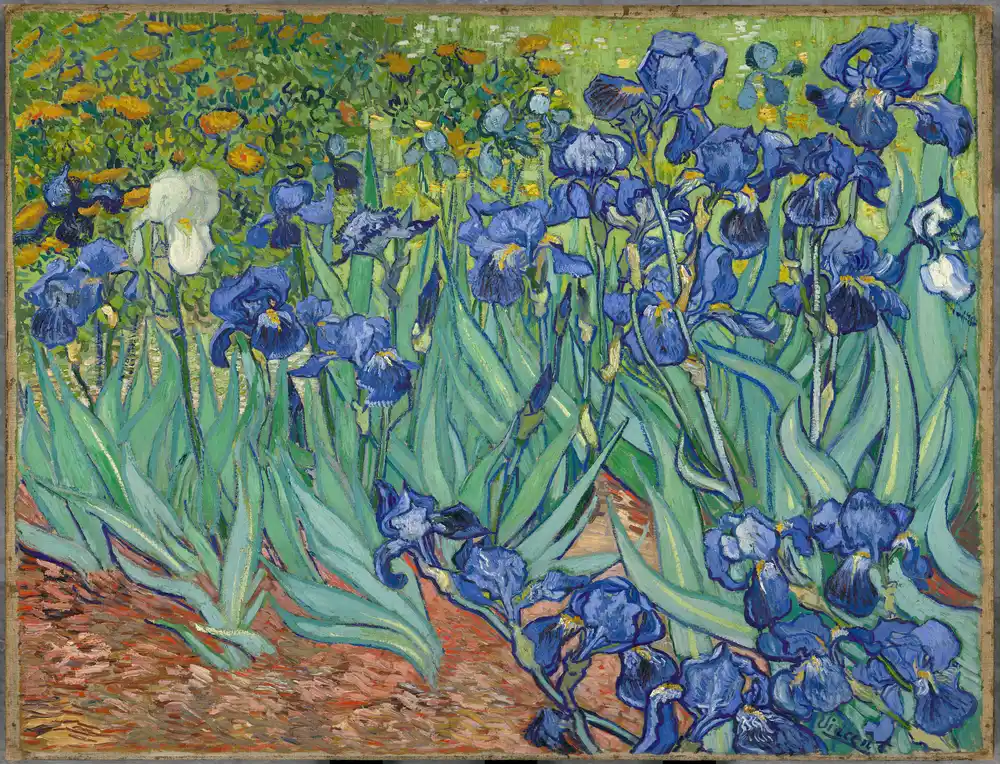
Irises (1889) by Vincent van Gogh is in The J. Paul Getty Museum, Los Angeles. Irises is an oil painting by Dutch artist Vincent van Gogh, created in May 1889 in the gardens of the Saint-Paul-de-Mausole asylum in Saint-Rémy-de-Provence, France — one week after he voluntarily committed himself. It depicts a mass of blue iris flowers against an orange soil background. In 1987 it sold at Sotheby's New York for $53.9 million — at the time the most expensive painting ever sold at auction. It is now in the collection of the J. Paul Getty Museum in Los Angeles. World Museum Guide explains what you're looking at and how to see it.
Frequently asked questions
Where is Van Gogh's Irises?
Irises is in the permanent collection of the J. Paul Getty Museum at the Getty Center, Los Angeles, California. Admission to the Getty is free (parking fees apply). The museum is at 1200 Getty Center Drive, Los Angeles. The painting is in the West Pavilion, usually in Gallery W204.
How much did Irises sell for?
Irises sold at Sotheby's New York on 11 November 1987 for $53.9 million (including buyer's premium) — a world auction record at the time, quickly surpassed by other sales in the same auction season. The buyer, Australian businessman Alan Bond, financed the purchase partly through a loan from Sotheby's itself — a practice that later led to regulatory changes preventing auction houses from financing purchases.
When did Van Gogh paint Irises?
Van Gogh painted Irises in May 1889 — within the first week of his voluntary admission to the Saint-Paul-de-Mausole psychiatric asylum in Saint-Rémy-de-Provence. He immediately set to work in the asylum garden, finding painting therapeutic. He wrote to his brother Theo that the act of painting was his best defence against the mental crises that had brought him to the asylum.
What is the white iris in Van Gogh's Irises?
On the left edge of the painting, among the predominantly blue-purple irises, one white iris is visible. Art historians have debated whether this was a real anomalous bloom that Van Gogh found in the garden, or a deliberate compositional device — an exception that highlights the uniformity of the rest, or a symbolic element (purity, difference). Van Gogh did not explain it in his letters.
Why are Van Gogh's irises blue and not purple?
Van Gogh used a red pigment called Red Lake to mix the violet-purple colour of the irises, but Red Lake is famously unstable and fades over time. Scientific analysis has shown that Van Gogh's irises were originally a more vivid reddish-violet or purple; they have faded to blue over the past 135 years due to pigment degradation. The same effect has altered the colours of several other Van Gogh paintings.