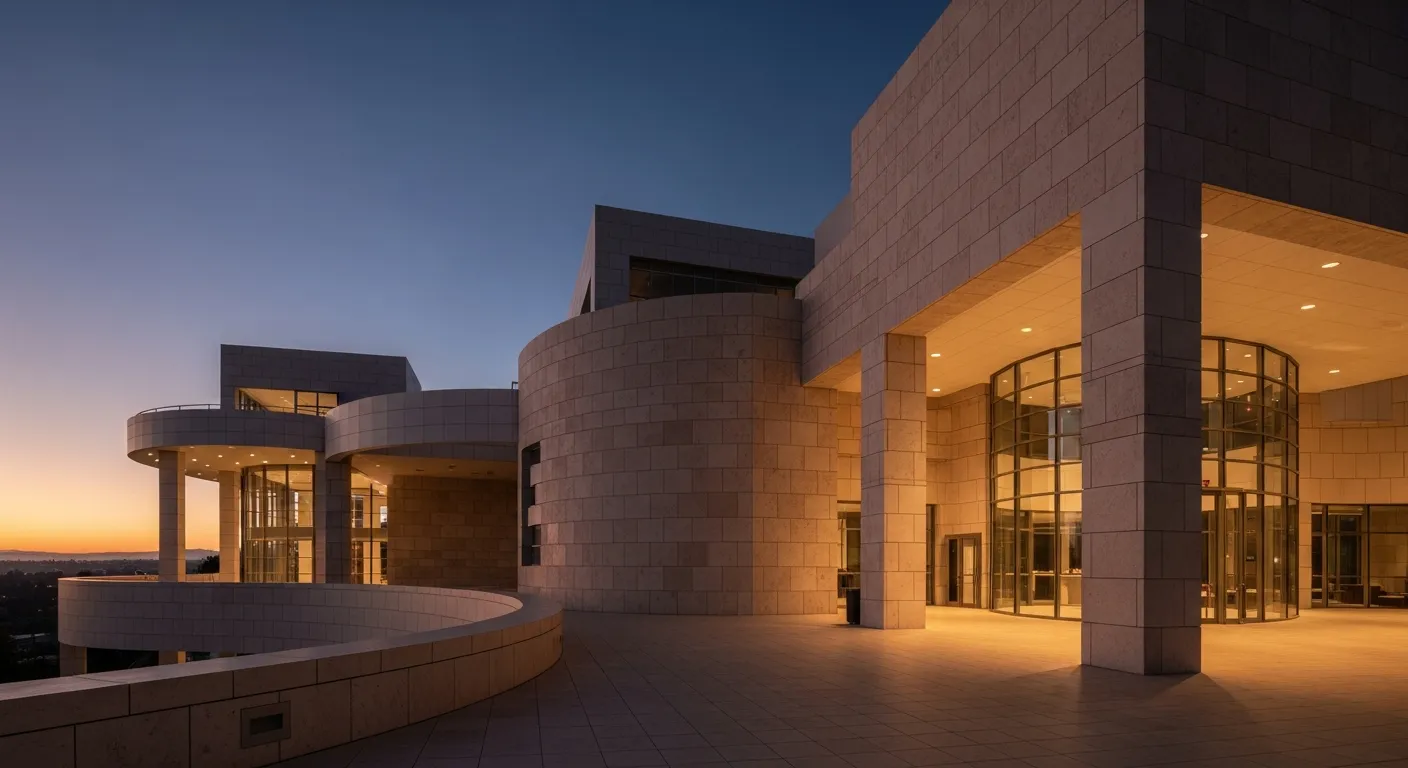
The J. Paul Getty Museum
Los Angeles · United States · Founded 1954
Good for: Art Lovers · First-timers · Rainy-day visits
1954
Founded
1.8 million
Annual Visitors
2–4 hours
Recommended Visit
Art
Museum type
Quick answer
The J. Paul Getty Museum in Los Angeles, United States — the J. Open Tuesday to Sunday: 10:00 AM – 5:30 PM (Closed Mondays). Admission: ✓ Free admission, parking is $20. Book timed-entry tickets ahead in peak season. World Museum Guide covers the highlights, getting there, and how long to allow (2–4 hours).
Verified 2026-06-30 against official sources.
About The J. Paul Getty Museum
The J. Paul Getty Museum, commonly referred to as the Getty, is an art museum in California housed on two campuses: the Getty Center and Getty Villa. The primary location is the Getty Center in the Brentwood neighborhood of Los Angeles, which features pre-20th-century European paintings, drawings, illuminated manuscripts, sculpture, and decorative arts.
The museum's second location, the Getty Villa, is in the Pacific Palisades neighborhood and displays art from Ancient Greece, Rome, and Etruria.
Established through the trust of oilman J. Paul Getty, the museum is renowned not only for its extensive collections but also for the striking architecture of its campuses and panoramic views of Los Angeles.
The museum has an extensive program of temporary exhibitions, educational initiatives, and ongoing research into art history and conservation.
2–4 hours highlights route
A focused route through 3 must-see highlights at The J. Paul Getty Museum without museum fatigue. · 2–4 hours
- 1
Irises
📍 West Pavilion
Painted in the garden of the Saint-Paul-de-Mausole asylum a week after Van Gogh admitted himself.
- 2
Abduction of Europa
📍 West Pavilion
A small but intensely coloured early Rembrandt — Zeus in the form of a white bull carrying Europa across the sea as her companions reach helplessly from the shore.
- 3
The Penitent Magdalene
📍 South Pavilion
A woman contemplates a skull by candlelight in de La Tour's characteristic chiaroscuro.
Masterworks & must-see highlights
The works that define The J. Paul Getty Museum — and why they matter.
Irises
Vincent van Gogh · 1889
📍 West Pavilion
Painted in the garden of the Saint-Paul-de-Mausole asylum a week after Van Gogh admitted himself. The swirling blue irises became one of the most expensive paintings in the world when sold for $53.9 million in 1987.
Abduction of Europa
Rembrandt van Rijn · 1632
📍 West Pavilion
A small but intensely coloured early Rembrandt — Zeus in the form of a white bull carrying Europa across the sea as her companions reach helplessly from the shore.
The Penitent Magdalene
Georges de La Tour · c. 1640
📍 South Pavilion
A woman contemplates a skull by candlelight in de La Tour's characteristic chiaroscuro. The identification of the sitter as Mary Magdalene remains debated; the work's meditative power is not.
Collections & highlights
- • Irises by Vincent van Gogh
- • The Abduction of Europa by Rembrandt
- • Getty Center Architecture
- • Central Garden
- • Illuminated manuscripts collection
Famous works in our collection guide
Frequently asked questions
Is the Getty Museum free to visit?
Yes — admission to the J. Paul Getty Museum is free. However, parking costs $20 per vehicle (cash or credit card accepted). Timed-entry reservations are strongly recommended on weekends and during school holidays and are free to book on the Getty website (getty.edu). Visitors who arrive by public bus (Line 761 from UCLA) receive free parking validation and no reservation is required. The Getty Villa in Pacific Palisades also has free admission but requires a separate reservation.
What is the difference between the Getty Center and the Getty Villa?
The Getty Center in Brentwood, Los Angeles, is the main campus, housing pre-20th-century European paintings, drawings, illuminated manuscripts, sculpture, and decorative arts. The Richard Meier-designed complex also features spectacular gardens and city views. The Getty Villa in Pacific Palisades is a separate campus inspired by a 1st-century Roman villa and displays antiquities from ancient Greece, Rome, and Etruria. Both are free; both require timed-entry reservations. They are about 12 miles apart — plan a separate visit for each.
What are the must-see works at the Getty Center?
Irises (1889) by Vincent van Gogh — the painting sold for $53.9 million in 1987, then a world auction record; The Abduction of Europa (c. 1632) by Rembrandt; Young Woman Combing Her Hair (c. 1894) by Edgar Degas; the Cabinet on Stand — an extraordinary piece of Baroque French furniture; and the entire collection of illuminated manuscripts, which is one of the finest in the world. The Central Garden, designed by Robert Irwin, is also essential and is free to all visitors.
Who was J. Paul Getty?
Jean Paul Getty (1892–1976) was an American oil magnate considered one of the wealthiest private individuals of the 20th century. He began collecting art seriously in the 1930s, focusing on European Old Masters, French decorative arts, and Greek and Roman antiquities. He founded the J. Paul Getty Museum at his Malibu villa in 1954. Upon his death, his estate — then valued at over $700 million — passed to the Getty Trust, transforming it into one of the wealthiest arts organisations in the world.
Do I need to book tickets to the Getty Center in advance?
Timed-entry reservations are strongly recommended, particularly on weekends, and are free through the Getty website. Walk-in entry is sometimes available, especially on weekdays or in the afternoon. Parking reservations are separate and also recommended during busy periods. The Getty Center is open Tuesday to Sunday, 10:00 AM to 5:30 PM, and is closed on Mondays.
How long should I spend at The J. Paul Getty Museum?
Plan 2–4 hours for the highlights. Add time for temporary exhibitions, the museum shop, and café.
World Animal Rescue Network
Adopt a sea turtle symbolically
Sea turtles depend on safe nesting beaches worldwide. Symbolic adoption funds nest protection, hatchling release, and anti-poaching patrols. Please consider a donation to support this work.
Enjoying our free guides? Support World Museum Guide — optional, and every guide stays free.