Les Demoiselles d'Avignon
Pablo Picasso · 1907
Oil on canvas
Quick answer
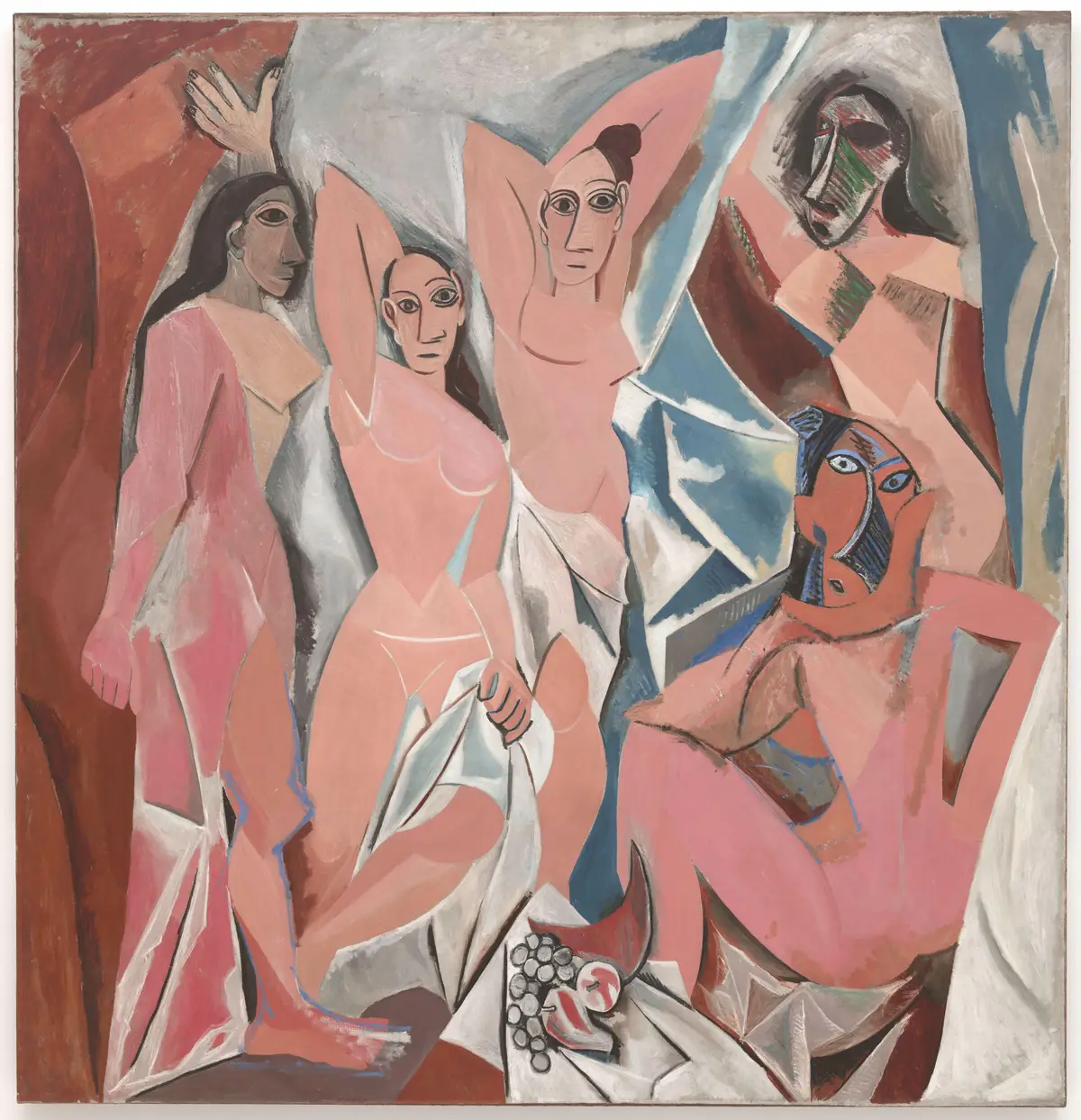
Les Demoiselles d'Avignon (1907) by Pablo Picasso is in Museum of Modern Art (MoMA), New York City. Les Demoiselles d'Avignon is an oil painting by Spanish artist Pablo Picasso, created in 1907. It depicts five naked women, three with Iberian-style faces (left) and two with African mask-like faces (right), against a background of angular blue and brown planes. The painting broke completely with Western pictorial tradition and is considered the founding work of Cubism. It is held in the permanent collection of the Museum of Modern Art (MoMA) in New York City. World Museum Guide explains what you're looking at and how to see it.
Frequently asked questions
What does Les Demoiselles d'Avignon depict?
The painting depicts five naked women. Three on the left have angular faces influenced by ancient Iberian stone masks. Two on the right have mask-like faces influenced by African sculpture that Picasso had encountered at the Trocadéro ethnographic museum in Paris. The title refers to a brothel on Carrer d'Avinyó in Barcelona. The women confront the viewer directly rather than posing for the viewer's pleasure.
Why is Les Demoiselles d'Avignon so important?
Les Demoiselles d'Avignon is considered the founding work of Cubism and the most radical single break in the history of Western painting since the Renaissance. It abandoned perspective, idealised human form, unified viewpoint, and every other convention that had governed painting for 500 years. Without it, Cubism — and the entire trajectory of 20th-century abstract art — is difficult to imagine.
Where is Les Demoiselles d'Avignon?
The painting is in the permanent collection of the Museum of Modern Art (MoMA) in New York City, displayed in Gallery 501 on the fifth floor. MoMA acquired it in 1939 from the estate of Paris fashion designer Jacques Doucet for approximately $24,000.
What is the African influence in Les Demoiselles d'Avignon?
In the spring of 1907, Picasso visited the Trocadéro ethnographic museum in Paris and was profoundly affected by the African masks and objects there. He later said: 'The masks were not just sculptures like the rest. Not at all. They were magic things... intercessors against everything.' He went home and repainted the two figures on the right of the canvas with distorted, mask-like faces influenced by this encounter.
Why is it called Les Demoiselles d'Avignon?
The title was not chosen by Picasso — it was given by his friend, the poet André Salmon, apparently as a jest. 'Les Demoiselles' means 'the young ladies' or 'the misses' — a politely ironic term for the women in a Barcelona brothel on Carrer d'Avinyó (Avignon Street). Picasso called it 'my bordello painting' and 'the philosophical brothel.' He may have found Salmon's euphemistic title amusing.