Olympia
Édouard Manet · 1863
Oil on canvas
Quick answer
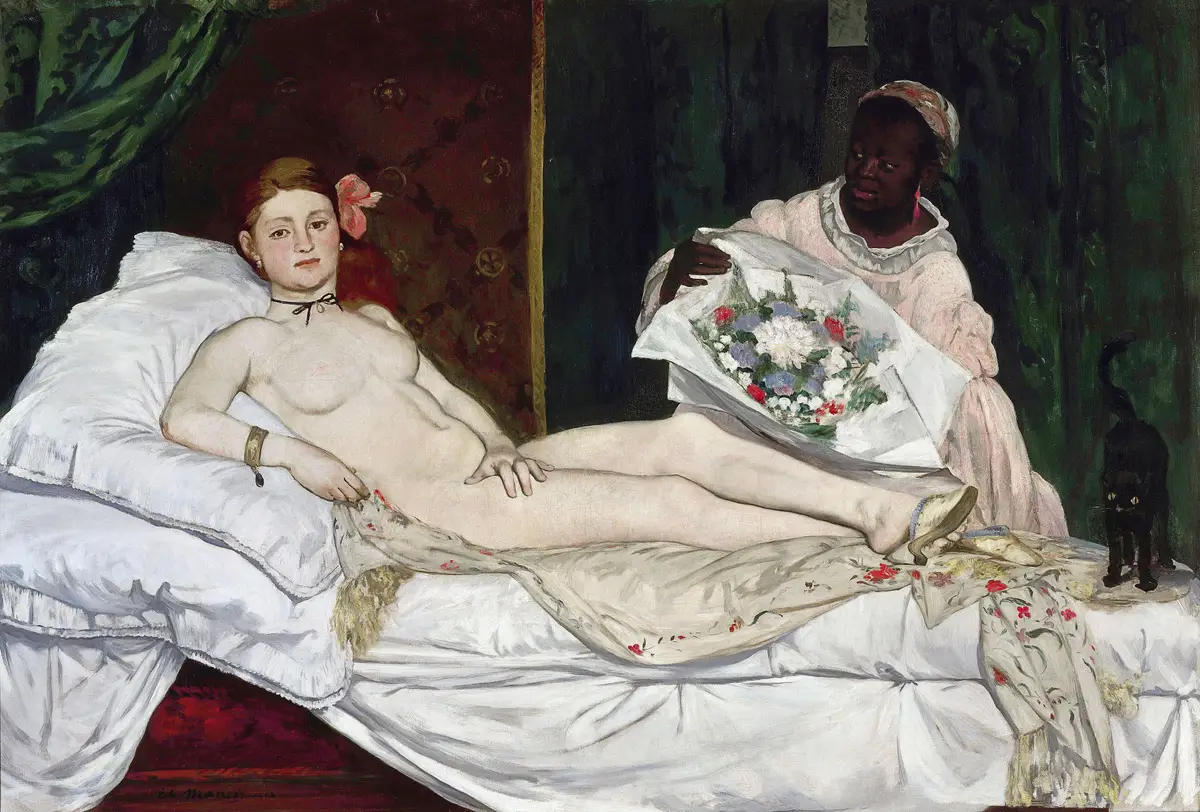
Olympia (1863) by Édouard Manet is in Musée d'Orsay, Paris. Olympia is an oil painting by French artist Édouard Manet, created in 1863 and exhibited at the Paris Salon of 1865, where it caused enormous scandal. It depicts a nude woman reclining on a bed, attended by a Black maidservant who holds a bouquet of flowers. The woman — modelled by Victorine Meurent — stares directly at the viewer. The painting is at the Musée d'Orsay in Paris and is considered the painting that began Modernism — the moment a nude woman stopped being a goddess and became a real person. World Museum Guide explains what you're looking at and how to see it.
Frequently asked questions
Why was Olympia so controversial?
Olympia shocked the 1865 Salon audience because it depicted a recognisably real, contemporary Parisian woman reclining in the pose of a classical nude — staring directly at the viewer. Reclining nudes were acceptable when they were mythological (Venus, Danae) — unrecognisable as real people. Manet's model is clearly a modern Parisian woman, the direct gaze implies she knows the viewer is looking at her, and the maidservant holding flowers implies a patron sending a gift. The painting made the erotic transaction of looking visible rather than hidden in mythology.
Where is Olympia by Manet?
Olympia is on Level 5 of the Musée d'Orsay in Paris, displayed in the central aisle of Impressionist and Post-Impressionist paintings. It entered the Louvre in 1907 after Monet organised a public subscription to purchase it for the French state; it transferred to the new Musée d'Orsay in 1986.
What does the black cat in Olympia mean?
Manet replaced the faithful dog at the foot of the bed in Titian's Venus of Urbino with a black cat, which in 19th-century French cultural symbolism was associated with independence, sexuality, and marginality. Where Titian's dog represents fidelity and domesticity, Manet's cat represents freedom and self-possession — qualities appropriate to the painting's frank, confrontational woman.
Who is the woman in Olympia?
The model is Victorine Meurent (1844–1927), a French painter and model who was one of Manet's favourite models. She also modelled for Le Déjeuner sur l'herbe (1863) and several other Manet works. Meurent was herself a working artist who exhibited at the Paris Salon — including in 1876, the same year Manet was rejected. Her own career has received growing scholarly attention in recent decades.
How is Olympia related to Titian's Venus of Urbino?
Manet based Olympia directly on Titian's Venus of Urbino (1538, Uffizi Gallery), copying the composition almost exactly: the woman reclines on a bed, her left hand covering her pubis, while an attendant arranges something in the background. Where Titian's figure is soft, idealised, and gaze averted, Manet's is harshly lit, contemporary, and confrontational. The deliberate reference was clear to any educated viewer — and the contrast was Manet's point.