Manet and Modern Life
Until 6 September 2026Olympia, Déjeuner sur l'herbe, and the café-concert paintings that scandalised and defined nineteenth-century Paris.
240 museums across 48 countries
Good for: Art Lovers · First-timers · Rainy-day visits
1986
Founded
3.6 million
Annual Visitors
2–4 hours
Recommended Visit
Art
Museum type
Musée d'Orsay in Paris, France — the Musée d'Orsay is a museum in Paris, France, on the Left Bank of the Seine. Open Tuesday to Sunday: 9:30 AM – 6:00 PM; Thursdays until 9:45 PM (Closed Mondays). Admission: €16 standard admission. Book timed-entry tickets ahead in peak season. World Museum Guide covers the highlights, getting there, and how long to allow (2–4 hours).
Verified 2026-06-30 against official sources.
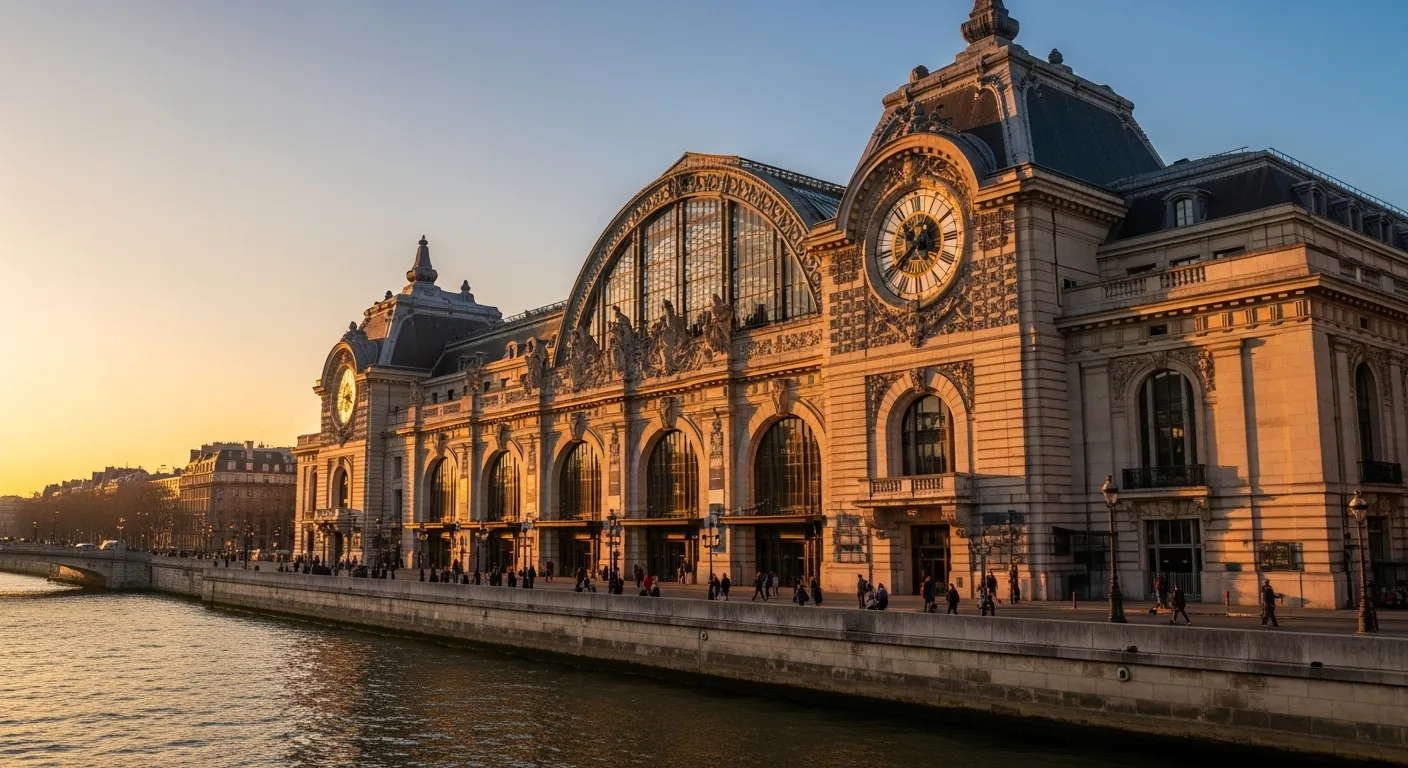
The Musée d'Orsay is a museum in Paris, France, on the Left Bank of the Seine. It is housed in the former Gare d'Orsay, a Beaux-Arts railway station built between 1898 and 1900.
The museum holds mainly French art dating from 1848 to 1914, including paintings, sculptures, furniture, and photography. It is best known for its extensive collection of Impressionist and Post-Impressionist masterpieces by painters including Monet, Manet, Degas, Renoir, Cézanne, Seurat, Sisley, Gauguin, and van Gogh.
Many of these works were held at the Galerie nationale du Jeu de Paume prior to the museum's opening in 1986. It is one of the largest art museums in Europe.
The renovation that transformed the disused station into a museum preserved the grand vaulted glass roof and the famous clocks, creating one of the most distinctive museum spaces in the world.
Updated June 2026. Confirm dates and tickets on the official Musée d'Orsay website.
Olympia, Déjeuner sur l'herbe, and the café-concert paintings that scandalised and defined nineteenth-century Paris.
The Musée d'Orsay occupies the former Gare d'Orsay railway station, its clock face overlooking the Seine becoming one of Paris's most photographed museum landmarks. Timed tickets are mandatory and pair naturally with morning Louvre or Left Bank walks. The central nave preserves train hall grandeur while sculpture fills the ground floor platforms. Seine river walk between Orsay and Louvre takes twenty minutes and passes Tuileries gardens en route. Restaurant behind the clock face requires reservation for dinner service but café accepts walk-ins at lunch. Orangerie Museum nearby holds Monet Water Lilies in oval rooms best combined on same Left Bank day. Former Gare d'Orsay railway station clock face overlooking the Seine has become one of Paris's most photographed museum landmarks since 1986.
Friday late opening until 9:45 PM offers quieter Impressionist gallery access beloved by repeat visitors. Combined Orsay-Orangerie tickets cover Monet's Water Lilies in manageable separate visit. Metro Solférino and RER Musée d'Orsay stations place the museum within minutes of Saint-Germain cafés. Station architecture preservation means some galleries retain original train platform proportions and ironwork. Sponsored exhibition catalogues in the shop often become definitive references for Impressionist scholarship. Accessible entrance on riverside avoids stairs at main nave entry during peak visitor periods. Seine river walk between Orsay and Louvre takes twenty minutes and passes Tuileries gardens en route. Restaurant behind the clock face requires reservation for dinner service but café accepts walk-ins at lunch. Central nave preserves train hall proportions with sculpture on ground floor platforms beneath barrel-vaulted glass roof natural lighting.
Wheelchair access via ramps and elevators improved significantly since renovation, though nave crowds persist at peak hours. Cloakroom mandatory for large bags. Plan two to three hours for Impressionist and Post-Impressionist masterpieces across three floors. Orangerie Museum nearby holds Monet Water Lilies in oval rooms best combined on same Left Bank day. Station architecture preservation means some galleries retain original train platform proportions and ironwork. Sponsored exhibition catalogues in the shop often become definitive references for Impressionist scholarship. Accessible entrance on riverside avoids stairs at main nave entry during peak visitor periods. Middle floor Impressionist galleries hold the museum's greatest concentration of Monet, Renoir, Degas, and Morisot within manageable scope.
Orsay's collection spans 1848 to 1914, bridging academic Salon painting and early modernism excluded from the Louvre's chronological ceiling. Manet's Olympia and Déjeuner sur l'herbe shocked contemporary Paris and now anchor realism-to-Impressionism transition galleries. Monet, Renoir, Degas, and Morisot hold extensive wall space documenting plein air innovation. Top floor Post-Impressionists present Van Gogh Starry Night over the Rhone, Gauguin Tahitian canvases, and Seurat pointillist technique.
Post-Impressionism upstairs presents Van Gogh Starry Night over the Rhône, Gauguin Tahitian canvases, and Cézanne apples-and-oranges still lifes predicting Cubism. Art Nouveau decorative arts and photography galleries extend beyond painting into design modernity. The museum's restaurant behind the clock face serves meals with Seine views. Restaurant behind the station clock face serves meals with Seine views and requires reservation for dinner service during peak tourist season.
Sculpture by Rodin, Carpeaux, and Claudel populates the ground floor amid natural light from the glass roof. Temporary exhibitions in the ground-floor galleries require separate tickets but often feature Symbolist and Nabi movements. Orsay's focused scope makes it manageable compared with encyclopedic neighbors. Combined visits with Orangerie Monet Water Lilies across the river suit a single Left Bank day when timed tickets align conveniently.
Orsay's Belle Époque railway station architecture is half the experience — the central nave with station clock faces the Seine and photographs beautifully at golden hour through the glass roof. Thursday late nights until 9:45 PM offer quieter Monet and Van Gogh rooms.
Pair with Musée de l'Orangerie in Tuileries for Monet Water Lilies in oval rooms — combined ticket available. Walk along the Seine to Louvre if energy permits, but Orsay alone deserves three hours minimum for Impressionist and Post-Impressionist floors.
Focused routes for Musée d'Orsay — pick one wing per visit to avoid museum fatigue.
Monumental sculpture lines the former train platforms beneath the barrel-vaulted glass ceiling. Rodin Gates of Hell and Carpeaux Dance groups demonstrate nineteenth-century three-dimensional ambition. Rodin Gates of Hell bronze portal on the ground floor demonstrates sculptural ambition that parallels Impressionist innovation in adjacent painting galleries.
The museum's heart holds Monet, Renoir, Degas, and Pissarro in galleries organized by artist and theme. Manet's major works introduce the movement's prehistory and Salon controversies. Manet Olympia and Déjeuner sur l'herbe in middle floor galleries shocked Salon audiences and now anchor realism-to-Impressionism transition narratives.
Van Gogh, Gauguin, Cézanne, and Seurat occupy upper galleries beneath the station roof structure. Pointillist masterpieces and Tahitian symbolism contrast with Impressionist light below. Van Gogh Starry Night over the Rhone on the top floor offers star-field brushwork distinct from the more famous Arles bedroom interior nearby in Amsterdam.
A focused route through 5 must-see highlights at Musée d'Orsay without museum fatigue. · 2–4 hours
📍 Impressionism Level (upper floor)
Wait — that's in Chicago.
📍 Room 14, Level 5
A nude reclines with a direct, challenging gaze — a radical reinterpretation of the classical Venus.
📍 Impressionism Level, Upper Floor
Renoir's sun-dappled crowd of Montmartre revellers captures the joyful leisure of a summer Sunday.
📍 Impressionism Level
Degas' immersive view into the world of the Paris Opéra ballet.
📍 Post-Impressionism, Upper Floor
Painted in Arles a year before the more famous Starry Night now in MoMA, this nocturne shows the glittering reflections of gas lamps on the Rhône.
The works that define Musée d'Orsay — and why they matter.
Georges Seurat · 1884–1886
📍 Impressionism Level (upper floor)
Wait — that's in Chicago. The Orsay holds Seurat's study and his other divisionist works. The star Orsay piece is Olympia by Manet.
Édouard Manet · 1863
📍 Room 14, Level 5
A nude reclines with a direct, challenging gaze — a radical reinterpretation of the classical Venus. Manet caused a scandal at the Salon of 1865 by depicting a real, modern woman rather than an idealised goddess.
Pierre-Auguste Renoir · 1876
📍 Impressionism Level, Upper Floor
Renoir's sun-dappled crowd of Montmartre revellers captures the joyful leisure of a summer Sunday. The flickering interplay of light and shadow through foliage is an Impressionist set piece of breathtaking confidence.
Edgar Degas · 1874
📍 Impressionism Level
Degas' immersive view into the world of the Paris Opéra ballet. The diagonal composition and off-centre cropping — influenced by Japanese woodblock prints — gave a new informality to a traditionally formal subject.
Vincent van Gogh · 1888
📍 Post-Impressionism, Upper Floor
Painted in Arles a year before the more famous Starry Night now in MoMA, this nocturne shows the glittering reflections of gas lamps on the Rhône. It is among the most luminous paintings in the Orsay collection.
Bal du moulin de la Galette (1876) by Renoir — a joyful scene of dancing in Montmartre sunlight; Olympia (1863) by Manet — the shocking nude that redefined what painting could depict; The Floor Scrapers (1875) by Caillebotte — the first major painting to celebrate urban working-class labour; The Dance Class (1874) by Degas; L'Origine du monde (1866) by Courbet; and The Starry Night over the Rhône (1888) by van Gogh (not to be confused with The Starry Night, which is at MoMA in New York).
Yes — EU citizens under 26 enter free at all times. The d'Orsay is also free for all visitors on the first Sunday of each month. Teachers from EU countries with appropriate credentials enter free. Otherwise, standard admission is €16 (subject to change — confirm on the official website).
The Louvre covers art from ancient civilisations through to approximately 1848, including Egyptian, Greek, Roman, and European painting and sculpture up to the mid-19th century. The Musée d'Orsay covers 1848–1914, specialising in French Impressionism, Post-Impressionism, and the art of the Belle Époque. Together they form a continuous art-historical narrative. If you have one day in Paris, a morning at the d'Orsay (Impressionism) paired with an afternoon at the Louvre (Old Masters) is the classic combination.
Thursday evenings (open until 9:45 PM) are the least crowded time to visit — most tourists have left and the museum is calmer and more enjoyable than on weekend mornings. Weekday mornings (especially Tuesday–Wednesday) are also significantly quieter than weekends. Book timed-entry tickets in advance at musee-orsay.fr to avoid queues.
Plan 2–4 hours for the highlights. Add time for temporary exhibitions, the museum shop, and café.
The Musée d'Orsay is a museum in Paris, France, on the Left Bank of the Seine. It is housed in the former Gare d'Orsay, a Beaux-Arts railway station built between 1898 and 1900. Key highlights include Bal du moulin de la Galette by Pierre-Auguste Renoir, Self-Portrait by Vincent van Gogh, Olympia by Édouard Manet.
World Animal Rescue Network
Andean bears — South America's only bear — face habitat loss and conflict with farmers. Gifts support research, rescue, and community education. Please consider a donation to support this work.
Enjoying our free guides? Support World Museum Guide — optional, and every guide stays free.