Saturn Devouring His Son
Francisco de Goya · 1819–1823
Oil mural transferred to canvas
Quick answer
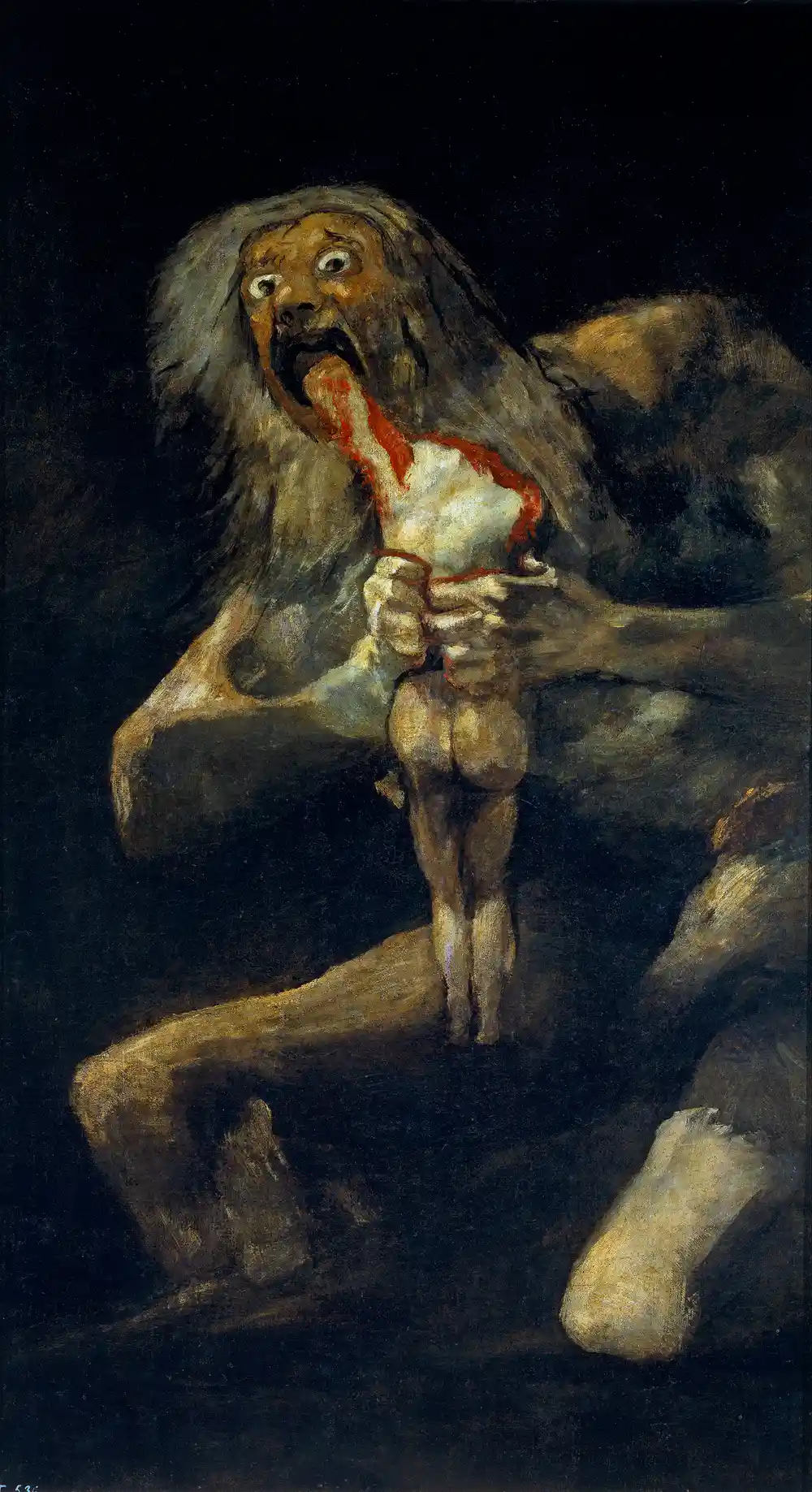
Saturn Devouring His Son (1819–1823) by Francisco de Goya is in Museo del Prado, Madrid. Saturn Devouring His Son is an oil mural by Spanish artist Francisco de Goya, painted directly on the walls of his house (the Quinta del Sordo) between 1819 and 1823. It depicts the Titan Saturn — eyes wide with terror — clutching and devouring the headless body of one of his sons. The work is one of Goya's Black Paintings — fourteen murals painted for his own private walls, never exhibited in his lifetime. The mural was transferred to canvas after Goya's death and is now in the Museo del Prado in Madrid. World Museum Guide explains what you're looking at and how to see it.
Frequently asked questions
What does Saturn Devouring His Son depict?
The painting depicts Saturn (the Roman Titan, equivalent to the Greek Kronos) in the act of eating one of his children. According to the myth, Saturn learned from a prophecy that he would be overthrown by one of his sons, so he swallowed each child as it was born. His wife Ops hid the infant Jupiter and substituted a wrapped stone, which Saturn swallowed instead — Jupiter later freed his siblings and overthrew Saturn. Goya depicts Saturn mid-consumption, wild-eyed, gripping a half-eaten human body.
Where is Saturn Devouring His Son?
Saturn Devouring His Son is in Room 067 of the Museo del Prado in Madrid, in the dedicated Black Paintings room. All fourteen of Goya's Black Paintings are displayed together, creating one of the most psychologically intense experiences in any museum. The Prado is at Paseo del Prado, Madrid.
Why did Goya paint Saturn Devouring His Son?
Goya never explained the Black Paintings — he never mentioned them in correspondence and gave them no titles. Scholars have proposed various interpretations: as expressions of Goya's fear of death and aging; as reactions to the restoration of absolutist monarchy in Spain; as explorations of violence, irrationality, and human darkness; or simply as the work of an old, deaf, politically disillusioned man working for himself without any audience. All remain speculative.
Were the Black Paintings intended to be public?
Almost certainly not. Goya painted them directly on the walls of his private home (the Quinta del Sordo) and never mentioned them in his extensive correspondence. They were discovered only after his death and after the house was sold. Painting violent, disturbing images on one's own dining room walls was not a public statement — the paintings were made for Goya's own private contemplation, perhaps as a kind of visual diary of his inner world.
How many of Goya's Black Paintings are there?
Fourteen murals are identified as Goya's Black Paintings. They originally decorated the ground floor and first floor of the Quinta del Sordo in two cycles. Besides Saturn, they include The Two Old Men, The Sabbath of the Witches (Aquelarre), Two Old Men Eating Soup, Judith and Holofernes, and Leocadia. All fourteen are in the dedicated Black Paintings room at the Museo del Prado.