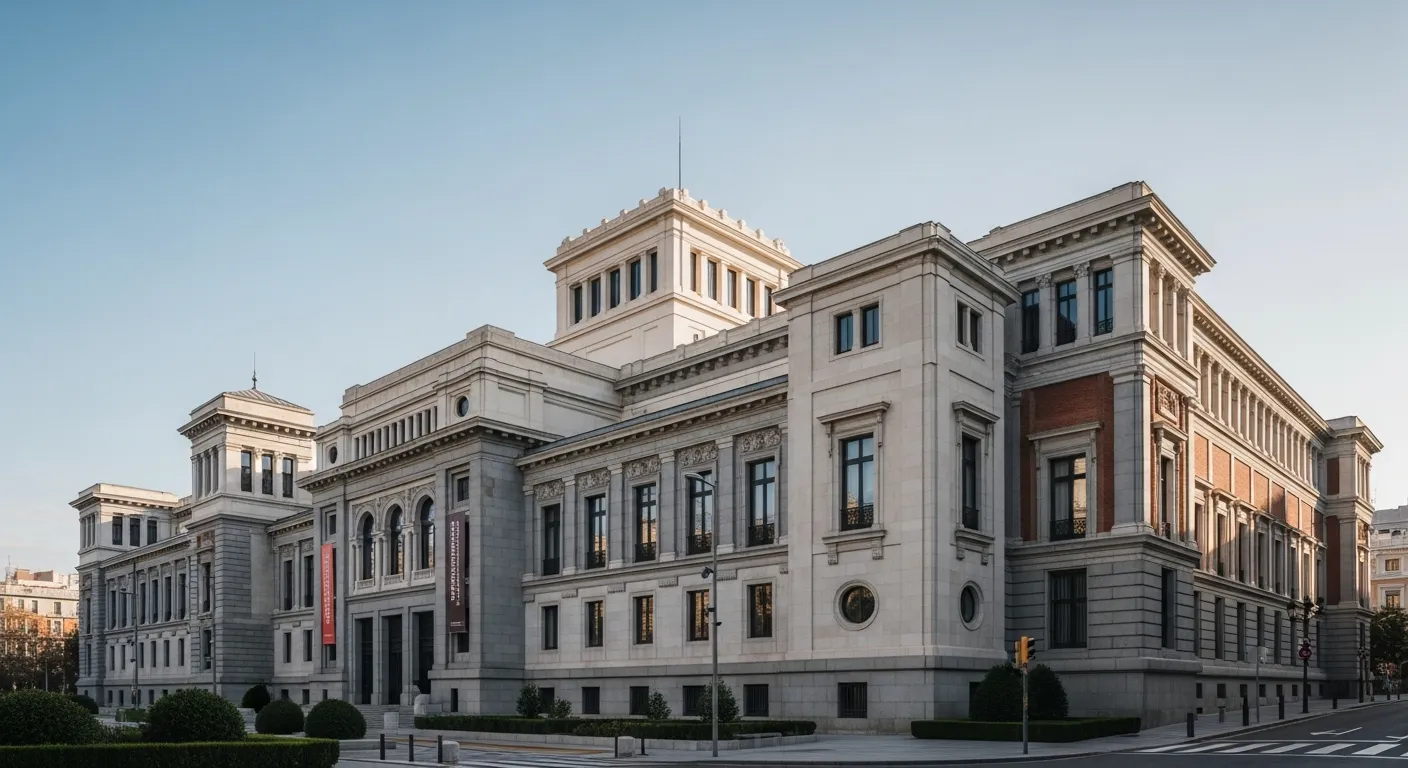
Museo Nacional Thyssen-Bornemisza
Good for: Art Lovers · First-timers · History Enthusiasts
1992
Opened in Madrid
1,600+
Paintings
2–3 hours
Recommended Visit
Quick answer
Museo Nacional Thyssen-Bornemisza in Madrid, Spain — opened in 1992 in the renovated Palacio de Villahermosa, the Thyssen-Bornemisza was acquired by the Spanish state from the Thyssen family in 1993. Open Tuesday to Friday: 10:00 AM – 7:00 PM; Saturday: 10:00 AM – 11:00 PM; Sunday: 10:00 AM – 7:00 PM. Admission: €14 standard admission. World Museum Guide covers the highlights, getting there, and how long to allow (2–3 hours).
Verified 2026-06-30 against official sources.
About Museo Nacional Thyssen-Bornemisza
The Museo Nacional Thyssen-Bornemisza occupies the renovated Palacio de Villahermosa on Madrid's Paseo del Prado — the third corner of the city's Golden Triangle of Art alongside the Prado and the Reina Sofía. The collection was assembled by Baron Hans Heinrich Thyssen-Bornemisza and acquired by the Spanish state in 1993.
Where the Prado excels in Spanish Old Masters and the Reina Sofía in twentieth-century art, the Thyssen fills the gaps: Italian primitives, Dutch Golden Age portraits, German Renaissance panels, Impressionism, Expressionism, and American Pop Art. It is the most encyclopedic of the three museums.
Visitors begin on the top floor with thirteenth-century Italian and Flemish panels and walk down chronologically through the Renaissance, Baroque, Rococo, Impressionism, and twentieth-century avant-garde — a complete journey through Western painting in a single building.
The collection includes major works by Duccio, Van Eyck, Caravaggio, Canaletto, Monet, Van Gogh, Hopper, and Lichtenstein — artists poorly represented or absent from the Prado's Spanish-focused collection.
2–3 hours highlights route
A focused route through 5 must-see highlights at Museo Nacional Thyssen-Bornemisza without museum fatigue. · 2–3 hours
- 1
Portrait of Giovanna Tornabuoni
📍 Second Floor, Early Renaissance
A profile portrait of a Florentine noblewoman — one of the finest Quattrocento portraits, showing Ghirlandaio's precise linear style and the sitter's elaborate brocade sleeve.
- 2
Les Vessenots in Auvers
📍 First Floor, Impressionism
One of Van Gogh's last landscapes — painted in Auvers-sur-Oise weeks before his death, with the swirling brushwork and intense greens of his final period.
- 3
Hotel Room
📍 Ground Floor, Modern Art
A woman sits on a bed in a spare hotel room — Hopper's meditation on urban loneliness that influenced generations of American painters and filmmakers.
- 4
Saint Catherine of Alexandria
📍 Second Floor, Baroque
Caravaggio's sensual depiction of the saint with the wheel of her martyrdom — dramatic chiaroscuro and direct human presence that defined Baroque painting.
- 5
Dream Caused by the Flight of a Bee
📍 Ground Floor, Surrealism
Dalí's portrait of Gala dreaming of tigers erupting from a pomegranate — a classic Surrealist image from the Thyssen's strong twentieth-century collection.
Masterworks & must-see highlights
The works that define Museo Nacional Thyssen-Bornemisza — and why they matter.
Portrait of Giovanna Tornabuoni
Domenico Ghirlandaio · 1488
📍 Second Floor, Early Renaissance
A profile portrait of a Florentine noblewoman — one of the finest Quattrocento portraits, showing Ghirlandaio's precise linear style and the sitter's elaborate brocade sleeve.
Les Vessenots in Auvers
Vincent van Gogh · 1890
📍 First Floor, Impressionism
One of Van Gogh's last landscapes — painted in Auvers-sur-Oise weeks before his death, with the swirling brushwork and intense greens of his final period.
Hotel Room
Edward Hopper · 1931
📍 Ground Floor, Modern Art
A woman sits on a bed in a spare hotel room — Hopper's meditation on urban loneliness that influenced generations of American painters and filmmakers.
Saint Catherine of Alexandria
Caravaggio · c. 1598
📍 Second Floor, Baroque
Caravaggio's sensual depiction of the saint with the wheel of her martyrdom — dramatic chiaroscuro and direct human presence that defined Baroque painting.
Dream Caused by the Flight of a Bee
Salvador Dalí · 1944
📍 Ground Floor, Surrealism
Dalí's portrait of Gala dreaming of tigers erupting from a pomegranate — a classic Surrealist image from the Thyssen's strong twentieth-century collection.
Collections & highlights
- • Italian primitives — Duccio, Fra Angelico, Ghirlandaio
- • Dutch Golden Age — Van Eyck, Petrus Christus, Rembrandt
- • Baroque — Caravaggio, Rubens, Van Dyck
- • Impressionism — Monet, Renoir, Degas, Van Gogh
- • Expressionism — Kirchner, Nolde, Beckmann
- • American art — Hopper, Pollock, Lichtenstein
- • German Renaissance — Holbein, Cranach, Dürer
- • Rococo — Fragonard, Boucher, Canaletto
Frequently asked questions
Is there a combined Madrid art ticket?
Yes, the Paseo del Arte ticket combines the Prado, Thyssen, and Reina Sofía.
Are children admitted free?
Children under eighteen enter free.
How long should I spend at Museo Nacional Thyssen-Bornemisza?
Plan 2–3 hours for the highlights. Add time for temporary exhibitions, the museum shop, and café.
What is Museo Nacional Thyssen-Bornemisza best known for?
Opened in 1992 in the renovated Palacio de Villahermosa, the Thyssen-Bornemisza was acquired by the Spanish state from the Thyssen family in 1993. It complements the Prado's Spanish strengths with works the national collections previously lacked. Key highlights include Italian primitives — Duccio, Fra Angelico, Ghirlandaio, Dutch Golden Age — Van Eyck, Petrus Christus, Rembrandt, Baroque — Caravaggio, Rubens, Van Dyck.
How do I get tickets for Museo Nacional Thyssen-Bornemisza?
€14 standard admission Tickets are usually available on the day, but booking online saves queue time in peak season. Official site: https://www.museothyssen.org/en
Should I visit all three Golden Triangle museums?
Each covers a different period: Prado (12th–19th century, Spanish focus), Thyssen (13th–20th century, encyclopedic), Reina Sofía (20th–21st century, Spanish modern). All three are within a 10-minute walk. The Paseo del Arte combined ticket makes a two-day visit excellent value.
What makes the Thyssen different from the Prado?
The Prado is stronger in Spanish art (Velázquez, Goya, El Greco) and Flemish masters. The Thyssen complements it with Italian primitives, Impressionism, German Expressionism, and American Pop Art — artists the Prado lacks. Together they form one of the world's greatest combined collections.
Is the top-down chronological route mandatory?
The recommended route starts on the second floor (thirteenth century) and descends to the ground floor (twentieth century). You can start on any floor, but the chronological descent tells the story of Western painting most coherently.
World Animal Rescue Network
Adopt a pangolin symbolically
Pangolins are the world's most trafficked mammals. A symbolic adoption gift funds confiscation response and specialist rehabilitation. Please consider a donation to support this work.
Enjoying our free guides? Support World Museum Guide — optional, and every guide stays free.