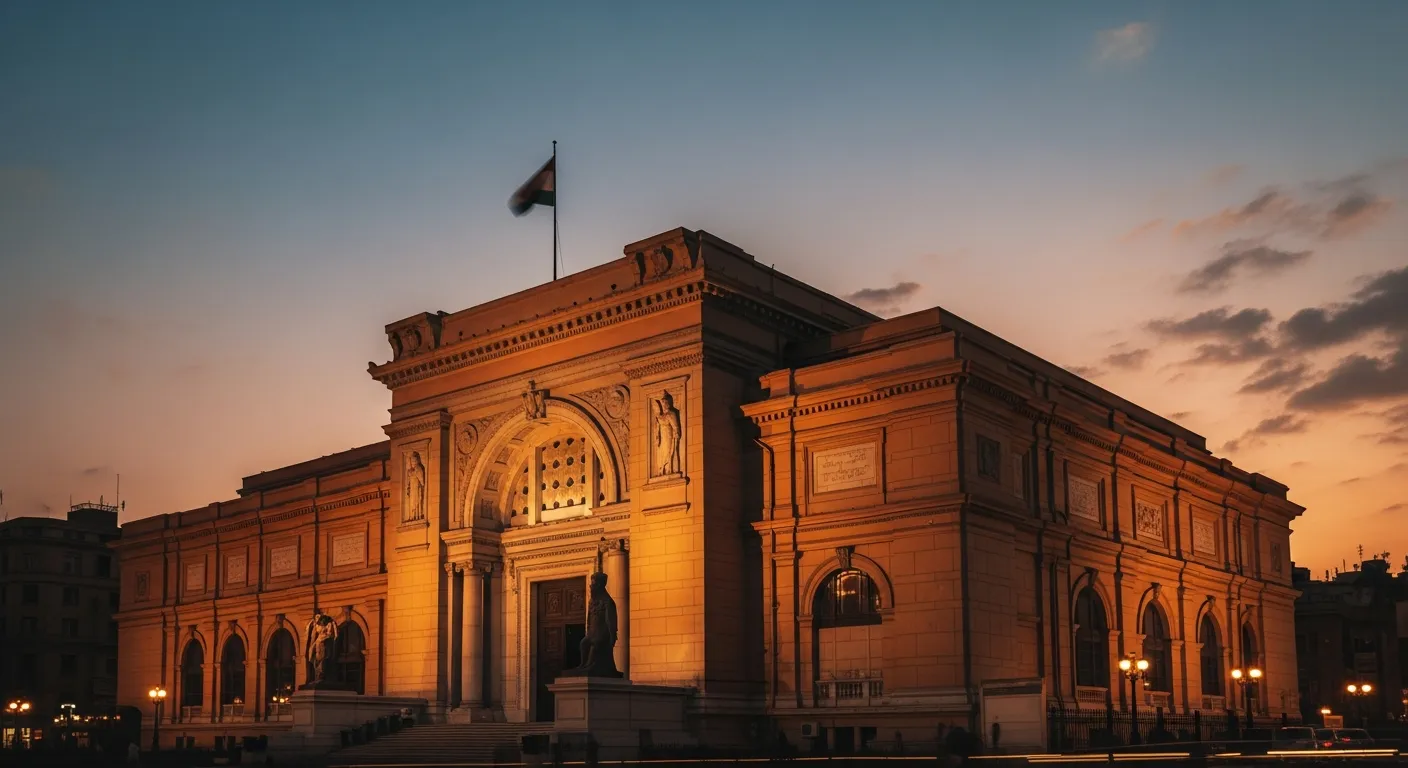
The Egyptian Museum
Good for: Art Lovers · First-timers · Rainy-day visits
1902
Founded
1.5 million
Annual Visitors
3–4 hours
Recommended Visit
Art
Museum type
Quick answer
The Egyptian Museum in Cairo, Egypt — the Museum of Egyptian Antiquities, known commonly as the Egyptian Museum or Museum of Cairo, in Cairo, Egypt, is home to an extensive collection of ancient Egyptian antiquities. Open Daily: 9:00 AM – 5:00 PM. Admission: 200 EGP for non-Egyptians. Book timed-entry tickets ahead in peak season. World Museum Guide covers the highlights, getting there, and how long to allow (3–4 hours).
Verified 2026-06-30 against official sources.
About The Egyptian Museum
The Museum of Egyptian Antiquities, known commonly as the Egyptian Museum or Museum of Cairo, in Cairo, Egypt, is home to an extensive collection of ancient Egyptian antiquities. It has 120,000 items, with a representative amount on display and the remainder in storerooms.
Built in 1901 by the Italian construction company Garozzo-Zaffarani to a design by the French architect Marcel Dourgnon, the edifice is one of the largest museums in the region.
The museum's collection includes artifacts from the Pharaonic era, Greco-Roman period, and beyond. It has served as the primary repository for discoveries made by archaeologists throughout Egypt for over a century.
While many items, including the treasures of Tutankhamun, are being relocated to the new Grand Egyptian Museum in Giza, the original institution remains a historic monument and a vital part of Egypt's heritage.
3–4 hours highlights route
A focused route through 4 must-see highlights at The Egyptian Museum without museum fatigue. · 3–4 hours
- 1
Mask of Tutankhamun
📍 Royal Mummies Hall, upper floor
The solid gold death mask of the boy pharaoh Tutankhamun weighs 10.23 kg and is inlaid with lapis lazuli, obsidian, quartz, and coloured glass.
- 2
Narmer Palette
📍 Ground Floor, Room 43
A ceremonial slate palette commemorating the unification of Upper and Lower Egypt — among the world's oldest historical documents.
- 3
Statue of Khafre
📍 Ground Floor, Tutankhamun Gallery
The seated diorite statue of Pharaoh Khafre (builder of the second Giza pyramid), with the falcon god Horus spreading protective wings behind his head.
- 4
Khufu Ivory Statuette
📍 Ground Floor
At just 7.5 cm tall, this tiny ivory figure is the only confirmed three-dimensional representation of Pharaoh Khufu — the builder of the Great Pyramid of Giza — in existence.
Masterworks & must-see highlights
The works that define The Egyptian Museum — and why they matter.
Mask of Tutankhamun
Ancient Egyptian craftsmen · c. 1323 BCE
📍 Royal Mummies Hall, upper floor
The solid gold death mask of the boy pharaoh Tutankhamun weighs 10.23 kg and is inlaid with lapis lazuli, obsidian, quartz, and coloured glass. One of the most instantly recognised artefacts in the world.
Narmer Palette
Ancient Egyptian craftsmen · c. 3100 BCE
📍 Ground Floor, Room 43
A ceremonial slate palette commemorating the unification of Upper and Lower Egypt — among the world's oldest historical documents. The palette shows King Narmer wearing the crowns of both Egypts.
Statue of Khafre
Ancient Egyptian craftsmen · c. 2530 BCE
📍 Ground Floor, Tutankhamun Gallery
The seated diorite statue of Pharaoh Khafre (builder of the second Giza pyramid), with the falcon god Horus spreading protective wings behind his head. One of the finest sculptures of the Old Kingdom.
Khufu Ivory Statuette
Ancient Egyptian craftsmen · c. 2570 BCE
📍 Ground Floor
At just 7.5 cm tall, this tiny ivory figure is the only confirmed three-dimensional representation of Pharaoh Khufu — the builder of the Great Pyramid of Giza — in existence.
Collections & highlights
- • The Gold Mask of Psusennes I
- • Statue of Khafre
- • Narmer Palette
- • Mummy Portraits
- • Statue of Djoser
Frequently asked questions
Are Tutankhamun's treasures still at the Egyptian Museum in Cairo?
The majority of Tutankhamun's treasure — including his golden death mask, solid gold coffin, and the complete funerary collection — has been moved to the new Grand Egyptian Museum (GEM) in Giza, which opened its main galleries in 2023. The original Egyptian Museum on Tahrir Square continues to display tens of thousands of artefacts, including the Royal Mummy Room, the Gold Mask of Psusennes I, the Narmer Palette, the Statue of Khafre, and many finds that have not yet transferred. Check current opening status for both before visiting.
What is the Grand Egyptian Museum and is it open?
The Grand Egyptian Museum (GEM) is a major new museum built at Giza, adjacent to the Pyramids, designed to house the complete treasures of Tutankhamun alongside thousands of other artefacts from ancient Egypt. It began partial opening in 2023. The GEM is intended to eventually replace the original Tahrir Square museum as Egypt's main antiquities display. At 480,000 square metres of total area, it will be the largest archaeological museum in the world when fully operational. Check the official website (gem.gov.eg) for current exhibition access.
What are the most important artefacts still in the Egyptian Museum on Tahrir Square?
The Royal Mummy Room houses the preserved remains of major pharaohs including Ramesses II, Seti I, and Thutmose III. Other highlights include the Gold Mask of Psusennes I (21st Dynasty; considered comparable to Tutankhamun's mask), the Narmer Palette (c. 3200 BCE — one of the earliest historical records), the Statue of Khafre (c. 2500 BCE — the idealised portrait of the pharaoh who built the second Giza pyramid), and Mummy Portraits from the Greco-Roman period.
How long does a visit to the Egyptian Museum in Cairo take?
The Egyptian Museum has 107 display halls and over 120,000 artefacts. A focused highlights visit — mummies, Tutankhamun room (if not yet transferred), and the principal statuary — takes 2–3 hours. A thorough visit through all floors requires a full day. Audio guides are available and strongly recommended; the labelling can be sparse. The museum is located directly on Tahrir Square and is most conveniently reached by Cairo Metro (Sadat station).
Do I need to book tickets for the Egyptian Museum in advance?
Walk-up tickets are generally available at the Egyptian Museum on Tahrir Square without advance booking, though busy periods (October–April) can see queues. The separate Royal Mummy Room requires an additional ticket purchased at the entrance. The Grand Egyptian Museum at Giza has an online booking system recommended for timed entry. Non-Egyptian visitors pay 200 EGP for the main Egyptian Museum.
How long should I spend at The Egyptian Museum?
Plan 3–4 hours for the highlights. Add time for temporary exhibitions, the museum shop, and café.
World Animal Rescue Network
Adopt an elephant symbolically
Elephants face poaching and habitat loss daily. Symbolic adoption supports rescue and protection programmes through frontline partners. Please consider a donation to support this work.
Enjoying our free guides? Support World Museum Guide — optional, and every guide stays free.