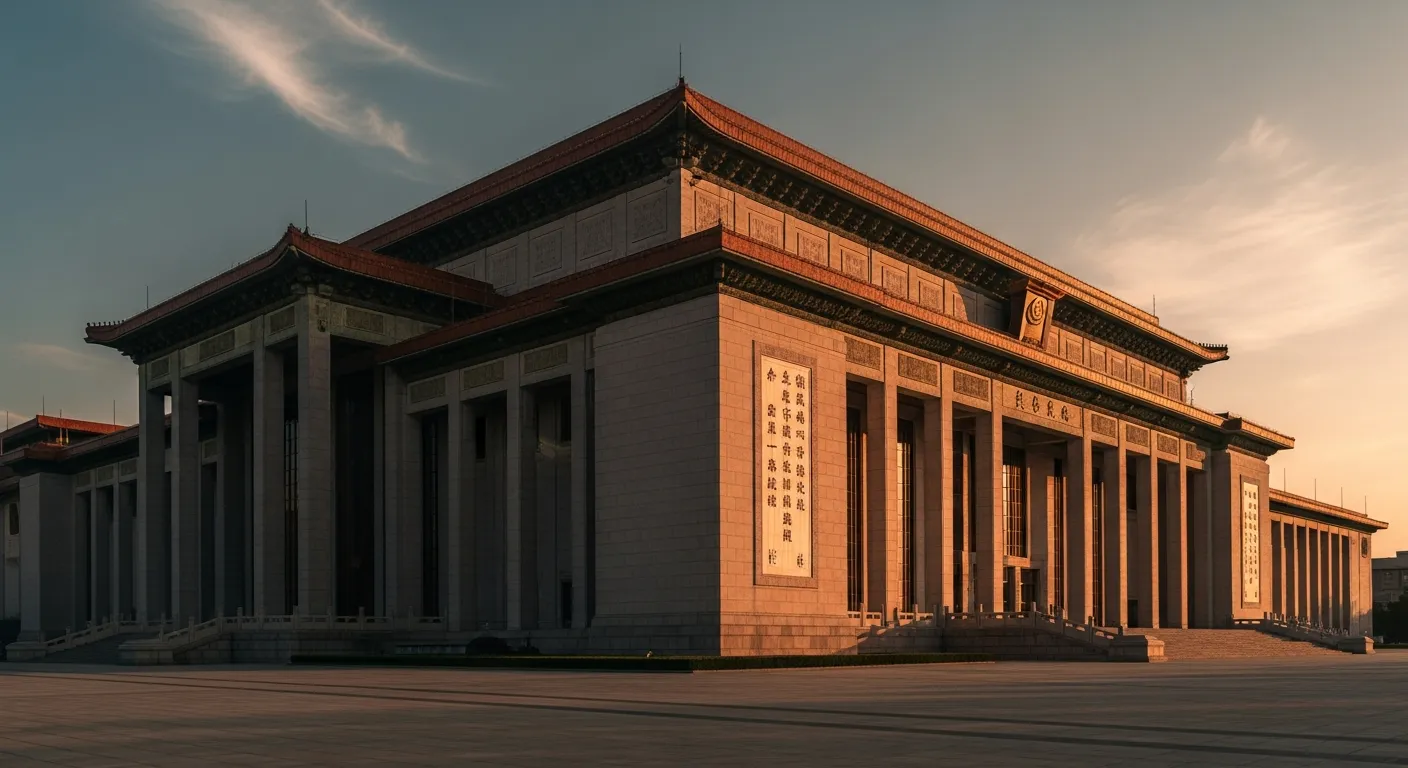
National Museum of China
Beijing · China · Founded 2003
Good for: History Enthusiasts · First-Time Visitors to Beijing · Families
2003
Current Institution
48
Exhibition Halls
3–5 hours
Recommended Visit
Quick answer
National Museum of China in Beijing, China — the National Museum of China flanks the eastern side of Tiananmen Square in Beijing, China. Open Tuesday to Sunday: 9:00 AM – 5:00 PM (Closed Mondays). Admission: ✓ Free admission with valid ID. Book timed-entry tickets ahead in peak season. World Museum Guide covers the highlights, getting there, and how long to allow (3–5 hours).
Verified 2026-06-30 against official sources.
About National Museum of China
The National Museum of China flanks the eastern side of Tiananmen Square in Beijing, occupying one of the largest museum buildings in the world with 191,900 square metres of floor area and 48 exhibition halls.
Formed in 2003 from the merger of the Museum of Chinese History and the Museum of the Chinese Revolution, it presents two permanent exhibitions: 'Ancient China' tracing civilisation from Yuanmou Man (1.7 million years ago) through the Qing Dynasty, and 'The Road of Rejuvenation' documenting modern Chinese history.
The Houmuwu Ding — a 832-kilogram bronze ritual vessel from the late Shang Dynasty — is the museum's most celebrated object and a Chinese Cultural Relic Forbidden from Exhibition Abroad.
Free admission requires advance online booking with passport or ID. With 7.4 million visitors in 2019, it was the second most visited art museum in the world that year.
3–5 hours highlights route
A focused route through 4 must-see highlights at National Museum of China without museum fatigue. · 3–5 hours
- 1
Houmuwu Ding (Simuwu Ding)
📍 Ancient China Gallery, Bronze section
At 832 kg and 133 cm tall, the largest and heaviest ancient Chinese bronze ever found — a designated Cultural Relic Forbidden from Exhibition Abroad.
- 2
Jade Burial Suit
📍 Ancient China Gallery, Jade section
A full jade suit sewn with gold thread for a Han prince — among the most spectacular jade objects in any museum.
- 3
Tang Tri-Colour Glazed Pottery
📍 Ancient China Gallery, Ceramics section
Sancai-glazed camels, horses, and court figures from Tang Chang'an — illustrating the cosmopolitan peak of the Silk Road era.
- 4
Four Great Inventions Display
📍 Road of Rejuvenation Gallery
Compass, gunpowder, papermaking, and printing — presented in the modern history wing as foundations of Chinese civilisation.
Masterworks & must-see highlights
The works that define National Museum of China — and why they matter.
Houmuwu Ding (Simuwu Ding)
Shang Dynasty casters · c. 1250 BCE
📍 Ancient China Gallery, Bronze section
At 832 kg and 133 cm tall, the largest and heaviest ancient Chinese bronze ever found — a designated Cultural Relic Forbidden from Exhibition Abroad.
Jade Burial Suit
Han Dynasty jade workers · 2nd century BCE
📍 Ancient China Gallery, Jade section
A full jade suit sewn with gold thread for a Han prince — among the most spectacular jade objects in any museum.
Tang Tri-Colour Glazed Pottery
Tang Dynasty potters · 8th century
📍 Ancient China Gallery, Ceramics section
Sancai-glazed camels, horses, and court figures from Tang Chang'an — illustrating the cosmopolitan peak of the Silk Road era.
Four Great Inventions Display
Various · permanent exhibition
📍 Road of Rejuvenation Gallery
Compass, gunpowder, papermaking, and printing — presented in the modern history wing as foundations of Chinese civilisation.
Collections & highlights
- • Ancient China — bronzes, jade, ceramics, calligraphy
- • The Road of Rejuvenation — modern Chinese history
- • Houmuwu Ding bronze vessel
- • Han jade burial suits
- • Tang sancai glazed pottery
Frequently asked questions
Is the National Museum of China free to visit?
Yes — entry to the National Museum of China is free, but visitors must book tickets in advance online and present a valid passport or national ID at the entrance. Foreign visitors must register through the official booking system (en.chnmuseum.cn). The museum is open Tuesday to Sunday, 9:00 AM to 5:00 PM, and is closed on Mondays. Popular exhibition periods can fully book weeks in advance.
What is the most important artefact at the National Museum of China?
The Houmuwu Ding (also known as the Simuwu Ding) — a massive bronze ritual vessel cast during the late Shang Dynasty (c. 1250 BCE) — is generally considered the museum's most significant object and is China's largest and heaviest piece of ancient bronze. At 832 kilograms and 133 cm tall, it is a designated Chinese Cultural Relic Forbidden from Exhibition Abroad, meaning it will never leave China. Other highlights include jade burial suits from the Han Dynasty, Tang tri-color glazed pottery, and an exceptional collection of ancient Chinese porcelain.
How large is the National Museum of China?
The National Museum of China is one of the largest museum buildings in the world, covering 191,900 square metres of total floor area and with about 66,000 square metres of exhibition space across 48 exhibition halls. It flanks the eastern side of Tiananmen Square in Beijing, next to the Great Hall of the People. With 7.4 million visitors in 2019, it was the second most visited art museum in the world that year — just behind the Louvre.
What can I see at the National Museum of China?
The museum has two permanent exhibitions: 'Ancient China,' which traces Chinese civilisation from the Yuanmou Man (1.7 million years ago) through the Qing Dynasty using over 2,000 artefacts; and 'The Road of Rejuvenation,' which documents modern Chinese history from the Opium Wars to the present. Temporary international exhibitions are also regularly hosted. The scope is encyclopedic — bronzes, jade, calligraphy, ceramics, paintings, coins, and artefacts covering every major Chinese dynasty.
How do I get to the National Museum of China?
The National Museum of China is located at 16 East Chang'an Avenue on the eastern edge of Tiananmen Square in central Beijing. The nearest metro station is Tiananmen East (Lines 1 and 5), a 5-minute walk. From the Forbidden City (Palace Museum) it is a 10-minute walk south along the square. The museum is closed on Mondays. Bags must go through security checks and large bags may not be permitted inside.
How long should I spend at National Museum of China?
Plan 3–5 hours for the highlights. Add time for temporary exhibitions, the museum shop, and café.
Is the National Museum of China free?
Yes — entry is free but visitors must book tickets in advance online and present a valid passport or national ID. Popular periods can fully book weeks ahead.
What is the most important artefact?
The Houmuwu Ding — a massive bronze ritual vessel from the late Shang Dynasty, China's largest ancient bronze and forbidden from leaving the country.
How does it compare to the Palace Museum?
The National Museum covers all of Chinese history and civilisation; the Palace Museum (Forbidden City) focuses on the imperial palace and its collections. Visit both — they are a 10-minute walk apart.
World Animal Rescue Network
Help Karachi street dogs
Karachi street dogs need vaccination, sterilisation, and emergency care. Donations fund mobile clinics and rescue teams across the city. Please consider a donation to support this work.
Enjoying our free guides? Support World Museum Guide — optional, and every guide stays free.