Fort Vredeburg Museum
Yogyakarta · Indonesia · Founded 1987
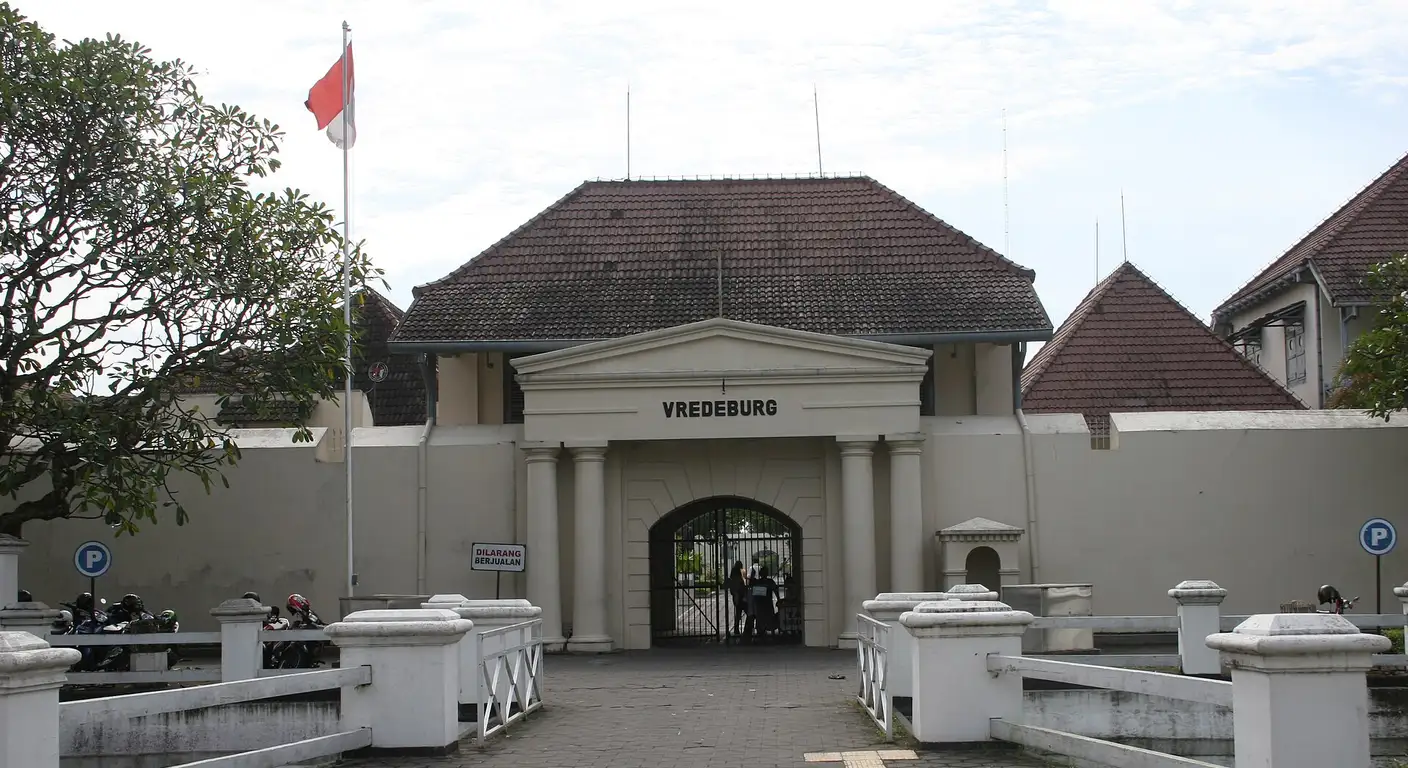
Photo: Pras · CC BY-SA 3.0
Quick answer
Fort Vredeburg Museum occupies an 18th-century Dutch fort at Yogyakarta's Titik Nol Kilometer, the southern end of Malioboro. Open Tuesday to Thursday: 8:00 AM – 8:00 PM; Friday to Sunday: 8:00 AM – 9:00 PM; closed Mondays. Admission: Rp15,000 for adults and Rp10,000 for students (Tuesday–Thursday); Rp20,000 and Rp15,000 (Friday–Sunday until 4 PM); Rp25,000 and Rp20,000 (Friday–Sunday from 4 PM); Rp100,000 for foreign visitors; Rp25,000 for foreigners with a limited-stay permit (KITAS). Allow 1.5–2 hours.
Visitor information last reviewed 22 October 2026. Check the official museum site for current details.
Fort Vredeburg Museum at a glance: hours, tickets and time needed
| Opening hours | Tuesday to Thursday: 8:00 AM – 8:00 PM; Friday to Sunday: 8:00 AM – 9:00 PM |
|---|---|
| Closed | Mondays |
| Admission | Rp15,000 for adults and Rp10,000 for students (Tuesday–Thursday); Rp20,000 and Rp15,000 (Friday–Sunday until 4 PM); Rp25,000 and Rp20,000 (Friday–Sunday from 4 PM); Rp100,000 for foreign visitors; Rp25,000 for foreigners with a limited-stay permit (KITAS) |
| Free or reduced entry | Children aged 0–3: free · Students (pre-school to university): Rp10,000–Rp20,000 depending on day and time · Foreigners with a limited-stay permit: Rp25,000 · Groups of 50+ in one visitor category: 20% off |
| Booking | Tickets usually available on the day |
| Time needed | 1.5–2 hours |
| Best time to visit | Evenings are the quietest time: the museum says daytime brings tour and school groups, while after dark the diorama halls are calmer and the buildings floodlit. |
| Getting there | Walk: At the Titik Nol Kilometer crossroads at the southern end of Malioboro, about 1.2 km south of Yogyakarta (Tugu) station in a straight line; ticket counters are at the west gate (Malioboro side) and the south gate |
| Address | Jl. Margo Mulyo No. 6, Yogyakarta 55121, Special Region of Yogyakarta, Indonesia |
| Official website | vredeburg.id |
Checked 2026-10-22 against the official website. Prices and hours change — confirm before you travel.
What is Fort Vredeburg Museum known for?
Fort Vredeburg was built for the Dutch East India Company (VOC) soon after the founding of the Yogyakarta Sultanate, officially to protect the new kraton but in practice to keep watch on it. According to the museum's own history, work began in December 1765 to a design by Frans Haag, with timber and labour supplied by the palace under the kerig aji system of compulsory service. Governor Jan Sieberg inaugurated it in 1785 as Fort Rustenburg, the 'fort of rest', and Sultan Hamengku Buwana I named its four corner bastions. It was later renamed Vredeburg, the 'fort of peace', while the land remained the Sultanate's property.
The fort's later history mirrors the country's. From 1942 the Japanese used it as a Kempeitai headquarters, ammunition store and prison. Indonesian forces took it over after the 1945 proclamation of independence, lost it to the Dutch in 1948 during the second military aggression and regained it in the General Offensive of 1 March 1949. After decades of military use, a 1980 agreement between Sultan Hamengku Buwono IX and the education minister opened the way to a cultural use. The museum opened to the public in 1987 and on 23 November 1992 was designated a museum of the national struggle. It is now run by the Indonesian Heritage Agency (Museum dan Cagar Budaya).
The permanent exhibition fills four diorama halls in the fort's old buildings, with 55 miniature dioramas (minirama) between them. Diorama 1, in former officers' housing, covers the Diponegoro period to the Japanese occupation in 11 scenes; Diorama 2 runs from the Proclamation of Independence to the Dutch military aggression in 19; Diorama 3 follows events from the Renville Agreement to the recognition of the sovereignty of the United States of Indonesia in 18; and Diorama 4, in the former societeit club building, takes the story to the New Order in seven. The museum holds more than 7,000 objects, including household goods, war equipment and items used by Soekarno and Mohammad Hatta.
A revitalisation closed the museum from March 2024 until it reopened on 8 June 2024 with refreshed diorama halls, the Taman Patriot garden and an edupark, a children's room, Cafe Rustenburg, a museum shop and evening opening. On Friday to Sunday evenings the Tirta Abirawa dancing fountain and the Lintas Cahaya video-mapping show bring the grounds to life, and the restored south-west bastion is a popular sunset viewpoint. Tickets are priced by day and time, sold at the gates or online, and paid cashless by card, QRIS or e-wallet. Free guiding in Indonesian and English is available on request when a guide is free.
Best for: History Enthusiasts · First-timers · Families
How long do you need at Fort Vredeburg Museum?
Allow 1.5 hours. A chronological walk through the four diorama halls, starting at the ramparts and ending in the former societeit building. Follow the stops in order:
- 1
West gate and south-west bastion
📍 Fort entrance and south-west corner
Enter from the Malioboro side and look for the reconstructed section of moat before climbing the bastion for a view over Titik Nol Kilometer.
- 2
Diorama 1
📍 Building M3 (former southern officers' housing)
Eleven scenes from the Diponegoro period to the Japanese occupation set the colonial background for the rest of the route.
- 3
Diorama 2
📍 Buildings M1 and M2 (former northern officers' housing)
The biggest hall, with 19 scenes from the Proclamation of Independence to the Dutch military aggression; the library is on its west side.
- 4
Diorama 3
📍 Building E, ground floor (former northern soldiers' barracks)
Eighteen scenes from the Renville Agreement to the recognition of sovereignty, including the struggle for Yogyakarta in 1948–1949.
- 5
Diorama 4
📍 Building G, ground floor (former societeit)
Seven scenes take the story from the unitary republic to the New Order; on Friday to Sunday evenings, finish with the fountain and video-mapping shows outside.
What are the must-see works at Fort Vredeburg Museum?
5 highlights that define the collection: Diorama 1: from Diponegoro to the Japanese occupation, Diorama 2: from the Proclamation to the Dutch military aggression, Diorama 3: from the Renville Agreement to the recognition of sovereignty and more.
Diorama 1: from Diponegoro to the Japanese occupation
Miniature dioramas · 19th century to 1945
📍 Diorama Hall 1 (Building M3, former southern officers' housing)
Eleven miniature scenes that open the story with the Diponegoro period and carry it through Dutch rule to the Japanese occupation of Yogyakarta.
Diorama 2: from the Proclamation to the Dutch military aggression
Miniature dioramas · 1945–1948
📍 Diorama Hall 2 (Buildings M1 and M2, former northern officers' housing)
The largest hall, with 19 scenes covering the Proclamation of Independence and the fighting that followed up to the Dutch military aggression.
Diorama 3: from the Renville Agreement to the recognition of sovereignty
Miniature dioramas · 1948–1949
📍 Diorama Hall 3 (Building E, ground floor, former northern soldiers' barracks)
Eighteen scenes on the most dramatic years of the revolution, from the Renville Agreement to the recognition of the sovereignty of the United States of Indonesia.
South-west bastion
VOC fortification · 18th century
📍 South-west corner of the fort
One of the four corner bastions named by Sultan Hamengku Buwana I, restored and opened to visitors in the 2024 revitalisation; the museum recommends it for sunset views over the city.
Tirta Abirawa dancing fountain and Lintas Cahaya video mapping
Evening programme · since 2024
📍 Museum grounds
Weekend evening shows on Friday to Sunday: a dancing fountain and a projection that tells the history of the fort's buildings.
Collections and highlights
- • 55 miniature dioramas of Indonesia's independence struggle
- • Objects used by Soekarno and Mohammad Hatta
- • Weapons, uniforms and equipment of the revolution, including Student Army (Tentara Pelajar) items
- • Household objects of the colonial and revolutionary periods
- • Paintings and historic photographs
- • 18th-century fort buildings with four corner bastions
Tips for visiting Fort Vredeburg Museum
- 1.
Best time to visit
Evenings are the quietest time: the museum says daytime brings tour and school groups, while after dark the diorama halls are calmer and the buildings floodlit. Come Friday to Sunday for the fountain and video-mapping shows, bearing in mind that tickets cost more after 4 PM at weekends. Closed Mondays.
- 2.
Tickets & booking
Buy at the west or south gate counters, or online through vredeburg.id or Traveloka. Payment is cashless (debit or credit card, QRIS or e-wallet). Groups of 50 or more in the same visitor category get 20% off at the counter.
- 3.
Accessibility
Free wheelchairs and strollers can be borrowed at the west ticket counter, and the museum has accessible toilets, ramps and guiding blocks, a lactation room, a quiet room and a Braille guidebook. In 2024 it was rated 'very accessible' for vulnerable groups by the civil-service reform ministry (Kementerian PANRB).
- 4.
Photography rules
Personal photography is welcome and the museum promotes its buildings and bastions as photo spots. Follow signs in the diorama halls, do not touch exhibits, and keep food and drink out of the galleries.
How do you get to Fort Vredeburg Museum?
- walk At the Titik Nol Kilometer crossroads at the southern end of Malioboro, about 1.2 km south of Yogyakarta (Tugu) station in a straight line; ticket counters are at the west gate (Malioboro side) and the south gate
- car The museum's own car park is reached from Jalan Senopati, on the fort's south side
- taxi Grab, Gojek or a becak to Jl. Margo Mulyo No. 6 (Benteng Vredeburg) at Titik Nol Kilometer
Address: Jl. Margo Mulyo No. 6, Yogyakarta 55121, Special Region of Yogyakarta, Indonesia
Sources we checked
Visitor facts and history on this page come from these sources, checked on the dates shown.
- Museum Benteng Vredeburg Yogyakarta (official website) — Museum Benteng Vredeburg / Indonesian Heritage Agency, checked 22 October 2026
- Harga Tiket — Museum Benteng Vredeburg, checked 22 October 2026
- Waktu Kunjungan — Museum Benteng Vredeburg, checked 22 October 2026
- Katanya Nyeremin?! Vredeburg di Malam Hari Bikin Betah (17 September 2026) — Museum Benteng Vredeburg, checked 22 October 2026
- Sejarah Singkat — Museum Benteng Vredeburg, checked 22 October 2026
- Profil — Museum Benteng Vredeburg, checked 22 October 2026
- Galeri Ruang Pameran Tetap — Museum Benteng Vredeburg, checked 22 October 2026
- Galeri: Koleksi (Diorama 1–4) — Museum Benteng Vredeburg, checked 22 October 2026
- 6 Alasan Kamu Harus Masukin Museum Benteng Vredeburg di Wishlist (13 April 2026) — Museum Benteng Vredeburg, checked 22 October 2026
- Ke Vredeburg Makin Nyaman dengan Fasilitas Super Lengkap untuk Pengunjung (12 May 2026) — Museum Benteng Vredeburg, checked 22 October 2026
- Usai Raih Penilaian 'Sangat Aksesibel' (28 August 2024) — Museum Benteng Vredeburg, checked 22 October 2026
- Diserbu Wisatawan Saat Libur Lebaran (7 April 2026) — Museum Benteng Vredeburg, checked 22 October 2026
- Fasilitas Pemanduan di Museum Benteng Vredeburg (24 March 2023) — Museum Benteng Vredeburg, checked 22 October 2026
- Peraturan Pengunjung — Museum Benteng Vredeburg, checked 22 October 2026
- Kembali Dibuka, Museum Benteng Vredeburg Hadir dengan Wajah Baru (9 June 2024) — Kontan / Momsmoney, checked 22 October 2026
- Fort Vredeburg Museum — Wikipedia, checked 22 October 2026
- Museum Benteng Vredeburg Yogyakarta (Sistem Registrasi Nasional Museum) — Ministry of Culture of the Republic of Indonesia, checked 22 October 2026
- Stasiun Tugu Yogyakarta (used for straight-line distance) — OpenStreetMap, checked 22 October 2026
Fort Vredeburg Museum: frequently asked questions
How much is the entrance fee for Fort Vredeburg Museum?
Prices depend on the day and time. From Tuesday to Thursday adults pay Rp15,000 and students Rp10,000; on Friday to Sunday it is Rp20,000 and Rp15,000 until 4 PM, then Rp25,000 and Rp20,000 in the evening. Foreign visitors pay Rp100,000 at any time, or Rp25,000 with a limited-stay permit (KITAS). Children up to three enter free, and groups of 50 or more get 20% off.
Where is Fort Vredeburg Museum and how do I get there?
The fort stands at Jl. Margo Mulyo No. 6, at Yogyakarta's Titik Nol Kilometer crossroads where Malioboro ends, facing the Gedung Agung presidential palace. Yogyakarta (Tugu) station is about 1.2 km to the north in a straight line, so many visitors simply walk down Malioboro. Ticket counters are at the west gate on the Malioboro side and at the south gate, and the car park is reached from Jalan Senopati.
How long should I spend at Fort Vredeburg Museum?
Plan 1.5–2 hours for the highlights of Fort Vredeburg Museum. Our 5-stop route — West gate and south-west bastion, Diorama 1, Diorama 2 and more — is designed to fit that time. Add extra time for temporary exhibitions, the shop and the café.
What are the highlights of Fort Vredeburg Museum?
The core of the visit is the four diorama halls: Diorama 1 covers the Diponegoro period to the Japanese occupation, Diorama 2 the 1945 Proclamation to the Dutch military aggression, Diorama 3 the Renville Agreement to the recognition of sovereignty, and Diorama 4 the unitary republic to the New Order. Outside, climb the south-west bastion at sunset and, at weekends, watch the evening fountain and video-mapping shows.
Can I take photos inside Fort Vredeburg Museum?
Yes, for personal use. No camera fee is published, and the museum itself promotes its lit buildings, bastions and grounds as photo spots, especially in the evening. Inside the diorama halls, follow any signs, do not touch the exhibits and keep food and drink out of the galleries, as the visitor rules require.
Is Fort Vredeburg worth visiting in the evening?
Yes. Since the 2024 revitalisation the museum stays open until 8 PM from Tuesday to Thursday and until 9 PM from Friday to Sunday. The museum says daytime brings tour and school groups, while evenings are calmer and cooler, with the buildings floodlit. Weekend evening tickets cost more after 4 PM, but they include the fountain and video-mapping shows.
Is Fort Vredeburg Museum open on Mondays?
No — Fort Vredeburg Museum is closed every Monday. It is open Tuesday to Thursday: 8:00 AM – 8:00 PM; Friday to Sunday: 8:00 AM – 9:00 PM. Plan a different museum for that day, and check the official website for holiday changes.
What are Fort Vredeburg Museum's opening hours?
Fort Vredeburg Museum is open Tuesday to Thursday: 8:00 AM – 8:00 PM; Friday to Sunday: 8:00 AM – 9:00 PM, and closed Mondays. Hours can change for holidays and events, so check the official website before you go.
Is Fort Vredeburg Museum free to visit?
Not for everyone. Standard admission: Rp15,000 for adults and Rp10,000 for students (Tuesday–Thursday); Rp20,000 and Rp15,000 (Friday–Sunday until 4 PM); Rp25,000 and Rp20,000 (Friday–Sunday from 4 PM); Rp100,000 for foreign visitors; Rp25,000 for foreigners with a limited-stay permit (KITAS). Free or reduced entry: Children aged 0–3: free; Students (pre-school to university): Rp10,000–Rp20,000 depending on day and time; Foreigners with a limited-stay permit: Rp25,000; Groups of 50+ in one visitor category: 20% off.