Lawang Sewu
Quick answer
Lawang Sewu, the 'thousand doors' building at Semarang's Tugu Muda roundabout, was built from 1904 as the head office of the Dutch-era NIS railway company. Open daily, 7:00 AM – 9:00 PM. Admission: Rp20,000 for adults and university students; Rp10,000 for children and school pupils; Rp30,000 for foreign visitors. Allow 1–1.5 hours.
Visitor information last reviewed 22 October 2026. Check the official museum site for current details.
Lawang Sewu at a glance: hours, tickets and time needed
| Opening hours | Daily: 7:00 AM – 9:00 PM |
|---|---|
| Admission | Rp20,000 for adults and university students; Rp10,000 for children and school pupils; Rp30,000 for foreign visitors |
| Free or reduced entry | Children and school pupils: Rp10,000 |
| Booking | Tickets usually available on the day |
| Time needed | 1–1.5 hours |
| Best time to visit | Open daily from 7 AM to 9 PM, so early morning or early evening avoids the midday heat. |
| Getting there | Taxi: Grab, Gojek or a taxi to Lawang Sewu on Jalan Pemuda, at the Tugu Muda roundabout |
| Address | Jl. Pemuda, facing the Tugu Muda roundabout, Semarang, Central Java, Indonesia |
| Official website | kaiwisata.id |
Checked 2026-10-22 against the official website. Prices and hours change — confirm before you travel.
What is Lawang Sewu known for?
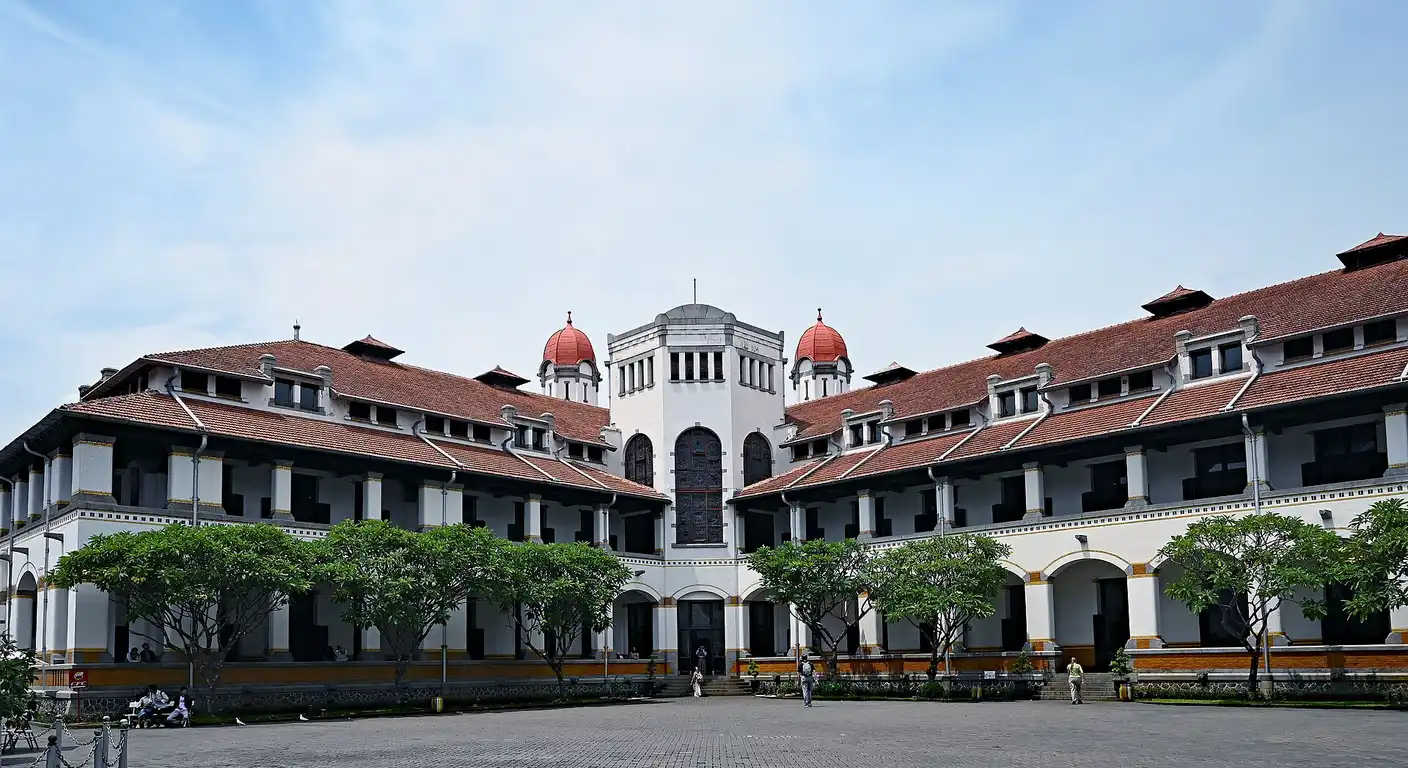
Lawang Sewu was built as the head office of the Nederlandsch-Indische Spoorweg Maatschappij (NIS), the private company that ran the first railway in the Dutch East Indies. Designed by the Amsterdam architects J.F. Klinkhamer and B.J. Ouëndag, the main building was begun on 27 February 1904 and completed in July 1907, and further buildings were added around 1916–1918 on an 18,232-square-metre site. Its Javanese name, meaning 'a thousand doors', comes from the rows of tall doors and windows designed to keep air moving through the offices in Semarang's heat.
The L-shaped Building A faces the Tugu Muda roundabout, flanked by two towers that originally held water tanks of 7,000 litres each, one of them crowned with a small copper-clad dome. Inside, a grand central staircase rises beneath large stained-glass windows by Johannes Lourens Schouten, which show the prosperity of Java, Dutch rule over Semarang and Batavia, maritime trade and the glory of the railway. Terracotta ornament above the curved balcony and bronze detailing at the top of the towers complete a design in the New Indies style.
The building's 20th century was turbulent. Japanese forces took it over in 1942 and used it as a transport office, and the basement of Building B became a prison. In October 1945 fighting around the complex killed Indonesian fighters and five railway employees, who are remembered by a monument in front of Building A. The Dutch army used it as a headquarters in 1946, and the Indonesian army's Diponegoro command after 1949, before it returned to the railways in 1994. It was declared a cultural property in 1992, restored from 2009, and the restored Building A was inaugurated on 5 July 2011.
Today KAI Wisata, a subsidiary of the state railway company, runs Lawang Sewu as a heritage museum. Exhibits include railway office equipment such as an Edmondson ticket machine, calculating machines and typewriters, a steam-locomotive replica and historic railway securities, alongside a display of photographs, film and materials from the restoration and a library of railway books near the exit. An immersive projection room on the history of Indonesian railways was added by February 2026. The site opens daily from 7 AM to 9 PM, and on major holidays such as Lunar New Year it can receive around 10,000 visitors a day.
Best for: Architecture Enthusiasts · Photographers · History Enthusiasts
What are the must-see works at Lawang Sewu?
4 highlights that define the collection: Stained-glass windows, Twin water towers, Edmondson ticket machine and office machines and more.
Stained-glass windows
Johannes Lourens Schouten · early 20th century
📍 Building A, central staircase
Large stained-glass panels depicting the prosperity of Java, Dutch rule over Semarang and Batavia, maritime trade and the glory of the railway — the building's most celebrated feature.
Twin water towers
J.F. Klinkhamer and B.J. Ouëndag · 1904–1907
📍 Building A
The two towers flanking the main facade originally held water tanks of 7,000 litres each, with a copper-clad dome and bronze detailing at the top.
Edmondson ticket machine and office machines
Railway equipment · Dutch colonial era
Ticketing, calculating and typewriting machines from the railway's offices, shown with historic railway securities and a steam-locomotive replica.
Immersive railway history room
Projection installation · KAI
A room of large-scale visual projections telling the history of Indonesian railways, in place on the building tour by February 2026.
Collections and highlights
- • Stained glass and New Indies-style architecture
- • Edmondson ticket machine, calculating machines and typewriters
- • Steam-locomotive replica
- • Historic railway securities
- • Restoration display with photographs, film and original materials
- • Railway library
- • Immersive projection room on Indonesian railway history
Tips for visiting Lawang Sewu
- 1.
Best time to visit
Open daily from 7 AM to 9 PM, so early morning or early evening avoids the midday heat. Major holidays such as Lunar New Year can bring around 10,000 visitors a day.
- 2.
Tickets & booking
Buy tickets on arrival: Rp20,000 adults and university students, Rp10,000 children and school pupils, Rp30,000 foreign visitors. KAI Wisata publishes no advance-booking requirement for individual visitors.
- 3.
Accessibility
No accessibility information is published; the main building has a grand central staircase and upper floors, so contact PT KA Pariwisata (0812-1516-8808) before visiting.
- 4.
Photography rules
No restrictions on personal photography are published; commercial shoots, weddings and filming are booked as building hire with PT KA Pariwisata.
How do you get to Lawang Sewu?
- taxi Grab, Gojek or a taxi to Lawang Sewu on Jalan Pemuda, at the Tugu Muda roundabout
- train Semarang Tawang and Semarang Poncol are the city's main railway stations; continue by ride-hailing or taxi to Tugu Muda
Address: Jl. Pemuda, facing the Tugu Muda roundabout, Semarang, Central Java, Indonesia
Sources we checked
Visitor facts and history on this page come from these sources, checked on the dates shown.
- Lawang Sewu — KAI Wisata (PT Kereta Api Pariwisata), checked 22 October 2026
- Lawang Sewu — Wikipedia, checked 22 October 2026
- Minister Inspects Lawang Sewu Readiness Ahead of Lunar New Year (11 February 2026) — RRI, checked 22 October 2026
- Heritage Trip KAI Wisata Hadir Selama Lebaran 2026 (23 March 2026) — Kompas TV, checked 22 October 2026
- Ambarawa Railway Museum Preserves Central Java's Rail History (17 September 2026) — RRI, checked 22 October 2026
Lawang Sewu: frequently asked questions
How much is the entrance fee for Lawang Sewu?
KAI Wisata, the state railway subsidiary that manages the building, charges Rp20,000 for adults and university students, Rp10,000 for children and school pupils and Rp30,000 for foreign visitors. Tickets are sold at the site. The building can also be hired for exhibitions, weddings, filming and workshops through PT KA Pariwisata (0812-1516-8808), which handles any commercial use.
Where is Lawang Sewu and how do I get there?
Lawang Sewu stands on Jalan Pemuda in central Semarang, and its L-shaped main building faces the Tugu Muda roundabout, so it is easy to find. Grab, Gojek and taxis drop off at the entrance. If you arrive by train at Semarang Tawang or Semarang Poncol station, continue by ride-hailing or taxi and ask for Lawang Sewu or Tugu Muda.
How long should I spend at Lawang Sewu?
Plan 1–1.5 hours for the highlights of Lawang Sewu. Add extra time for temporary exhibitions, the shop and the café.
What are the highlights of Lawang Sewu?
Start with the great stained-glass windows by Johannes Lourens Schouten, which depict Java's prosperity, Dutch rule over Semarang and Batavia, maritime trade and the glory of the railway. Then look at the twin towers that once held water tanks, the arcaded corridors behind the 'thousand doors' nickname, and railway exhibits such as an Edmondson ticket machine, calculating machines, typewriters and a steam-locomotive replica.
Can I take photos inside Lawang Sewu?
KAI Wisata publishes no restrictions on personal photography for ordinary visitors, and the corridors and stained glass are the main draw for many of them. Professional photo shoots, weddings and filming are handled separately as paid building hire through PT KA Pariwisata, so arrange those in advance rather than turning up with a crew and lighting.
What happened at Lawang Sewu during the Second World War and the revolution?
Japanese forces occupied the building from 1942 to 1945 and used it as a transport office, and the basement of Building B was used as a prison. In October 1945 fighting around the complex killed Indonesian fighters and five railway employees, who are remembered by a monument in front of the main building. The Dutch army used it in 1946, and the Indonesian army after 1949.
Can I combine Lawang Sewu with the Ambarawa Railway Museum?
Yes. Both are run by KAI Wisata, and during the 2026 Lebaran holiday it sold a Heritage Trip from Lawang Sewu to the Ambarawa Railway Museum and back, from Rp255,000 per person including entry tickets, the Ambarawa tourist train and road transport. Outside such packages, Ambarawa is a separate trip inland from Semarang by car or ride-hailing.
Is Lawang Sewu open on Mondays?
Yes — Lawang Sewu is open every day of the week, including Mondays and Sundays: 7:00 AM – 9:00 PM. Check the official website for holiday hours.
What are Lawang Sewu's opening hours?
Lawang Sewu is open daily, 7:00 AM – 9:00 PM. Hours can change for holidays and events, so check the official website before you go.
Is Lawang Sewu free to visit?
Not for everyone. Standard admission: Rp20,000 for adults and university students; Rp10,000 for children and school pupils; Rp30,000 for foreign visitors. Free or reduced entry: Children and school pupils: Rp10,000.