Textile Museum Jakarta
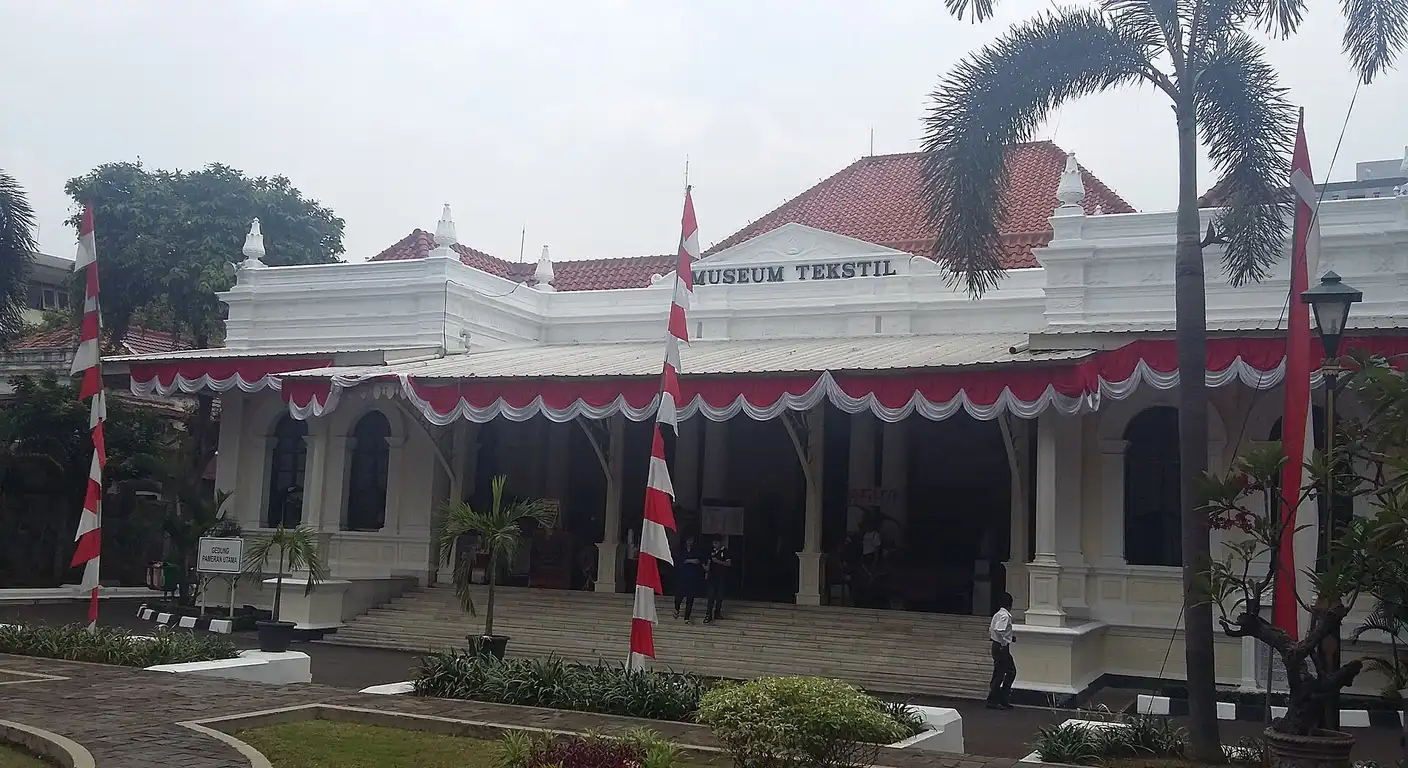
Photo: Humboldt · CC BY-SA 4.0
Quick answer
Textile Museum Jakarta in Jakarta, Indonesia — the Textile Museum (Museum Tekstil) occupies a 19th-century villa on Jalan K.S. Open Tuesday to Sunday: 9:00 AM – 3:00 PM; closed Mondays. Admission: Rp10,000 for adults on weekdays and Rp15,000 on weekends; Rp50,000 for foreign visitors. Allow 1–1.5 hours.
Visitor information last reviewed 22 October 2026. Check the official museum site for current details.
Textile Museum Jakarta at a glance: hours, tickets and time needed
| Opening hours | Tuesday to Sunday: 9:00 AM – 3:00 PM |
|---|---|
| Closed | Mondays |
| Admission | Rp10,000 for adults on weekdays and Rp15,000 on weekends; Rp50,000 for foreign visitors |
| Free or reduced entry | Children, school and university students: Rp5,000 · Groups of 30+: adults Rp7,500 on weekdays and Rp11,250 at weekends, children and students Rp3,750 · Free for visitors with disabilities, seniors aged 60+ and KJP Plus student-card holders (Jakarta ID, disability card or active KJP Plus proof required) |
| Booking | Tickets usually available on the day |
| Time needed | 1–1.5 hours |
| Best time to visit | Any day from Tuesday to Sunday; arrive in the morning if you want to join a batik session, as the museum and the Pendopo Batik both close at 3:00 PM. |
| Getting there | Train: KRL Commuter Line to Tanah Abang station, the nearest station to the museum on Jalan K.S. Tubun |
| Address | Jl. K.S. Tubun No. 2–4, Kota Bambu Selatan, Palmerah, West Jakarta, Indonesia |
| Official website | dinaskebudayaan.jakarta.go.id |
Checked 2026-10-22 against the official website. Prices and hours change — confirm before you travel.
What is Textile Museum Jakarta known for?
The museum's main building began life in the early 19th century as a villa, or landhuis, owned by a Frenchman living in Batavia. It later passed to a Turkish consul, Abdul Azis Al Mussawi Al Katiri, and in 1942 to a Dutch resident, Dr Karel Christian Cruq. During the struggle for independence in 1945 it served as headquarters of the Barisan Pelopor youth front and the People's Security Body (BKR). It was bought by Lie Sion Pin in 1947 and by the Ministry of Social Affairs in 1952, before being handed to the Jakarta government in 1976.
Tien Soeharto, wife of President Soeharto, inaugurated the Textile Museum on 28 June 1976. It is now run by the Museum Seni management unit of Jakarta's culture office, which also manages the Museum of Fine Arts and Ceramics and the Wayang Museum. The museum describes its mission as preserving Indonesia's textile culture and the natural resources behind it, documenting and researching traditional textiles from every region, and sharing that knowledge with the public through exhibitions, seminars, competitions and travelling displays.
Displays are split between two buildings. The main house hosts temporary exhibitions, while the permanent collection is shown in the Batik Gallery, opened on 2 October 2010, with batik from Sumatra, West Java, Central Java, Yogyakarta and East Java, natural dye materials, batik stamps, an explanation of the batik process and interiors decorated with batik patterns, including a bed, furniture, masks and wayang golek puppets. The wider collection includes Batak ulos, ikat and other woven cloths, together with traditional looms and textile-making equipment from across the archipelago.
The grounds also hold a natural-dye garden, a textile introduction room, a library, a children's textile play room and the Pendopo Batik, where visitors can learn hand-drawn or stamped batik with materials provided. The museum opens Tuesday to Sunday from 9:00 AM to 3:00 PM and is closed on Mondays. Adults pay Rp10,000 on weekdays and Rp15,000 at weekends, children and students Rp5,000 and foreign visitors Rp50,000. The museum is on Jalan K.S. Tubun in Palmerah, close to Tanah Abang station and well away from the Kota Tua museum cluster.
Best for: Art Lovers · Families · Rainy-day visits
What are the must-see works at Textile Museum Jakarta?
5 highlights that define the collection: Batik Hokokai, Merak Ngibing batik, Koffo (hote) cloth and more.
Batik Hokokai
Iwan Tirta · batik tulis on machine-woven cotton
A batik in the Hokokai style with parang, nitik, butterfly, chrysanthemum and peacock motifs, divided diagonally into two patterns so the cloth can be worn for two different occasions.
Merak Ngibing batik
Garut, West Java · batik tulis
A Garut batik showing dancing peacocks with trailing tails beside small parang motifs, in blue and cream, with a two-part pagi-sore (morning and evening) layout.
Koffo (hote) cloth
Sangihe, North Sulawesi · abaca-fibre weaving
Cloth woven on a backstrap gedhog loom from abaca (manila hemp) fibre and coloured with local natural dyes, used as room-dividing curtains in traditional Sangihe houses.
Tampan ship cloth
Saibatin people, Lampung · hand-spun cotton
A small woven ship cloth, under a metre long, used only by nobles and customary leaders to line trays or cover betel offerings at Lampung weddings.
Bidang sarong
Dayak weavers, Kalimantan · supplementary-weft songket
A knee-length ceremonial tube skirt for women in red, yellow, green, white, black and blue, with bird motifs linked to the deity of the upper world, worn with a silver belt.
Collections and highlights
- • Batik from Sumatra, Java and Yogyakarta
- • Woven textiles, including ulos and ikat
- • Natural dye materials and the natural-dye garden
- • Batik stamps and batik-making tools
- • Traditional looms and textile equipment
- • Weavings from Sulawesi, Kalimantan and Lampung
- • Batik by Iwan Tirta
Tips for visiting Textile Museum Jakarta
- 1.
Best time to visit
Any day from Tuesday to Sunday; arrive in the morning if you want to join a batik session, as the museum and the Pendopo Batik both close at 3:00 PM. Closed on Mondays.
- 2.
Tickets & booking
Buy tickets on arrival: Rp10,000 adults on weekdays, Rp15,000 at weekends, Rp5,000 children and students, Rp50,000 foreign visitors; groups of 30 or more pay reduced rates. Batik-class fees are not published; enquiries go to [email protected].
- 3.
Accessibility
Visitors with disabilities enter free, but no accessibility information is published for the historic villa and gallery buildings; contact the museum before visiting.
- 4.
Photography rules
No photography policy is published online; ask staff before filming, keep flash off near light-sensitive textiles and do not touch cloths on display.
How do you get to Textile Museum Jakarta?
- train KRL Commuter Line to Tanah Abang station, the nearest station to the museum on Jalan K.S. Tubun
- taxi Grab, Gojek or taxi to Museum Tekstil, Jl. K.S. Tubun No. 2–4, Palmerah
Address: Jl. K.S. Tubun No. 2–4, Kota Bambu Selatan, Palmerah, West Jakarta, Indonesia
Sources we checked
Visitor facts and history on this page come from these sources, checked on the dates shown.
- Tiket Masuk Museum Tekstil (January 2024) — Unit Pengelola Museum Seni, Dinas Kebudayaan DKI Jakarta, checked 22 October 2026
- Museum Tekstil — Dinas Kebudayaan Provinsi DKI Jakarta, checked 22 October 2026
- Yuk, Belajar Membatik di Museum Tekstil — Dinas Kebudayaan Provinsi DKI Jakarta, checked 22 October 2026
- 7 Kegiatan Seru di Museum Tekstil — Dinas Kebudayaan Provinsi DKI Jakarta, checked 22 October 2026
- Batik Hokokai Iwan Tirta (with collection articles Tampan, Koffo, Bidang dari Kalimantan, Merak Ngibing) — Dinas Kebudayaan Provinsi DKI Jakarta, checked 22 October 2026
- Siaran Pers 4559/SP-HMS/12/2023: Tiga Museum di Jakarta Buka Kembali (30 December 2023) — Pemerintah Provinsi DKI Jakarta, checked 22 October 2026
- Peraturan Gubernur DKI Jakarta Nomor 23 Tahun 2025 tentang Layanan Gratis Masuk Tempat Wisata bagi Masyarakat Tertentu — Pemerintah Provinsi DKI Jakarta (JDIH), checked 22 October 2026
- Pemprov DKI Naikkan Tarif Sewa Gedung Pertunjukan, Paling Mahal Rp30 Juta (17 January 2024) — RMOL, checked 22 October 2026
- Textile Museum (Jakarta) — Wikipedia, checked 22 October 2026
- Jakarta offers free tourist entry and transit on anniversary (21 June 2026) — ANTARA News, checked 22 October 2026
Textile Museum Jakarta: frequently asked questions
How much is the entrance fee for the Textile Museum Jakarta?
Adults pay Rp10,000 from Tuesday to Friday and Rp15,000 on Saturdays and Sundays. Children, school pupils and university students pay Rp5,000 and foreign visitors Rp50,000, and groups of at least 30 get reduced rates. Visitors with disabilities, seniors aged 60 and over with a Jakarta ID card and pupils holding an active KJP Plus card enter free.
Where is the Textile Museum Jakarta and how do I get there?
The museum is at Jalan K.S. Tubun No. 2–4 in Kota Bambu Selatan, Palmerah, West Jakarta, close to Tanah Abang railway station on the KRL Commuter Line, from where you can walk or take a short Grab or Gojek ride. It is a separate trip from the Kota Tua museums in the north of the city.
How long should I spend at the Textile Museum Jakarta?
Plan 1–1.5 hours for the highlights of Textile Museum Jakarta. Add extra time for temporary exhibitions, the shop and the café.
What are the highlights of the Textile Museum Jakarta?
The Batik Gallery, opened in 2010, shows batik from Sumatra, West, Central and East Java and Yogyakarta, with dye materials, copper stamps and furniture covered in batik patterns. Look for a Batik Hokokai by Iwan Tirta, a Merak Ngibing batik from Garut, koffo cloth woven from abaca fibre in Sangihe, a Lampung tampan ship cloth and a Dayak bidang sarong.
Can I take photos inside the Textile Museum Jakarta?
Jakarta's culture office does not publish a photography policy for the museum online, so ask staff on arrival, particularly before filming or using a tripod. Textiles are sensitive to light, so keep flash off in the galleries, and do not touch cloths on display unless a guide or instructor invites you to.
Can I learn batik at the Textile Museum Jakarta?
Yes. The Pendopo Batik, a workshop pavilion in the museum grounds, is open from Tuesday to Sunday, 9:00 AM to 3:00 PM. Participants can try hand-drawn batik tulis, tracing a prepared pattern or their own design with a canting and hot wax, or stamped batik cap, then dye the cloth and take it home. The session fee is not published online, so ask at the counter.
Is Textile Museum Jakarta open on Mondays?
No — Textile Museum Jakarta is closed every Monday. It is open Tuesday to Sunday: 9:00 AM – 3:00 PM. Plan a different museum for that day, and check the official website for holiday changes.
What are Textile Museum Jakarta's opening hours?
Textile Museum Jakarta is open Tuesday to Sunday: 9:00 AM – 3:00 PM, and closed Mondays. Hours can change for holidays and events, so check the official website before you go.
Is Textile Museum Jakarta free to visit?
Not for everyone. Standard admission: Rp10,000 for adults on weekdays and Rp15,000 on weekends; Rp50,000 for foreign visitors. Free or reduced entry: Children, school and university students: Rp5,000; Groups of 30+: adults Rp7,500 on weekdays and Rp11,250 at weekends, children and students Rp3,750; Free for visitors with disabilities, seniors aged 60+ and KJP Plus student-card holders (Jakarta ID, disability card or active KJP Plus proof required).