Wayang Museum
Quick answer
Wayang Museum in Jakarta, Indonesia — the Wayang Museum on Fatahillah Square in Kota Tua is dedicated to Indonesian puppetry, with more than 6,000 shadow, rod and other puppets from across the archipelago and abroad. Open Tuesday to Friday: 9:00 AM – 3:00 PM; Saturday and Sunday: 9:00 AM – 8:00 PM; closed Mondays. Admission: Rp10,000 for adults on weekdays and Rp15,000 on weekends; Rp50,000 for foreign visitors. Allow 1 hour.
Visitor information last reviewed 1 September 2026. Check the official museum site for current details.
Wayang Museum at a glance: hours, tickets and time needed
| Opening hours | Tuesday to Friday: 9:00 AM – 3:00 PM; Saturday and Sunday: 9:00 AM – 8:00 PM |
|---|---|
| Closed | Mondays |
| Admission | Rp10,000 for adults on weekdays and Rp15,000 on weekends; Rp50,000 for foreign visitors |
| Free or reduced entry | Children, school and university students: Rp5,000 · Free Tuesday–Friday for seniors, visitors with disabilities and KJP student-card holders (ID required) |
| Booking | Tickets usually available on the day |
| Time needed | 1 hour |
| Best time to visit | Arrive by 2 PM on weekdays (closing time is reported as 3–4 PM), or visit on a Saturday or Sunday, when doors stay open until 8 PM. |
| Getting there | Train: KRL Commuter Line to Jakarta Kota station — about a 5-minute walk to the west side of Fatahillah Square |
| Address | Jl. Pintu Besar Utara No. 27, Pinangsia, Taman Sari, West Jakarta 11110, Indonesia |
| Official website | museum.kemenbud.go.id |
Checked 2026-09-01 against the official website. Prices and hours change — confirm before you travel.
What is Wayang Museum known for?
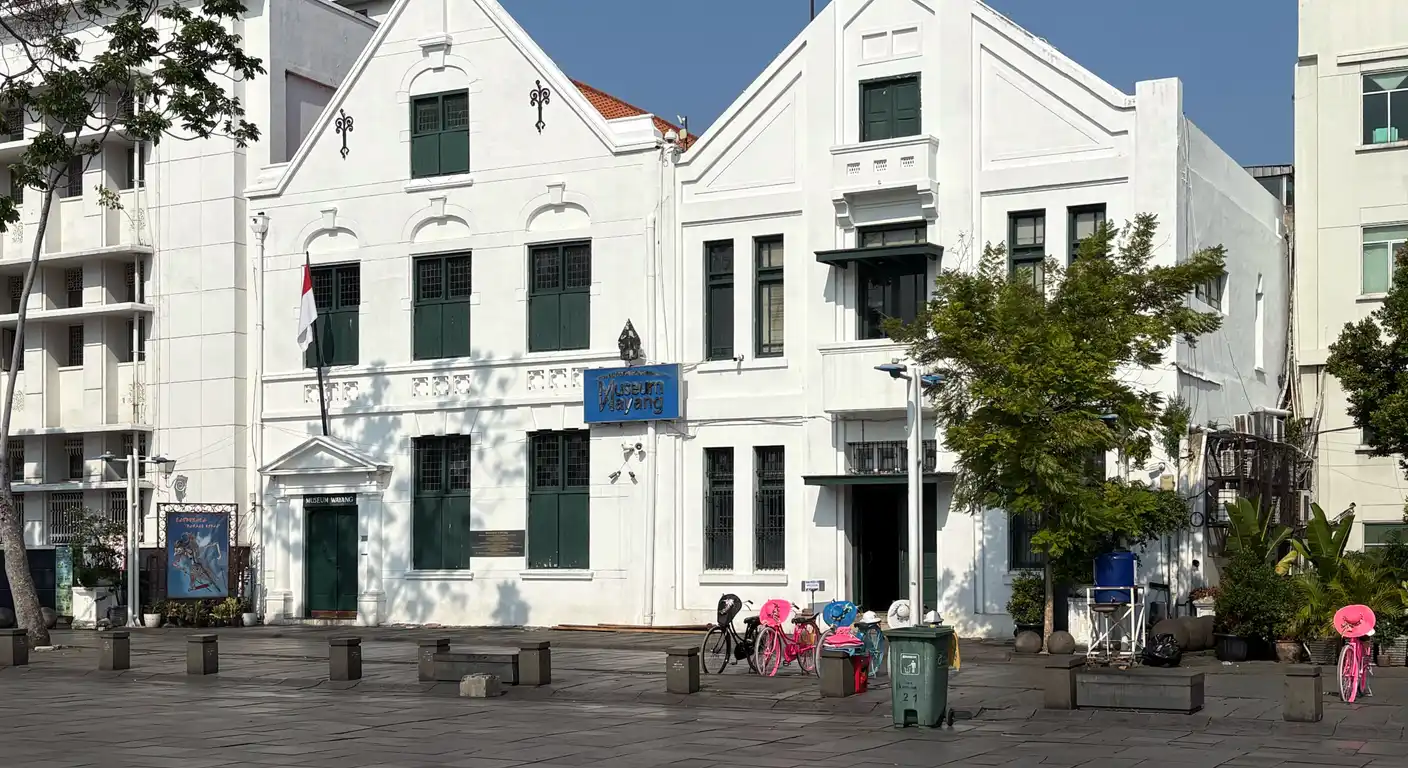
The Wayang Museum stands on the west side of Fatahillah Square on the site of Batavia's first Dutch church, the Oude Hollandsche Kerk, built in 1640 and rebuilt in 1732 as the Nieuwe Hollandsche Kerk. The church was destroyed by an earthquake in 1808. Its churchyard had been the burial place of Governor-General Jan Pieterszoon Coen, founder of Batavia, and a memorial stone to him is kept in the museum. The present building went up in 1912 as a neo-Renaissance warehouse for the firm Geo Wehry & Co and was remodelled in 1938.
The building was acquired by the Batavian Society of Arts and Sciences and opened on 22 December 1939 as the Oude Bataviasche Museum, a museum of old Batavia. After independence it passed to Indonesian cultural institutions and then to the Jakarta government, which designated it the Wayang Museum; the museum was inaugurated on 13 August 1975. Its earlier collection of Batavian history later moved to the Jakarta History Museum across the square. Today the museum is run by the Jakarta government's Unit Pengelola Museum Seni, which also manages the city's art museums in Kota Tua.
The museum holds more than 6,000 puppets from Indonesia and beyond. They include Javanese wayang kulit shadow puppets of cut and painted leather, Sundanese wayang golek rod puppets, Jakarta's own Betawi wayang and other regional forms, as well as masks, gamelan instruments and puppets from other countries. Wayang theatre, usually drawing on the Mahabharata and Ramayana, was proclaimed a Masterpiece of the Oral and Intangible Heritage of Humanity by UNESCO in 2003 and inscribed on the Representative List of the Intangible Cultural Heritage of Humanity in 2008.
After a six-month renovation the museum reopened in January 2025 with bilingual Indonesian–English displays, interactive games including a digital gamelan, virtual performances and immersive rooms. Two three-metre figures of Gatotkaca and Pergiwa now greet visitors at the entrance, regional traditions fill the first galleries, and an upper floor covers contemporary and international puppetry. Since May 2025 the museum stays open until 8:00 PM on Saturdays and Sundays, and entry costs Rp10,000 on weekdays and Rp15,000 at weekends.
Best for: Families · Culture seekers · First-timers
How long do you need at Wayang Museum?
Allow 1 hour. From the giant entrance figures through Indonesia's regional puppet traditions to the interactive and international galleries. Follow the stops in order:
- 1
Gatotkaca and Pergiwa
📍 Entrance
The three-metre figures set the scale — and make the classic photo stop.
- 2
Regional wayang traditions
📍 Regional galleries
Compare flat wayang kulit with carved wayang golek and look for Jakarta's own Betawi wayang.
- 3
Interactive zone
📍 Interactive displays
Try the digital gamelan game and watch a virtual performance to see how a dalang works.
- 4
Contemporary and international puppets
📍 Upper floor
See how puppetry traditions from other countries compare with Indonesian wayang.
- 5
Coen memorial stone
📍 Ask staff
A reminder that this was once the churchyard of Batavia's Old Dutch Church.
What are the must-see works at Wayang Museum?
5 highlights that define the collection: Gatotkaca and Pergiwa, Wayang kulit shadow puppets, Wayang golek rod puppets and more.
Gatotkaca and Pergiwa
Giant wayang figures · Mahabharata characters
📍 Entrance
Two three-metre-tall figures of the Mahabharata hero Gatotkaca and his wife Pergiwa, installed in the 2025 renovation to welcome visitors.
Wayang kulit shadow puppets
Javanese puppet makers · various periods
📍 Regional galleries
Flat puppets of cut, punched and painted buffalo hide, including characters from the Mahabharata and Ramayana and the comic punakawan servants such as Semar.
Wayang golek rod puppets
West Javanese (Sundanese) carvers
📍 Regional galleries
Three-dimensional carved and painted wooden puppets operated with rods, the classic puppet theatre of West Java.
International puppets
Puppet traditions from other countries
📍 Upper floor
Puppets from outside Indonesia displayed alongside contemporary wayang, showing how shadow and rod puppetry developed elsewhere.
Jan Pieterszoon Coen memorial stone
Dutch colonial period · 17th century
A memorial plate marking the grave of Batavia's founder, Governor-General Jan Pieterszoon Coen, who was buried in the churchyard of the Old Dutch Church that once stood on this site.
Collections and highlights
- • Javanese wayang kulit shadow puppets
- • Sundanese wayang golek rod puppets
- • Betawi (Jakarta) wayang and other regional forms
- • Masks and gamelan instruments
- • International puppets
- • Interactive and immersive wayang displays (2025 renovation)
- • Colonial memorial stones from the Old Dutch Church site
Tips for visiting Wayang Museum
- 1.
Best time to visit
Arrive by 2 PM on weekdays (closing time is reported as 3–4 PM), or visit on a Saturday or Sunday, when doors stay open until 8 PM.
- 2.
Crowds & busy periods
Busy on weekends and holidays, when families fill Kota Tua — during the 2026 Eid break the Kota Tua art museums drew up to about 2,800 visitors a day.
- 3.
Tickets & booking
Rp10,000 weekdays / Rp15,000 weekends for adults, Rp5,000 for children and students, Rp50,000 for foreign visitors.
- 4.
Food & cafés nearby
Cafés and street-food stalls around Fatahillah Square.
- 5.
Accessibility
A historic building with an upper floor; step-free access may be limited — contact the museum or ask staff on arrival.
- 6.
Photography rules
Casual photography is common in the galleries; avoid flash near painted leather puppets and follow any signage.
How do you get to Wayang Museum?
- train KRL Commuter Line to Jakarta Kota station — about a 5-minute walk to the west side of Fatahillah Square
- bus TransJakarta Corridor 1 (Blok M–Kota) to the Kota terminus beside Jakarta Kota station
- metro MRT Jakarta to Bundaran HI, then TransJakarta Corridor 1 north to Kota
- walk One minute across Fatahillah Square from the Jakarta History Museum
Address: Jl. Pintu Besar Utara No. 27, Pinangsia, Taman Sari, West Jakarta 11110, Indonesia
Wayang Museum: frequently asked questions
How much does the Wayang Museum cost?
Adults pay Rp10,000 from Tuesday to Friday and Rp15,000 on Saturdays and Sundays; children and school or university students pay Rp5,000, and foreign visitors pay Rp50,000, according to Jakarta's revenue agency. Tickets are bought at the counter on arrival. Some travel sites still list the old Rp5,000 adult fare, which was replaced under Jakarta's 2024 regulation on user fees.
What are the opening hours?
The museum is closed on Mondays. Since May 2025 it opens until 8:00 PM on Saturdays and Sundays (from 9:00 AM). On weekdays it opens at 9:00 AM; most sources give a 3:00 PM closing, while the national museum registry lists 4:00 PM, so arrive before 3:00 PM on a weekday to be safe.
What is wayang?
Wayang is Indonesia's traditional puppet theatre. The best-known forms are wayang kulit, flat leather shadow puppets from Java performed behind a lit screen, and wayang golek, carved wooden rod puppets associated with West Java. Performances, accompanied by gamelan, often tell episodes from the Mahabharata and Ramayana. UNESCO proclaimed wayang puppet theatre a Masterpiece of the Oral and Intangible Heritage of Humanity in 2003.
What are the highlights?
Two three-metre-tall figures of Gatotkaca and Pergiwa from the Mahabharata greet visitors at the entrance. The galleries then show regional puppet traditions from across Indonesia, including Jakarta's own wayang, before an upper floor devoted to contemporary and international puppets. Since the 2025 renovation, interactive displays include a digital gamelan game and virtual wayang performances, with bilingual Indonesian–English labels.
Is Jan Pieterszoon Coen buried here?
The museum stands on the site of Batavia's Old Dutch Church (1640), whose churchyard was the burial place of Governor-General Jan Pieterszoon Coen. The church was destroyed by an earthquake in 1808, but a memorial stone marking Coen's tomb is displayed in the museum. The site links the museum to the earliest decades of Dutch Batavia.
How long should I spend here?
About an hour is enough for most visitors to see the entrance figures, the regional galleries and the interactive displays; puppet enthusiasts may want longer. Because the Jakarta History Museum and the Fine Art and Ceramics Museum are on the same square, the Wayang Museum fits easily into a half-day tour of Kota Tua.
How do I get there?
Take the KRL Commuter Line to Jakarta Kota station and walk about five minutes to the west side of Fatahillah Square. TransJakarta Corridor 1 (Blok M–Kota) ends at the Kota stop beside the station. The MRT does not yet reach Kota Tua, so change from MRT Bundaran HI to TransJakarta Corridor 1. The Jakarta History Museum is a one-minute walk away.
Are there live puppet performances?
The museum periodically stages wayang performances and puppet-making workshops, but they do not run every day. Check the Jakarta museum units' social media or ask at the ticket desk for the current schedule. Outside performance times, the interactive galleries and videos introduce how puppets are made and how a dalang (puppeteer) brings them to life.
Is Wayang Museum open on Mondays?
No — Wayang Museum is closed every Monday. It is open Tuesday to Friday: 9:00 AM – 3:00 PM; Saturday and Sunday: 9:00 AM – 8:00 PM. Plan a different museum for that day, and check the official website for holiday changes.
Is Wayang Museum free to visit?
Not for everyone. Standard admission: Rp10,000 for adults on weekdays and Rp15,000 on weekends; Rp50,000 for foreign visitors. Free or reduced entry: Children, school and university students: Rp5,000; Free Tuesday–Friday for seniors, visitors with disabilities and KJP student-card holders (ID required).